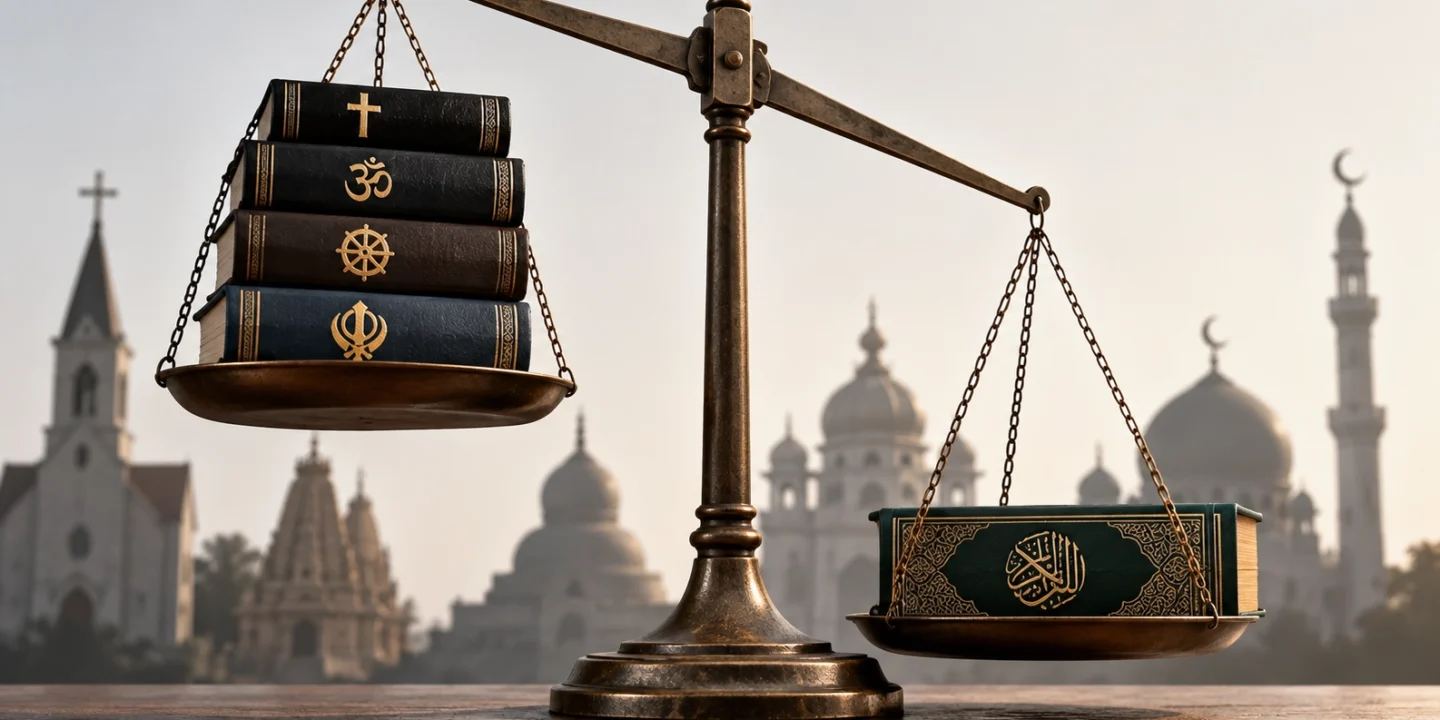




The One-Way Offence
How a colonial-era clause became Islam’s firewall, why even hardcore Hindus never asked for it, and why the BJP keeps winning elections it does not have to campaign for.
I. A plate of mandhi, a god, a police station
On April 15, 2026, a restaurant in Cherthala posted a Vishu greeting. Baby Krishna, a plate of kuzhimandhi, the caption “Happy Vishu.” Within forty-eight hours, a complaint was filed, two managing partners were taken into custody, an FIR was registered under Section 192 of the Bharatiya Nyaya Sanhita for “provocation with intent to cause a riot,” and one of the owners — son of a local Muslim League functionary — was on camera apologising and blaming the designer. The restaurant is called Mehr Mandi and Grills. The owners are Muslim. The outrage is Hindu. The arrest is real.
I want to say three things up front, and I mean them.
First: I am for the poster. It should stay up. I don’t find it blasphemous. I find it cheerful. A baby god next to a plate of biryani is the most Kerala thing that has happened this Vishu season, and I like it.
Second: no arrests. Not one. This is a marketing decision by a restaurant, not a crime.
Third: the law under which these men were arrested should either be abolished or applied equally. There is no third option that is not a fraud.
Now I want to ask one question. Just one. If that poster had run the other way — the Prophet Muhammad, with a plate of pork biryani in front of him, and the caption “Eid Mubarak,” posted by a Hindu restaurant owner — what would have happened in Cherthala on April 16?
Would there be an arrest? No. There would not be an arrest. There would be a body. The restaurant would not exist by Friday evening. The designer would not exist by Friday night. Nobody in Kerala disputes this. We just don’t like saying it out loud.
This essay is me saying it out loud.
Why is it true? When did it become true? And who, exactly, is paying the tax for pretending it isn’t?

II. 1923. Lahore. Two pamphlets.
A lot of people think blasphemy in India begins with Salman Rushdie. It doesn’t. It begins in Punjab in the 1920s, and it begins symmetrically.
In 1923, pamphlets began circulating in Lahore that depicted the goddess Sita as a prostitute. Sita Ka Chinala. Also Krishna Teri Gita Jalani Padegi — “Krishna, we will burn your Gita.” Also Unnisvi Sadi Ka Lampat Maharishi, which portrayed Swami Dayanand Saraswati as a sex-obsessed sage. These were Muslim-authored attacks on Hindu gods and Hindu figures. They were distributed openly. Historians tell us they were circulated even in mosques.
Nobody had their head cut off.
The Hindu response was to write back. An Arya Samaji scholar, Pandit Chamupati, wrote a counter-pamphlet. Rangila Rasul — a satire of the Prophet’s domestic life. Every fact in the book, as its defenders pointed out then and point out now, was drawn from Islamic scripture itself. The publisher, Mahashe Rajpal, put it out anonymously in 1924.
This is the most important part of the whole history, and it is the part that gets erased every time an Indian liberal columnist writes a piece about “our tradition of religious pluralism.”
The first move was a Muslim verbal attack on Hindu gods. The Hindu response was word for word. Pamphlet for pamphlet. Argument for argument. It was ugly. It was vulgar. But in a functional sense, it was civil. Nobody died.
Then the asymmetry began. This is where the modern politics of Indian blasphemy was born. Listen carefully.
Rajpal was arrested. The case dragged on for years. On 4 May 1927, Justice Dalip Singh of the Lahore High Court acquitted him. The judge’s reasoning, recorded in the judgement: there was no law at the time against insulting a religious prophet.
That acquittal set the Muslim community of Punjab on fire. Protests. Riots. Khilafatists and Ahmadis on the streets. The Ahmadi caliph wrote personally to the Viceroy demanding a new law against insulting the Prophet.
The British folded. That same year — September 1927 — they inserted Section 295A into the Indian Penal Code. “Deliberate and malicious acts intended to outrage religious feelings.”
I want you to read this sentence twice, because most Indians go their whole lives without anybody saying it to them:
Hindus didn’t ask for this law.
Lala Lajpat Rai, the Hindu Mahasabha leader, supported 295A in the Legislative Assembly — but only as what he called a “temporary measure” to “satisfy some hyper-sensitive folk.” He proposed a sunset clause: the law was to expire in 1930. The sunset clause was defeated.
That “temporary measure” turns a hundred years old this year.
Now, the end of the story. On 6 April 1929, a twenty-year-old Lahore carpenter named Ilm-ud-Din walked into Rajpal’s shop with a dagger and stabbed him eight times in the chest. Rajpal died on the spot.
Ilm-ud-Din was hanged. Then he was turned into a saint. Muhammad Ali Jinnah — yes, that Jinnah — appeared in court in Lahore as the appeal counsel for his killer. Allama Iqbal wept at the grave. In Pakistan today, Ilm-ud-Din has a shrine. Schoolchildren there are taught he was a hero of the faith.
The slogan chanted at his hanging, and subsequently at every Islamist mobilisation in this subcontinent for the next hundred years, was one you will recognise.
Sar tan se juda. Separate the head from the body.
This is the birth of Indian blasphemy law. Hindus didn’t demand it. Islamists did. Hindus wrote pamphlets back. Islamists got the law first — and then picked up the knife.
And the clause that arrested two caterers in Cherthala last Friday is the direct lineal descendant of the clause written in 1927 to satisfy the Muslim community’s outrage at the acquittal of a Hindu publisher. That is not my interpretation. That is the text of the statute.

III. The switch
When people hear this history, they sometimes say, fine, but that was a century ago, haven’t things changed?
They have. But look at how they’ve changed.
In 1923, when Muslims were offended, they used the legal route. File a complaint. Lobby the British. Get a law. Ilm-ud-Din was an outlier. The mainstream response was lawful.
In 2022, when Nupur Sharma quoted a hadith on an Indian TV panel, Kanhaiya Lal — a tailor in Udaipur — was beheaded in his own shop because he had shared a post supporting her. The killers walked in disguised as customers, asked for measurements, and while he was attending to them, cut off his head and filmed the corpse on a phone. Then they posted the video on social media. The slogan?
Sar tan se juda. The same words chanted when Ilm-ud-Din was hanged in 1929. A hundred years later, now on TikTok. In Friday sermons. On hashtags.
The old outlier has become the new centre. The law is still used, yes — but it’s only step one. The street is step two. The knife is step three. The law may not reach the cartoonist in time. The knife can.
And the Hindu? The Hindu never made the switch.
When a Hindu is offended in 2026, he does what Hindus did in 1923. He writes an angry op-ed. He sits in a dharna. He goes on Asianet and shouts. The VHP goes and stands outside Mehr Mandi and shouts slogans. He occasionally even files an FIR now — I’ll come back to that, because it matters. He riots sometimes, yes. But the riot is a spasm. It is not a doctrine.
There is no Hindu Ilm-ud-Din. There is no pan-Hindu hadith that says “whoever insults Ram must be beheaded.” There is no Hindu version of sar tan se juda chanted at VHP rallies on Malayalam television.
I have a lot of criticism of Hindu religion. I have made it publicly, and I will go on making it. But Hindu religion does have one structural feature that you only really see when you look for it elsewhere: it bends. It absorbs insult. It metabolises satire. Two thousand years of internal Hindu literature, film, painting and poetry has depicted Hindu gods naked, drunk, comical, erotic, homoerotic, mocking, menstruating, murderous. Nobody got assassinated for any of it. That is why the tradition is called sanatana dharma — the one that endures. What endures is what bends.
Now, some of you are going to push back here. What about M.F. Husain? Didn’t the Hindu right hound him into exile for painting the goddess Saraswati nude?
Yes, they did. And I want you to look at when they did, because this is one of the most clarifying facts in modern Indian cultural history, and almost nobody knows it.
Husain made his nude Saraswati in the mid-1970s. The first FIR against him was filed in 1996. That is a twenty-year gap. Twenty years.
Outrage over a religious depiction is not a dish you can leave in the fridge for twenty years and reheat. It is a spontaneous emotional reaction. If that image had offended Hindu religious consciousness as such, there would have been a response in 1976, or 1978, or 1980. There wasn’t. Hindu India — the actual, living, breathing Hindu society that saw the painting in the 1970s — absorbed it. Metabolised it. Didn’t like it maybe, but didn’t move against it.
What changed in 1996 was not the painting. What changed was Indian politics. A Hindi magazine called Vichar Mimansa reprinted the painting as the cover of an article titled “M.F. Husain: A Painter or Butcher?” The Bajrang Dal noticed. The machinery of Hindu political mobilisation, already in motion after the Ram Janmabhoomi movement and the Babri demolition, picked it up and ran.
So the Husain case doesn’t disprove the thesis that Hinduism bends. It proves it. The initial, organic, religious response to nude Saraswati in 1976 was silence. The 1996 response was political. Hindu theology absorbed the image. Hindu politics, two decades later, weaponised it. These are different things, and anyone who conflates them is not thinking clearly.
Islam does not bend. I say this as someone who prayed behind the imam for years. I say it because it is a doctrinal point the tradition is perfectly clear about. The Qur’an is ghayr makhluq — uncreated. The Prophet is ma’sum — infallible. An insult to Muhammad is not like an insult to a dead saint or a long-ago teacher. It is, in orthodox theology, an injury to a person who is still alive, still listening. That is the premise. Argue with it if you like, but it is the premise.
And when a premise like that enters a multi-religious democracy that also has a blasphemy law on its books, the law becomes that community’s private property. Every other tradition’s culture of self-criticism — the one Hinduism is drenched in, the one Christianity fought a painful war to earn after the Enlightenment, the one that Jewish rabbinical argument built into its bones — is held hostage by the one tradition that refuses to enter that culture. And when a Kerala artist puts Krishna next to a plate of mandhi, the law comes for him, because the other direction is foreclosed by the knife.
IV. The liberal’s easy mark
Here is a sentence that has cost me a lot of friendships. Take it slow.
“Ganapathi is a myth” is a graduate seminar.
“Allah is a myth” is a beheading.
Every Indian liberal knows this. Almost none of them will say it.
Say the first sentence and your career goes up. NDTV call you for a panel. The Wire gives you a column. The book deal comes. You get the label “rationalist.” Everyone you want to impress is impressed.
Say the second sentence and you get a threat assessment. If you’re lucky, police protection. If you’re not, a body on a street somewhere. The two sentences are logically identical. Any honest atheist is committed to both, or neither. But the incentives of Indian public life have made the first trivially cheap and the second professionally and physically impossible.
That is why Hindu gods became the easy mark for the Indian liberal. Not because they’re worse. Because criticising them is safe. It is the cheap route to the liberal aesthetic. Wear the khadi. Quote Periyar. Mock Ganesha. Collect your Sahitya Akademi. Feel like Voltaire.
But Voltaire attacked the god of his own society at personal cost. Our Indian Voltaires attack Hindu gods in a Hindu-majority country and tell themselves they are brave. The real test is next door. They won’t take it. They have a whole vocabulary for not taking it. Punching down. Minority sensitivity. Islamophobia. Words designed to let cowardice feel like principle.
The Hindu watching this happen is not a communalist. He is a logician. He has noticed the rule. The rule is: the secular framework is not neutral. It is a one-way door. His gods are fair game. The other god is not. A plate of mandhi next to Krishna gets a court case — even if, as I’ll argue in a moment, that court case is a desperate reactive mutation of Hindu grievance rather than a natural expression of it. A plate of pork next to the Prophet gets a funeral.
This is the actual engine of Hindu political consolidation in India. Not Modi. Not Savarkar. Not the RSS shakha. The one-way door. Every time a Malayali intellectual goes on Asianet and says, “Krishna is a myth, we must rationalise,” every Hindu in the room does the math. If he said that sentence about the Prophet, what would happen to him?
That math is the politics. The BJP doesn’t need to campaign. The asymmetry campaigns on their behalf, twenty-four hours a day, for free.
V. Who actually asked for 295A
This is the part of the argument that almost nobody in Indian public life will state plainly, and it is the part that rearranges the whole board once you see it.
Hindus did not ask for blasphemy law. They did not want it. They do not want it now. They never have.
Hindus have rioted. Hindus have vandalised. Hindus have protested, burned effigies, boycotted films. Hindus have made enormous amounts of noise when they felt their sentiments were hurt. All that is real. But look at what they have not done: mount a doctrinal, sustained, political demand for a legal instrument that criminalises religious speech.
In 1927, no major Hindu intellectual demanded 295A. Lajpat Rai accepted it as a tactical concession with an expiry date. Tilak had died years earlier. Gandhi — strangely, and to his lasting discredit — extended a form of sympathy to Rajpal’s murderer. Through the decades that followed, no Hindu court pandit, no Hindu Mahasabha leader, no Jan Sangh resolution, no BJP manifesto, no RSS document has demanded the strengthening of the blasphemy statute to protect Hindu gods.
Hindutva, for all its many sins, does not actually want blasphemy law. Its grievance politics runs on other machinery: history, temple, land, law-and-order. Not scripture protection.
So who wants 295A? Who has always wanted it? Who files under it? Who protests when it is diluted?
Islamists. Full stop.
From the 1924 Lahore agitation, to the Jamaat-e-Islami-run Madhyamam taking T.J. Joseph’s question paper to the police in 2010, to the IUML-linked partner at Mehr Mandi facing an FIR last Friday under the direct descendant of 295A — the users of Indian blasphemy law are, with rare exceptions, one community’s organisations pursuing one type of grievance. This is not my accusation. It is a public record anyone can read. Go look at the filings. Count who files, count who is filed against.
Now here comes the fraud that completes the whole machine, and I want you to watch it carefully.
Because Hindus do riot, do vandalise, do sometimes file cases — the Hindu-guilty liberal gets to write the column he wants to write. “Look, both communities misuse blasphemy law.”
The column is technically not false. It is functionally a lie. Both communities do not misuse it symmetrically. One community wrote it into the penal code. One community has sustained it for a hundred years. One community built a shrine to the man who murdered for it. One community named him ghazi and put him in school textbooks. The other community made nude paintings and waited. And when the liberal columnist needs a villain for his piece, the villain is always the Hindu rioter — never the institution that made blasphemy a federal crime in the first place.
The deception has layers. The shield was built for Islam. Hindus get blamed for the shield. The Hindu-guilty liberal launders the blame. The reader walks away thinking this is a symmetric problem in which the majority is the main offender.
This is not a political failure. This is a species of intellectual fraud that has been running, uninterrupted, in India since 1927.
One small thing I want to add here, because you might come back at me with it. “But the Cherthala case itself — Hindus filed a police complaint, Hindus got the arrest. Isn’t that Hindus using 295A?”
Yes and no. And the “no” is more interesting than the “yes.” Hindu complaints under BNS 299 and its predecessor are a recent, reactive, almost mimetic phenomenon. For seventy-five years after independence, Hindus simply didn’t do this. Nude Saraswati sat in private collections in the 1970s unbothered. Comical Ganesha stickers sold on the streets of Madras in the 1960s without any arrest. The current wave of Hindu 295A-style filings is a desperate imitation of what Hindus have watched the other community do successfully for a hundred years. It is the student, not the architect. It is the reaction, not the original design.
Which means what? It means the case for repealing the law gets stronger, not weaker, the moment a Hindu files under it. Because if both sides are now mis-using a statute that was only ever used by one side, the statute has gone from unjust to actively corrosive. It was never a good law. It is getting worse.
VI. The global map
If anyone thinks this is a uniquely Indian pathology, open a world map.
The Pew Research Centre counts seventy-nine countries and territories in the world that had blasphemy laws on their books as of 2019. Of those, eight allow the death penalty for blasphemy. Every single one of those eight is Muslim-majority: Iran, Pakistan, Afghanistan, Brunei, Mauritania, Saudi Arabia, northern Nigeria, Somalia.
Of the roughly twenty countries in the world that criminalise apostasy — leaving the faith — every single one is Muslim-majority. Not one non-Muslim country on earth criminalises apostasy. Zero. In MENA — the Middle East and North Africa — ninety percent of countries criminalise blasphemy and sixty-five percent criminalise apostasy. This is not fringe. This is the core of the legal geography.
Now look at the Christian world. The harshest blasphemy law in any non-Muslim-majority country is Italy’s, and its maximum sentence is two years’ imprisonment, almost never enforced. The recent trajectory of the Christian world is a straight line of repeals: Britain 2008, Iceland 2015, Norway 2015, Denmark 2017, Ireland 2018, Canada 2018, New Zealand 2019, Greece 2019. The French Republic never had one in its modern form. The United States has the First Amendment.
The pattern isn’t subtle. Over the last forty years, the Christian world has systematically repealed blasphemy laws as vestigial pre-Enlightenment relics. Over the same forty years, the Muslim world has expanded them — particularly after Zia-ul-Haq’s Pakistan from 1977, Khomeini’s Iran from 1979, and the global Sunni Islamist revival since. The Jewish state has no serious blasphemy statute. The Buddhist states of Southeast Asia have them largely to protect Buddhism from Muslim insult. Hindu-majority India — if that’s what it is, and it is not — still has 295A and its BNS descendants because one community has refused for a century to let the statute go.
There is a word for this pattern, and it is not Islamophobia. The word is data. When I point at the map and say the global blasphemy regime is overwhelmingly Islamic, I am not slandering Muslims. I am reading the statute books of the member states of the United Nations and reporting what is written there. The distinction matters.
VII. T.J. Joseph, M.A. Baby, and the sentence no one will say today
I want to tell you one story from our own state, slowly, because this single case blows the Kerala liberal consensus of the last twenty years open.
March 2010. Newman College, Thodupuzha. T.J. Joseph, a Malayalam professor, is setting a BCom internal examination paper. Question eleven asks students to insert punctuation into a conversation between a character and God. The passage is adapted from the writer P.T. Kunju Muhammed’s own book, Thirakathayude Reethisasthram, published by the Kerala State Institute of Languages. Joseph names the character “Muhammed” — as a tribute to Kunju Muhammed, the author of the original text. That is the entire basis of the event that is about to unfold.
Madhyamam, the newspaper of the Jamaat-e-Islami, carries a story interpreting the character as a reference to the Prophet. Protests erupt. The PFI mobilises. The Campus Front mobilises. The Indian Union Muslim League marches. Joseph is charged under IPC 295 for promoting communal hatred. His own Catholic college — Newman — suspends him. He goes underground. The only place he can find refuge is, ironically, a lodge run by a Muslim proprietor in Palakkad, from where he is eventually arrested. He is then granted bail. And then comes the part of the story that the liberal establishment of Kerala has, to this day, never honestly confronted.
Before the attack on Joseph, while the question paper controversy is still raging and the police cases are pending, the state’s Education Minister — M.A. Baby of the CPI(M), today the party’s national General Secretary — goes on record. He calls Joseph a madayan. A fool. An idiot. He suggests the “lesson” Kerala’s teachers must learn from the incident is that they must exercise caution not to hurt Muslim sentiments.
Read that carefully. The sitting Education Minister, before the attack, essentially ratifies the blasphemy accusation and lectures the teaching profession to be more deferential to Muslim feeling. That is not a bystander’s lapse. That is the state granting an unwritten licence to the mob.
On 4 July 2010, Joseph is driving home from Sunday mass with his mother and sister. Eight men in a Maruti Omni stop his car, smash the windscreen, drag him out, and with a sword chop off his right hand at the wrist. They also injure his left leg. When his mother and sister try to intervene, they are attacked. The men set off crackers and bombs to create panic and flee. A neighbour packs the severed hand in ice and rushes Joseph to hospital.
Joseph loses his job. His family is ostracised. Four years later, on 19 March 2014, his wife Salomi kills herself. She cannot bear the economic and mental load of a family whose breadwinner has been crippled, defamed and abandoned.
That is the case. Every Malayali hearing this already knows it. If this doesn’t move you, I don’t know what to say to you.
Here is the part the English-language press has memory-holed but Kerala’s own Malayalam press has kept on the record. A Malayalam outlet called Malayalivartha asked, in plain print: “ജോസഫ് മാഷ് മഠയൻ എന്ന് വിളിച്ച എം.എ. ബേബി മാപ്പ് പറയുമോ?” Will M.A. Baby, who called Joseph Mash a madayan, ever apologise? “പച്ചയും കാവിയും കാണുമ്പോൾ നിലപാടും മാറും” — when he sees green and saffron, his position shifts. The framing wasn’t imported from Delhi or the Sangh. It came from Kerala’s own Malayalam journalism, reporting on its own CPI(M) minister.
Now fast-forward to April 2026. Cherthala. A Muslim restaurant owner puts Krishna next to a plate of chicken. Where is the same CPI(M)? The same liberal commentariat? The same Madhyamam editorial line that mobilised against Joseph?
Are they writing columns saying “exercise caution not to hurt Hindu sentiments on Vishu”? Are they demanding the poster come down? Is any district collector convening an all-party meeting of the kind that was convened against Joseph in 2010?
No. They are writing the opposite column. “Manufactured outrage.” “It’s just a poster.” “Hindus are being intolerant.” “This is Sanghi mobilisation.”
I want you to notice the rule. It is very simple.
When the offended party is Muslim, the intellectual demand is caution, context, restraint, minority protection.
When the offended party is Hindu, the intellectual demand is free speech, artistic freedom, don’t be intolerant.
Each of these positions has an honest argument behind it. The scandal is not that either exists. The scandal is that the same commentators flip between the two depending on who is offended, and call the flip secularism.
And I want you to see how this actually plays out in practice, not abstractly.
Take 2010. Joseph’s question paper uses the name “Muhammed” as a tribute to an author. No offence was intended, no blasphemy was committed, no student complained. The only thing that existed was the possibility that a Muslim reader somewhere might misread the intent. That possibility alone was enough. The Education Minister went on record calling Joseph a madayan and lecturing the teaching community that they must exercise caution so as not to wound Muslim sentiment. Madhyamam ran the story as a front-page offence. The district collector convened an all-party meeting. All of that happened before any crime. That is the caution reflex, and it is instant, pre-emptive, and enormous. A Hindu hasn’t even actually offended anyone yet, and the entire state-media-intellectual apparatus is already lecturing Hindus on the need for caution.
Now watch what happens when a Hindu cartoonist actually does go further. Imagine he draws Prophet Muhammad with a plate of pork vindaloo wishing “Eid Milad.” Imagine a Hindu restaurant owner posts a Muhammad cartoon in a pork biryani ad captioned “Eid Mubarak.” What is the ministerial response? What is Madhyamam‘s front page? What does the liberal columnist write? They all rush to the same register instantly. Caution. Restraint. This is irresponsible. Do not wound Muslim sentiment. The artist must reconsider. Pluralism requires sensitivity. You know this because you’ve seen it for fifty years. The caution reflex fires on a hair trigger the moment a Hindu even potentially brushes against Muslim feeling.
Now reverse it. April 2026. Cherthala. A Muslim restaurant owner actually does what Joseph never did. He actually places a Hindu god next to food that, in Hindu religious reading, is religiously loaded. Where is the same caution reflex? Where is a single CPI(M) minister saying, even as a throwaway line, that restaurateurs must exercise caution not to wound Hindu sentiment on Vishu? Where is Madhyamam‘s front page framing this as an offence the community must take seriously? Where is the all-party meeting?
Gone. Vanished. In its place, a different reflex has arrived. Free speech. Artistic freedom. Manufactured outrage. Don’t be intolerant. Hindus are overreacting. This is Sanghi mobilisation. The exact same commentators who demanded caution in 2010 now demand free speech in 2026. The exact same column inches that lectured Hindus on Muslim sensitivity now lecture Hindus on tolerance.
That is the hypocrisy. Both reflexes exist. Caution is real. Free speech defence is real. But caution flows in one direction only — it is invoked to restrain Hindu expression and protect Muslim feeling. And free speech flows in the other direction only — it is invoked to protect Muslim expression and tell Hindus to absorb the insult.
Listen to what is being said and what is not being said, and you’ll see it on your own.
Here is a sentence you hear all the time in Kerala. “Muslims who offend Hindu religious feeling are entitled to the protection of free speech, and Hindus must learn to tolerate it.” That sentence is being said right now, this week, about Cherthala. It is the liberal column’s entire thesis. It is sayable. It is, in fact, the default register.
Now here is the other sentence. “Hindus who offend Muslim religious feeling are entitled to the protection of free speech, and Muslims must learn to tolerate it.” That sentence has never been said in Kerala public life. It is unsayable. Nobody has ever written that column. Nobody has ever gone on Asianet and argued it. It cannot be said because the moment you say it, you are called Islamophobic, you are handed over to the mob, and by the way — half the offended community will interpret the words themselves as further blasphemy.
Two sentences, one sayable and one unsayable. That is the rule. The rule is not about principle. The rule is about the direction of the offence.
And the hypocrisy gets worse when you look at how often either direction of offence actually happens. Hindu liberals love to talk about “both sides offend each other.” This is a lie. Instances of Hindus deliberately offending Muslim religious feeling — in Kerala, in Malayalam public life — are rare, usually manufactured, and typically trivial. When one is found, it gets national attention because the supply is so thin. Instances of Muslims offending Hindu religious feeling are abundant, well-evidenced, and frequently deliberate. Cherthala is not a freak event. It is one data point in a long, visible, documentable pattern — Vishu posters mocking Krishna, azaan loudspeakers drowning out temple bells, Friday traffic blockades, slaughter photos on social media before Hindu festivals, restaurants calling their biryani by names of Hindu deities, slippers in Vishu kani compositions. The supply is large and growing. And the reaction to all of it, from the same commentariat, is free speech, free speech, free speech.
When Hindus offend Muslims — rare, usually imagined, or trivial — the rule is caution for Muslim feeling. When Muslims offend Hindus — routine, deliberate, documented — the rule is free speech for Muslim expression. The Muslim community is protected both ways. The Hindu community is restrained both ways. And this bilateral protection racket is called secularism by the very people running it.
The Hindu watching this flip is not a communalist. He is a logician. He has seen the rule. Once you have seen the rule, you cannot unsee it. And once you cannot unsee it, you vote accordingly. The BJP’s vote share grows. The liberal columnist writes another piece about India’s descent into majoritarianism. And somewhere in Cherthala, a Hindu auto driver with two children quietly decides, in the polling booth, that enough is enough.
VIII. The Hindu right’s monopoly, and how it was handed to them
Now I need to say something that will upset my own side.
The BJP did not create this issue. It inherited it. It inherited it because every other political formation in India, every secular party, every liberal intellectual, every Left commentator, every ex-Muslim organisation that fancies itself sophisticated, walked off the field.
The field was this: criticism of Islamic doctrine from a non-Hindutva, non-supremacist, civic-liberal, constitutional perspective. That terrain was empty. It remains empty. Because every time someone tries to stand on it, the chorus starts: you’re helping the Sangh.
This is the single most successful rhetorical manoeuvre in Indian political history, and it has been executed mostly by my own former comrades — the ex-Muslim and secular left. The argument goes: if you criticise Islam now, you hand the BJP ammunition. The argument sounds responsible. It is in fact suicidal. The only thing that actually hands this issue to the BJP is the silence of the people who could have held it without the Hindutva baggage.
Think about how the Indian public sphere looks to a Hindu farmer in Kerala. The only voices willing to name the asymmetry of blasphemy law honestly are BJP spokespersons, Organiser columnists, and RSS pamphleteers. The only voices willing to say “Muslim personal law needs reform” are on the political right. The only voices willing to name jihadist ideology as what it is are wearing saffron. This is not because these things are only true when spoken in saffron. It is because everyone without saffron has decided silence is the safer career move.
I am an ex-Muslim. I read the Qur’an in Arabic before I left. I prayed behind the imam. I sat in the mosque and believed, and then I walked out and stopped believing. That history gives me a particular standing. I cannot be dismissed as an ignorant Islamophobic outsider. I cannot be called a sanghi with a straight face. I know the doctrine from the inside. Every ex-Muslim who has made that journey has the same standing. And yet the “woke” ex-Muslim scene in India — which is now most of it — has decided to use that unique standing not to criticise the tradition we left, but to defend it against the wrong critics.
That is an abdication. It is moral abdication dressed up as tactical sophistication. The calculation is that criticising Islam now strengthens the BJP, so the correct move is to wait for some future political configuration that makes criticism safe. That configuration is never going to arrive. Because the absence of civic criticism is precisely what keeps the configuration impossible. You are waiting for a weather that your own silence guarantees will never come.
IX. On being called a Hindutva sympathiser
I am not going to spend a whole section of this essay defending myself against the predictable charge. But I do want to answer it once, clearly, so I don’t have to answer it again.
Some of you are going to read this and reach for the familiar label. He’s a Hindutva sympathiser. He’s gone saffron. He’s secretly Sangh.
If stating what I have stated here — that blasphemy law in India was built to protect Islam and now blocks its reform, that the global blasphemy map is overwhelmingly an Islamic map, that Ambedkar named the asymmetry between Hindu and Muslim reform traditions eighty-five years ago in print, that M.A. Baby called T.J. Joseph a madayan before the PFI picked up the sword — if stating all that makes me look like a Hindutva sympathiser to you, then be my guest, call me one. I am not afraid of the label. My words are my responsibility. Your reading of them is yours. I am not going to rearrange my argument to dodge a label you know how to weaponise.
I like being uncomfortable. That’s what I came into public writing for. If the price of naming this asymmetry accurately is being called a sanghi by people who won’t read past paragraph three, it is a small price and I am going to keep paying it.
What I am not: a supremacist of any religion. I don’t want a Hindu Rashtra. I don’t want a Muslim state. I don’t want a caliphate, a canon, or a constitutional bench of clergy. I want a functioning secular republic in which blasphemy is a crime for everyone or for no one, and in which Ambedkar, Ayaan Hirsi Ali, Taslima Nasreen, T.J. Joseph, the Cherthala mandhi poster designer, the hypothetical Hindu cartoonist who draws the Prophet with pork, and the Hindu atheist who tweets Ganapathi is a myth, can all walk home tonight alive. That’s my bar. It isn’t a high bar. It’s a bar every Christian-majority democracy has cleared. It’s a bar most Muslim-majority democracies have not. And it’s a bar India cannot clear for as long as we keep pretending the problem is symmetric.
Call that Hindutva if it lets you dismiss the argument more easily. It won’t make the argument wrong.
X. What this essay does not say
I want to be precise, because I know how easily careful arguments get turned into lazy summaries.
This essay does not say that every Muslim in India is a blasphemy enforcer. Most Muslims in India, like most people of every community, want to run their businesses, raise their children, and get through the month. This essay is about a legal and doctrinal architecture, not about three hundred million individuals.
This essay does not say Hindus have no flaws, no orthodoxies, no violence. Hindus have plenty of all three. Gujarat 2002 is real. Manipur 2023 is real. Lynching is real. The difference I am naming is not Hindu virtue versus Muslim vice. It is a specific structural asymmetry in how blasphemy, as a legal and social weapon, has been deployed in Indian life, and in what that deployment has done to the possibility of civic reform.
My position, for the record, is four lines long.
- The Cherthala poster should stay up.
- Nobody should be arrested.
- India should repeal blasphemy law altogether, which is what a serious secular republic does.
- Or apply it equally — and here I need to be precise, because the asymmetry I am naming is not mainly about arrests. The asymmetry is in which reflex the ecosystem performs depending on who is offending whom. When a Hindu potentially offends a Muslim, the reflex is instant caution: Madhyamam runs the story, the Education Minister lectures teachers to mind Muslim feelings, the district collector convenes a meeting, liberal columnists write about pluralism and sensitivity. When a Muslim actually offends a Hindu, the reflex flips: now the same commentators discover free speech, artistic freedom, the dangers of majoritarianism, and the virtue of thick skin. Caution flows one way. Free speech flows the other. The Muslim community is protected both ways. The Hindu community is restrained both ways. So “apply it equally” means this: the caution demanded of Hindus when they might offend Muslims must be demanded of Muslims when they offend Hindus. The free speech extended to Muslims when they offend Hindus must be extended to Hindus when they offend Muslims. Same ministers. Same front pages. Same columnists. Same reflex, applied without regard to the direction of the offence. Do that, and most of these cases never reach the police station. Refuse to do that, and the arrest in Cherthala is only the visible tip of a much larger, much older injustice.
Either option works. Any liberal who claims to support both free speech and equality before the law is logically required to pick one. The position most of them currently occupy — blasphemy law stays, but in practice only one community gets shielded by it and only the other community gets arrested under it, while reformers in both communities are blocked by it — is not a position. It is a scam.
XI. Coda: the mandhi, one more time
Back to Cherthala. Two men in police custody over a poster. An FIR complaining that the image was shared with “the intention of hurting the sentiments of Hindu believers.” A co-owner who is the son of an IUML leader on camera apologising. VHP outside the gate. Television crews. The wheel turning exactly the way the wheel is built to turn.
I want the poster to stay. I want those restaurant owners home tonight. I want them to run the same ad next Vishu and do roaring business with it. Because the joke is good, and Kerala — of all states — should be able to take a joke about its own gods, about any gods, about all gods, from any citizen with a phone and a design app.
But I also want these other things, and I want you to hear them one at a time:
I want the next Hindu restaurant owner in Kerala who posts the Prophet with a plate of pork biryani and the caption “Eid Mubarak” to walk out of his shop tomorrow morning alive.
I want the next Malayalam teacher in Thodupuzha to keep his right hand and his left leg.
I want the next cartoonist to die in his own bed at ninety-three.
I want the next Muslim woman who wants a divorce to get one without a fatwa.
I want the next reformer who says “Uniform Civil Code” to be argued with, not burnt in effigy.
And I want the Kerala liberal who is going to write a column this week about the Cherthala poster to notice, just once, that the symmetry he is about to pretend exists doesn’t exist, hasn’t existed since 1923, and will not exist until people like him and people like me stop letting it be paid for by somebody else’s silence.
Ganapathi is easy. Allah is hard. Start there, or don’t start at all. Because if you can’t start there, this isn’t really your fight.




No Comments