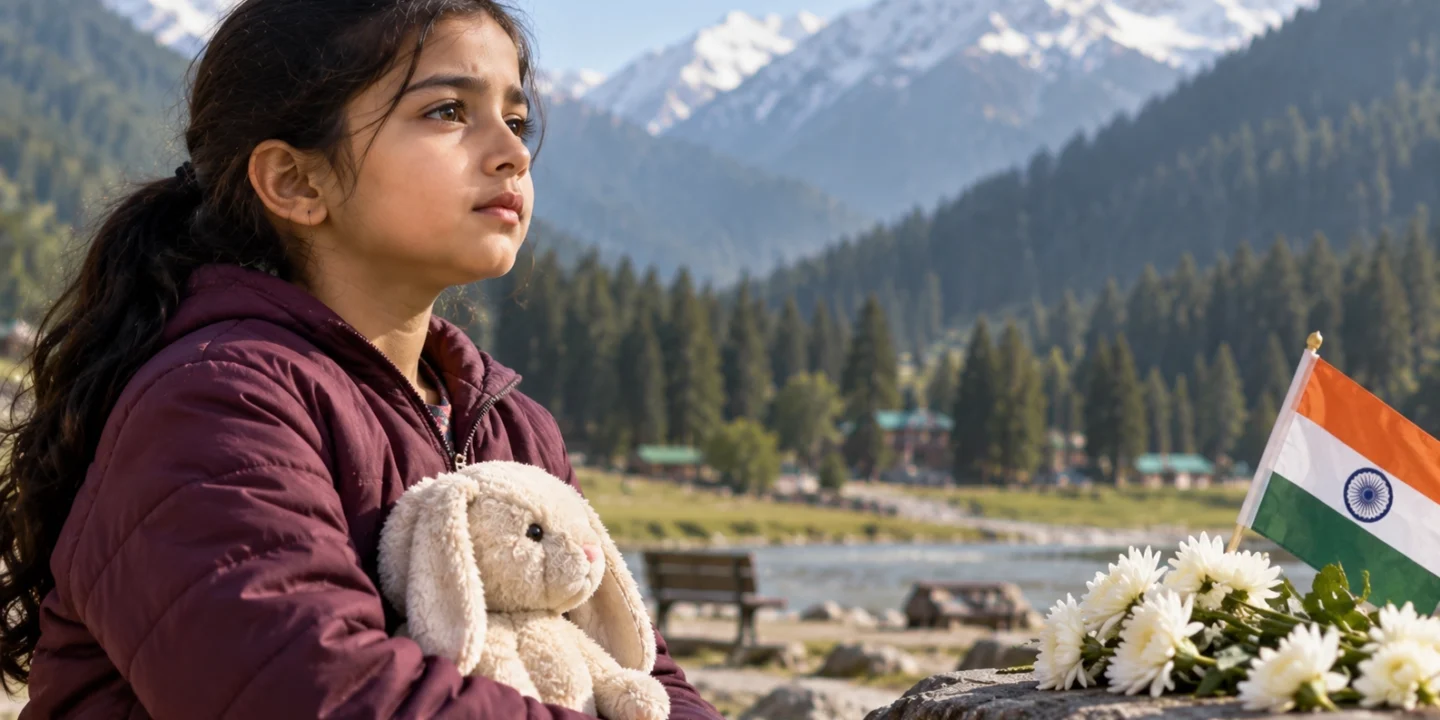




She watched her father die, memorised the killers, and refused to cry. India did the rest.

I. The House in Edappally
There is a house in Edappally, Kochi, where the front door opens to the smell of cardamom and the soft television hum of a Malayalam news bulletin in the next room. It is the kind of upper-middle-class Kerala home where the slippers are arranged neatly inside the threshold, and family photographs climb the wall in a slow chronological staircase. Wedding. Cradle ceremony. Two boys with identical faces grinning at a birthday cake. A grey-haired man with kind eyes and a Gulf-returnee’s quiet dignity, his arm around his wife.
That man, N. Ramachandran, was sixty-five years old. He had worked in the Gulf, raised a daughter who built her own career in Dubai, watched two grandsons learn to walk, and on the morning of April 22, 2025, he climbed onto a horse in a meadow in Kashmir to take a few photographs.
Five minutes later he was dead.
The man who put a bullet through his head spoke an Urdu that was not Kashmiri. He had been radicalised in a seminary across the border, trained in a camp run by a UN-designated terror group, and walked into a meadow called Baisaran with two companions and three rifles to ask men whether they were Hindu and to shoot them in the head when they were.
Arathi was kneeling beside him.
This is her story. But it is also the story of the man who could not save him and tried; of the Kashmiri driver named Muzafir who became her brother for twelve hours; of the soldiers who hunted his killers for ninety-three days through the high pines of Dachigam; of the missiles that, two weeks later, levelled the seminaries that had built him; and of the country that decided, in the spring of 2025, that it had done weeping for its dead.
It is, finally, the story of a woman who walked in front of cameras with her lipstick on, refused to perform her grief on demand, and was bullied across the internet for her composure. She had her reasons. Some of them are very old. The men who watch Indian television in safe houses in Bahawalpur and Muzaffarabad were watching her too, looking for the broken faces of widows and orphans. She decided they would not get hers.
II. April 21: A Change of Plan
The trip had been planned for months. Arathi flew in from Dubai. Ramachandran wanted his grandchildren, Dhrupad and Kedar, to see Kashmir at the age where it still meant snow, horses, and apple orchards. His wife had a disc prolapse and could not climb hills, but she could ride in a car and watch them from a distance, which is the bargain that grandmothers make.
They reached Srinagar on the evening of April 21. Their driver was a man named Muzafir, not a stranger off a tourist counter but a Kashmiri Ramachandran had arranged in advance through a friend who had worked with him before and vouched for him. Muzafir had also booked their hotel. He was, in the local idiom, their muzafir, which in Persian and Urdu means traveller. It would turn out to be the right name.
The original plan was Gulmarg, but the morning tickets were gone. So Muzafir suggested Pahalgam instead, and the family agreed. The car turned south. In Pahalgam they switched to a smaller arrangement to climb up to Baisaran. The mother stayed in the car at the base. Ramachandran, Arathi, and the twin boys went up on horseback with the local pony men.
The intention was simple. Let the children play. Take two photographs. Come back. Five minutes maximum.
Five minutes was almost exactly correct.
III. The Meadow
There were perhaps two thousand people in the meadow. The horses were tied. Children were chasing one another. Vendors were selling bottled water and corn. The afternoon was bright. It was three o’clock. There was no security perimeter, because Baisaran has no road, only a bridle track, and security forces had not, until that day, considered it a target. After all, the Line of Control was 220 kilometres away through high mountains. Tourists had been climbing this hill for decades.
Three men walked into the clearing, dressed in pheran-style outerwear over what witnesses later said looked like fatigues. They carried rifles, two AK-103s and an M4 carbine, weapons whose serial numbers and ballistic signatures would, ninety-seven days later, become the forensic spine of a parliamentary statement.
They began asking men their names. Then their religion. Then they began asking men to recite the Islamic kalima. Some they ordered to lower their trousers, because the absence of circumcision was, in the logic of their training, evidence enough. Of the twenty-six who would die in the next twenty minutes, the trousers of about twenty were found pulled down or unzipped. The first to fall was a young man from Kanpur named Shubham Dwivedi, on honeymoon with his wife. He answered honestly. He was shot in the head at point-blank range.
Ramachandran was older, bareheaded, with no obvious religious markers. He may not have been asked. He may have been part of the wave. The first burst of fire came from the direction of the higher slope. He took a round to the head and went down where he stood.
The intention was clear. Husbands were made to die in front of wives. The women were spared so they could go home as messengers. One gunman reportedly told a survivor that she had been left alive so she could go and tell Modi. Ramachandran’s daughter did not need to be told to deliver any message. She had her own.
IV. Beside Her Father
The four of them, Ramachandran and Arathi and the twins, had knelt together on the grass. Whether for a photograph or simply to bring the boys to eye level, the geometry was the same: the grandfather behind, the daughter in front, the children in front of her. They were close enough that one arm could hold all of them.
The gunman came from one side. He asked her father a question. Some accounts say he asked his name, some that he asked his religion, some that he ordered him to recite the kalima. The exact words do not matter to the outcome. The answer, whatever it was, was the wrong one. The rifle came up. The shot went into his head. He folded forward over his own knees.
Arathi did what any daughter would do in the first reflex: she lifted his head and screamed. The scream was in Malayalam. The words have not been recorded, and it is not necessary to know them.
A rifle was pressed against her own temple. She did not look away. She made herself look. She made herself memorise the face above the rifle, the eyes, the angle of the cheekbones, the way the man held his weapon. She would, in the days that followed, ask her boys quietly to do the same, to keep what they had seen in their heads, to not let the faces dissolve into the smear of trauma. It was the only weapon she had in that moment, and she used it with a clarity that she would later describe as bizarre. She felt the metal. She felt, with the same uncomplicated clarity, that her father was already dead and there was no use in pretending otherwise. The rifle did not fire. The man, for reasons she would never know, walked away. Perhaps he had been told to spare women so that they could go and tell the country what had happened. Perhaps his magazine was empty. Perhaps it was something else. What mattered, ninety-three days later, was that she had his face.
She looked at her two boys. They were screaming. They were eight-year-olds, and the world had just collapsed, and they were screaming.
Her own father, she told the journalists later, used to chide her mother for losing her composure during small household crises. A problem comes; you do not howl, you act. She had always thought this was just one of those things her father said. Kneeling on the grass with her dead father in her arms and a rifle muzzle still warm somewhere in her peripheral vision, she discovered that she was, after all, his daughter.
She did the small, impossibly composed things that nobody could have rehearsed. There was a pine tree close by. She turned her father’s body so that his back rested against its trunk, slanted, as if he had simply paused there to catch his breath. It was not a dignified posture. It was the most dignity available in the moment. She put his identification documents into the most visible part of his pocket, so that whoever found him next would know who he was, and whose he was.
Then she gathered her boys.
“Don’t cry. Move. Amma is also scared. But we should be very brave. If something happens to Amma, don’t look back. Just run forward.”
This is what she said to them, in the half-English half-Malayalam patter that bilingual urban Indian families use. Dhrupad and Kedar were eight.
The way down from Baisaran is not a path. It is a slope: pine roots, loose stones, sudden drops, the kind of terrain that a child in ordinary times would be carried over by a parent. Arathi did not have the option to carry. Her boys had to climb on their own legs. She went ahead and behind them by turns, holding a wrist, breaking a fall, pulling the smaller one back from a ledge, urging the older one over a root. It was, by her own later description to family, an adventure: the word adults use when they are explaining to children, in retrospect, things that they themselves do not want to have to remember.
A small group of survivors had already started moving down. Local men, terrified themselves, were waving their arms and shouting in Urdu: Seedhe jao, seedhe jao. Go straight. Go straight. Arathi did not know who they were. They could be the killers’ accomplices. They could be ordinary villagers. They could be leading her over a cliff. There was no choice but to follow.
She climbed down with her boys for several hundred metres before her phone caught a signal.
V. Muzafir
The first person she called was Muzafir.
The Kashmiri driver who had picked them up the previous evening had been waiting at the foot of the bridle path. He had heard the shots. He was already running uphill when his phone rang. She told him the bare minimum: her father was dead, her boys were with her, her mother did not know. Do not let her know.
When he reached her she was sitting at the side of a slope, holding both children tight enough to crack ribs. Her face must have been something. She fell into his arms and he held her, and she said it again, in English, because Malayalam was no longer available to her and his Urdu and her Hindi were not equal to this. He is dead. My father is dead.
The driver, who only the previous evening had been the booking of a careful father with the right local contacts, became at that moment the brother she did not have in Kashmir. He held her. He called a friend, a man named Samir, who came too. They organised. They did the things that needed doing. They got her down the hill. They got the mother into the car without telling her, because the mother had a recent cardiac history and the news, delivered roadside on a Kashmir highway by a driver and his friend, would have killed her.
Arathi took her mother’s phone and pocketed it. She told her mother that her father had run in a different direction during the panic and was being treated at a hospital. She told her sons, in low whispers, that Muthassan will come. The boys stared at her, and then at their grandmother, and said it: Muthassan will come. The mother believed them. Of course she believed them; she wanted to.
Muzafir drove them back to Srinagar in the same car they had ridden up in two days earlier, the mother in the passenger seat with no idea that the husband she was waiting for was already being processed through a different set of vehicles behind them.
Back at the hotel, the cover had to hold for hours. The television in the room stayed off; bulletins by then were running her father’s name and face on a loop, and her mother could not be allowed to walk past a screen. The phone rang constantly with reporters who had pieced together a number; she did not answer a single call. She invented test results. She invented doctors. She invented hours of stable observation. The boys held the line in their five-word fragments, Muthassan will come, while she ran the larger fiction in the next chair.
She would later put the entire enterprise in two sentences, of the kind that carry a whole essay underneath them.
“I had to pretend to be strong. I couldn’t break down as I have to manage my mother and my children.”
That sentence is the operational logic of every choice she would make in the next ninety-three days. The composure on the hill. The lies in the hotel. The neutral lipstick on television. The refusal to give her grief to anyone whose seeing it would harm someone she loved. It was not stoicism, in the sense of not feeling. It was triage, in the sense that there were people in the room who could not survive what she could survive, and the cost of being seen to break would be paid by them.
Muzafir, behind the scenes, was doing the things she could not. He had been hired to drive a family safely. He also did about a hundred things he had not been hired to do, including the thing that no one ever wants to be hired to do, which is help arrange the transport of a body in a sealed coffin in the cargo hold of an aircraft while the family sits, knees pressed to seat backs, in the cabin above.
Arathi has said, to anyone who will listen, that the worst hours of her life were the hours on that plane. Above her, in the seats, were her mother and her two boys, and her mother was asking constantly: Is your father on a ventilator? Are there nurses? Did you arrange everything? Below her, in the cargo hold, in a wooden box, was her father. She answered without crying. She answered for hours. Her brother was waiting at Nedumbassery airport in Kochi, and he would be the one to tell their mother the truth in the home, with relatives gathered, with the cardiologist on standby. She would not let her mother find out at thirty thousand feet over central India that her husband of four decades was in the box below her feet.
She had reached out, in the hours before landing, for help in keeping the media away from the family at Nedumbassery. The Kochi District Collector arranged it. Instead of being walked out through the exit, where television cameras and microphones were already lining up for the country’s first sight of a Pahalgam family coming home, she and her mother and the boys were brought out quietly through the entry gate, behind the public lens, into a waiting car. It was a small administrative kindness. It was also, in a country where grief is so often turned into footage before it has finished being grief, a decisive one. She had thought through the choreography of her own arrival like a stage manager. She had, in the space of a single afternoon, become the head of her family.
VI. The Lipstick
Arathi Menon went on television within the next forty-eight hours.
She wore a bindi. She wore eyeliner. She wore a small, neutral lipstick. She spoke clearly. She did not weep. She praised Muzafir, by name, as a man who had treated her like a sister. She said the gunmen had no religion that she would recognise. She said India needed to act.
The internet erupted.
A subset of Indian social media, the same subset that has spent years training itself to read the optics of women’s faces with the prosecutorial intensity of a religious tribunal, decided that her composure was a performance. Look at her, one viral post said. Lipstick. Bindi. As if her father had not been killed. Another asked whether she was angling for a Mollywood role. A third demanded to know how she could praise a Kashmiri while her father’s body was still warm.
Arathi answered, when she eventually answered, with a flatness that was its own kind of force.
“I, my mother, my mother’s sisters, all of us regularly wear lipstick. We dress nicely when we step out. Just because my father is no more, my mother is not going to stop wearing her bindi tomorrow and walk around in pale colours for the rest of her life. To those who want to measure our love for my father with their own measuring stick, I have only one thing to say. Say what you want. We don’t care.”
It was a small sentence. It carried the weight of a generation of Indian women who have been taught to perform widowhood and grief like a folk dance, and who are now, increasingly, refusing.
She would not give the men who killed her father the gift of her tears.
VII. What 26/11 Taught a Generation
The image is internalised for any Indian over thirty. Ajmal Kasab walking through a Mumbai railway station with an AK-47. The Taj on fire against a black sky. A reporter live on camera while another floor erupted into orange.
What 26/11 taught was uncomfortable. The handlers in the Karachi safe houses were on satellite phones with the gunmen inside the Taj, in real time, watching Indian news channels. They wanted footage. They wanted screaming. They wanted the parade of widows. Televised grief was part of the operational reward. A particular generation of Indians, especially women in public-facing roles, has not forgotten this. You absorb it from journalists who learned to keep their voices steady on live television because they knew an attacker’s controller might be listening. You absorb it from victims’ families who decided, quietly, that they would not cry on camera, because their tears were not personal grief alone but also strategic content for the people who had killed their men.
Arathi has said the operative thing more than once: I will not let those who killed my father see my tears. So she put on a small lipstick. She combed her hair. She practised her father’s voice in her head: you do not howl, you act. And she walked into the press conference and said the thing the planners in Bahawalpur and Muzaffarabad would least like to hear: that the Kashmiri driver had been her brother, that the killers had no religion she would recognise, that the country needed to act and she trusted it would.
VIII. The Two Kashmirs
Every Indian conversation about Kashmir is, eventually, a conversation about which Kashmir is being discussed.
There is the Kashmir of Adil Hussain Shah, the local pony operator who tried to wrestle a rifle out of a gunman’s hands in the same meadow that morning and was shot dead for it. He was a Muslim. He was a Kashmiri. He died defending Hindu tourists with his bare hands. There is the Kashmir of Muzafir, who held a stranger in his arms while she said the word dead. There is the Kashmir of the dozens of pony men and shopkeepers and small traders who, that afternoon, ran toward the screaming and not away from it. This Kashmir is the overwhelming, ordinary, decent Kashmir: an economy that lives off tourism, a population that has watched, with mounting bitterness, what every cycle of violence does to its bookings and to its name.
But there is another Kashmir, and to pretend otherwise is to insult the first one. There is the Kashmir of the fifteen local facilitators that the National Investigation Agency identified as having helped the three foreign terrorists move, eat, sleep, recharge their satellite phone, and stay alive in the high forests of Dachigam for over three months. There is the Kashmir of Mohammad Yousuf Kataria, the seasonal teacher from Kulgam who met the gunmen at least four times in the Zabarwan hills and supplied them with equipment, including the phone charger that turned out to be the breadcrumb to his arrest. There is the Kashmir of the radicalised young men who pick up the WhatsApp invitations and the offers of Pakistani martyrdom money.
The first Kashmir is what makes the second Kashmir possible. Not because it endorses the second; it manifestly does not. But because the second hides inside the first, the way a parasite lives inside a healthy host. The handler in Muzaffarabad chooses Kashmir as his theatre precisely because it is full of Muzafirs. The decent majority pays twice. Once when their neighbours kill tourists. Again when the rest of India, in its rage, tars all of them with the same brush.
Arathi understood this, which is why she did the politically inconvenient thing within forty-eight hours of her father’s funeral. She named Muzafir. She praised him publicly. She refused to let her own grief be conscripted into a project of communal generalisation. For this she was bullied. For this she will, in twenty years, be remembered.
IX. How They Got There
Baisaran is 220 kilometres from the Line of Control. The men who walked into it had infiltrated weeks earlier, were guided by a pipeline of local helpers later identified by the National Investigation Agency, and lived in the high forests on satellite-phone bandwidth while they waited. Their handler was Sajid Saifullah Jatt of Lashkar-e-Taiba in Lahore; the funding ran through Yasir Hayat in Malaysia, with onward links to Sajid Mir’s network, the master planner of the 2008 Mumbai attacks. This is the work of a state apparatus, not three lone men. It is also the work an open democracy with a 740-kilometre Himalayan frontier cannot completely prevent. Anyone who tells you a perfect seal is possible is selling something. What you can do is make the price unbearable for the senders.
X. Operation Sindoor
The word sindoor is the vermilion married Hindu women apply along the parting of their hair. The Pahalgam attackers had executed husbands in front of wives. The choice of name was not decorative. In the small hours of May 7, 2025, fifteen days after Pahalgam, the Indian armed forces struck nine targets in Pakistan and Pakistan-occupied Kashmir: the camps and command nodes of Lashkar-e-Taiba, Jaish-e-Mohammed, and Hizbul Mujahideen. The Indian missiles went to Bahawalpur, in Pakistan’s Punjab heartland, a place American drones had not gone in their darkest post-9/11 years. The Indian Army said the targeted command structures collapsed inside twenty-two minutes; over a hundred terrorists, trainers and handlers were killed in the first wave.
Pakistan escalated, firing drones and shells at Indian religious sites: the Shambhu temple in Jammu, the Gurudwara in Poonch, Christian convents in Punjab. India responded. The exchange ran for four days.
What ended it was geographic. In the early hours of May 10, Indian missiles struck the Nur Khan Airbase in Rawalpindi’s Chaklala area. Nur Khan sits a short distance from the Pakistan Army’s General Headquarters and within line of sight of the Strategic Plans Division, the body that runs Pakistan’s nuclear command and controls its arsenal. The proximity, not the damage, was the message. Within hours, Pakistan’s Director General of Military Operations was on a line to his Indian counterpart asking for a ceasefire. President Asif Ali Zardari was reportedly advised to move to a bunker. By the end of the day, a ceasefire was agreed. Pakistan’s Deputy Prime Minister Ishaq Dar would publicly confirm the strike eight months later, calling it a mistake. It was not, as is now clear, a mistake.
Sindoor went further than Uri or Balakot. It struck the Pakistani heartland and the trainers. It went right up to the perimeter of Pakistan’s nuclear command and demonstrated that the cover of nuclear blackmail was no longer a cover. The new doctrine was articulated bluntly: any act of terrorism by non-state actors operating from Pakistani soil would henceforth be treated as an act of war by the sponsoring state.
XI. Operation Mahadev
Sindoor was the strike against the masters. Mahadev was the hunt for the men. Army, CRPF, J&K Police, and Para Special Forces combed the high pines for ninety-three days. The breakthrough came through a Huawei satellite phone whose unusual call patterns had been monitored since April 22. On July 28, teams ascended Mahadev hill in Dachigam; by 12:45 p.m., the three terrorists who had walked into Baisaran lay dead. Their names were Suleman Shah (alias Faizal Jatt), Hamza Afghani, and Yasir, also called Zibran. The AK-103 barrels recovered from them were striation-matched to the cartridges from Baisaran. Forensic certainty: one hundred per cent.
The forensic chain was decisive, but it was not the only confirmation. Photographs of the three dead men were taken to Edappally and laid before Arathi and her two sons. The three of them had carried those faces in their heads for ninety-three days, deliberately, on practice. The identification was unambiguous. Her testimony, and theirs, closed the loop the laboratory had opened.
For Arathi, watching from Edappally, the news did not bring back her father. But she stood up and said something the cameras caught: “Their act was cowardice. Ours was brave. Our loss cannot be compensated, but hearing this news is a relief. As a citizen, I am proud to be an Indian.” She had done her part, which was to refuse to give the killers the satisfaction of seeing her broken. The state had done its part, which was to find them and to kill them.
XII. The Lie of the False Flag
Within hours of the attack, certain online accounts began suggesting that Pahalgam had been staged. Within days, this had hardened into a familiar genre. Where is the blood? the accounts demanded. Where are the bullet marks? Why did Modi fly back from Saudi Arabia so quickly? Why did the BJP have a Bihar rally already lined up to capitalise on the attack? The most ambitious version of the theory held that the Modi government had orchestrated the attack itself, using Indian intelligence proxies, to consolidate Hindu votes, justify Operation Sindoor, and silence dissent. The theory was exported, with enthusiasm, by elements of the Pakistani information ecosystem and by a small ecosystem of Indian-origin commentators who have built careers on the proposition that the Indian state cannot be trusted on questions of terror.
The blood and the bullet marks exist. There is voluminous photographic and videographic evidence from the meadow, from the helicopter evacuations, from the hospitals, from the autopsies. The reason a viewer of a particular kind of social media feed sees no blood is that platforms moderate graphic content. The reason an honest researcher sees plenty is that the National Investigation Agency, in eight months of investigation, filed a 1,597-page chargesheet to a special court in Jammu, against Lashkar-e-Taiba, The Resistance Front, and six named individuals, with forensic, ballistic, communications, and financial evidence appended.
The forensic chain alone is worth understanding. Empty cartridges from Baisaran were collected and sent to laboratory examination. Three months later, three rifles were recovered from three dead men in Dachigam. The barrel striations matched the cartridges from Baisaran. Independently, the faces of those same three dead men were identified, without hesitation, by the daughter who had seen them at point-blank range and by the two eight-year-old boys who had been beside her. Two independent chains of evidence, ballistic and eyewitness, converged on the same conclusion. This is reproducible, contestable in court, and uncontested.
A senior Lashkar-e-Taiba commander, Abu Musa Kashmiri, was caught on video celebrating the Pahalgam attack as a strategic gain for Pakistan. The video was authenticated and circulated. The ideological owner of the operation was on tape taking credit, while the Pakistani Information Minister Attaullah Tarar was simultaneously calling the attack a false flag by India. The right hand of the Pakistani state was busy denying what its left hand was busy celebrating. In May, the Press Information Bureau’s Fact Check unit had to formally debunk a viral video of an alleged Indian Army soldier confessing to a false flag; the man turned out to be a deserter who had not been on duty since March 2025.
Did Modi fly back from Saudi Arabia urgently and chair a Cabinet Committee on Security meeting? Yes. Did the BJP, like every political party in every democracy on earth, derive political advantage from a moment of national rage? Yes. None of this is evidence of a false flag. All of it is evidence of a state that, having been attacked, behaved like a state. The deeper inversion in the false-flag charge is moral. It asks the country to believe that a government, in order to win an election, would arrange for twenty-six tourists to be lined up and executed in front of their families on the basis of religious identity. It asks the country to believe that the soldiers who climbed Mahadev hill on July 28 were acting out a script. It asks Arathi Menon to believe that her father’s killing, which she watched, was a play.
The cost of this charge is paid by the soldiers. Imagine a Para Special Forces officer who has just spent ninety-three days in the high pines of Dachigam, on minimal sleep, in pursuit of three men whose handler he can hear on intercept after intercept. He climbs Mahadev hill on July 28. He takes his shot. He hands the weapons to a forensics chain that confirms, to one hundred per cent certainty, that these were the men. He comes home and turns on a television and sees a panel of articulate men and women in a Delhi studio suggesting that the operation he executed was political theatre, that the cartridges were planted, that the men he killed may not have been the men. The analyst Arif Hussain Theruvath has called this Schrödinger’s terror: the same incident is, simultaneously, a heroic act of resistance for one audience and a fictional invention of the Indian deep state for another. The point of the trick is not to convince. The point is to muddy. If the question of who killed Ramachandran can be made to feel unanswerable, then the question of what to do about it can be deferred indefinitely.
It is possible to hold two convictions simultaneously, and one must. One: every Indian Muslim is an Indian, full stop, and no terror attack, however brutal, justifies the harassment of a single Indian citizen on the basis of religion. Two: every terror attack from Pakistani soil is a Pakistani state operation in some degree, and the soldiers who hunt the perpetrators deserve our gratitude and our trust, not our suspicion and our cleverness. To hold one of these without the other is to fail the country. Arathi Menon, in those press conferences, was holding both. She named Muzafir as her brother. She also said that India must hit back hard. She thanked the soldiers without qualification. The trolls bullied her on the lipstick because they could not touch her on the substance. Pseudo-intellectuals, especially of the Indian variety, who have built careers on the false-flag proposition, owe Arathi an apology. They are unlikely to deliver it.
XIII. Why It Happened
On April 10, 2025, the United States extradited Tahawwur Hussain Rana, a co-conspirator of the 2008 Mumbai attacks, to India. Six days later, the Pakistan Army Chief General Asim Munir delivered a speech in Islamabad invoking the two-nation theory and calling Kashmir Pakistan’s jugular vein. Six days after that speech, three men walked into Baisaran. The deeper context is that Pakistan was founded in 1947 on the premise that Hindus and Muslims could not share a political community; a democratic, multi-religious, economically rising India is the existential refutation of that founding idea. The Pakistani military establishment has spent five decades exporting violence to keep the wound open. The doctrine, in one Pakistani general’s words, is to bleed India by a thousand cuts. The point is to make the Indian project look uglier than it is, so that Pakistanis can be told their state is the only thing standing between them and that. Whether Sindoor will work in the long run, no one knows. But the alternative, of absorbing attack after attack while one’s own intellectuals debate whether the attacks even happened, is no longer a political possibility in the India of 2026.
XIV. The Long Memory
A year after the attack, on April 22, 2026, Arathi attended a small memorial gathering at Edappally for her father. She wore, by all accounts, the same neutral lipstick. She thanked the soldiers. She named Muzafir again. She said the words proud Indian, without flinching, in front of a microphone.
She also made a specific argument about what the attack had been for. The Pahalgam attack, she said, had been a Hindu-targeted terrorist operation aimed at dividing India by triggering riots across the country. The plan had failed. The country had not torn itself apart. It had stayed united. This is our reply.
It is not a small point. The handlers who designed Pahalgam were aiming at a hundred thousand street fights between Indian Hindus and Indian Muslims in the days that followed. They wanted images of mosques on fire and temples on fire, and they wanted those images to constitute Pakistan’s strategic gain. It did not happen. Indian streets stayed mostly calm. The state directed the rage outward, at the actual perpetrators, not inward at fellow citizens. The communal trigger that the attack had been designed to pull, did not pull. Arathi, by naming Muzafir within forty-eight hours of her father’s funeral, was refusing the script that the killers had written for her. She did this knowing that a section of her own ideological allies would punish her for it. She did it anyway.
XV. The Children and the Frame
Dhrupad and Kedar are now nine. They will remember some things: the running, their mother’s hand on their backs, the gunshots in a way that registers more as a smell than a sound, the airport in Kochi, the moment their grandmother was told. They will also remember, because she has made sure of it, that a Kashmiri man named Muzafir held them in the back seat of a car and gave them water; that not everyone in Kashmir was a killer; that the country, when it lost their grandfather, did not lose itself.
In the house in Edappally, there is a private photograph of N. Ramachandran from before the trip. He is grinning at something off-camera, possibly one of his grandsons, his shoulders relaxed, a man enjoying the quiet pleasures of being a grandfather. Arathi has it framed near the front door. Her mother passes it several times a day. This is the man who was killed: not a symbol, not a statistic, a husband of forty years, a man who taught his daughter that you do not howl, you act.
The killers are dead. Their handlers’ camps have been levelled. The next attack will come; India is not so naïve as to believe otherwise. But the next attack will be answered, and the answer will not be a candlelight vigil. It will be missiles to Bahawalpur, special forces on Mahadev hill, and a chargesheet that runs to fifteen hundred pages. That is what the new normal means. It is a contract the Indian state has now repeatedly demonstrated it will honour.
XVI. Coda
The line her father used to repeat to her mother, whenever a small crisis sent her into tears, was simple.
A problem comes. You do not howl. You act.
It is the kind of household instruction that gets repeated for years and then half-forgotten. Then one afternoon the father is dead in a meadow, the mother is in a car at the foot of a hill, the children are in the dirt holding their mother, the gunmen are walking away, and the daughter, in the precise moment that the world ends, finds that the small instruction is the whole inheritance.
She did not howl. She acted. She got her children down the hill. She got her mother home with the truth withheld until it could be delivered safely. She named the Kashmiri who had held her. She refused to give her tears to the men who had earned them. She memorised their faces and so did her sons, and ninety-three days later that memory closed a courtroom loop the laboratory had opened. She told the country that India must hit back, and she trusted, against the cynicism of a generation, that India would.
India did. The men who killed her father are dead. The men who sent them have been hit harder than they have been hit in fifty years.
There is a memorial now in Pahalgam, on the banks of the Lidder, of black marble, with twenty-six names. If you ever go, find Ramachandran’s name. Run your fingers along the engraved letters. Then think of his daughter, in a house in Edappally, framing his smile near the door, and refusing, on his behalf, to break.
That is what it looks like when a country, and one of its quieter daughters, decides that it will mourn its dead, and answer for them, and live.




No Comments