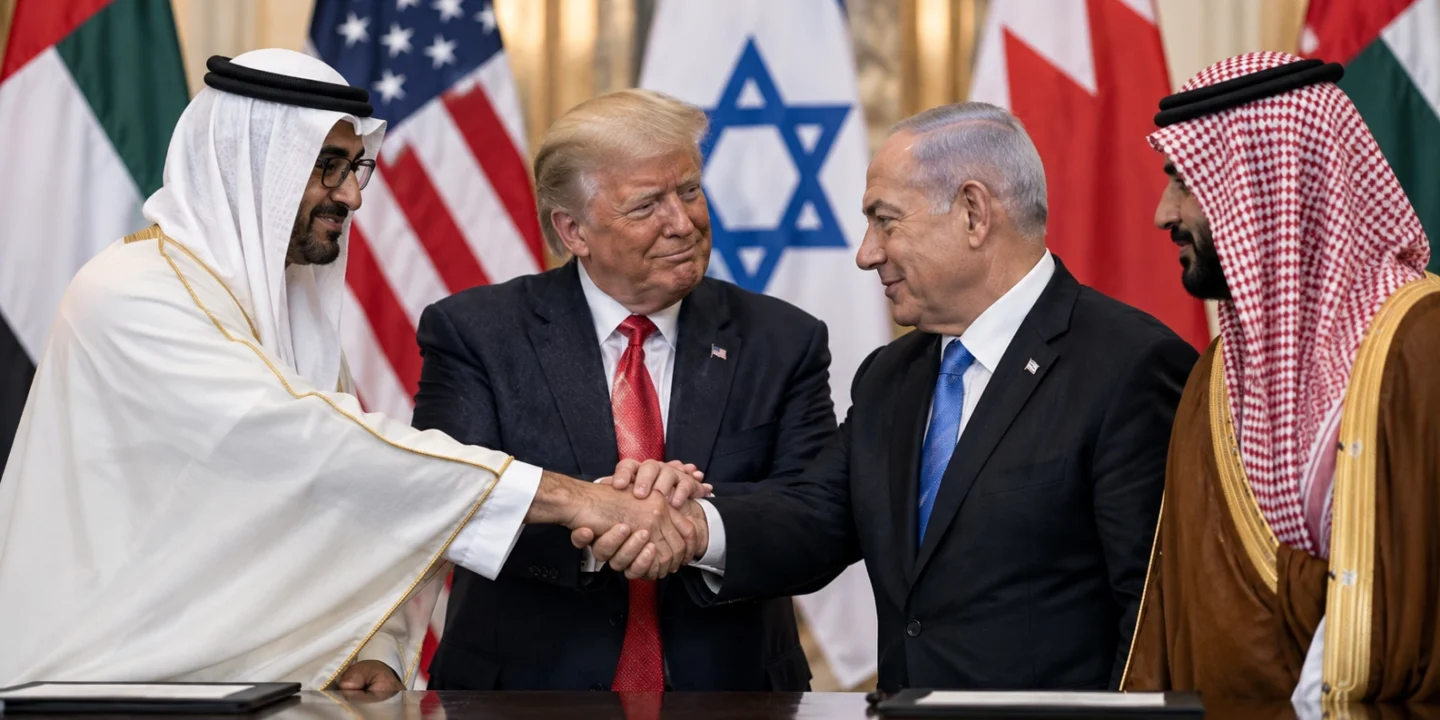




The most important geopolitical story of our time is not Israel versus Iran. It is the Arab world choosing a side – and what that choice reveals about how peace is actually made.
The Choice
Arab states, led by the Gulf, looked at the landscape and made a calculation. Iran was the threat. Not Israel.
This required courage. For decades, the default Arab political position was to treat Israel as the enemy and avoid any posture that could be called collaboration with Washington or Tel Aviv. The Palestinian cause was sacred. Opposing it, even indirectly, was political suicide.
The Gulf states broke with that script. They looked past the optics and asked a harder question: who is actually destroying Arab lives, Arab economies, and Arab sovereignty? The answer was not Israel. It was Iran and the network of proxies it had spent four decades building.
Lebanon handed over its state to Hezbollah and collapsed. Yemen was torn apart by the Houthis. Iraq became a theater for Iranian-backed militias. Syria was shattered. Every country that fell into Iran’s orbit became poorer, more violent, and less capable of governing itself. The “resistance” axis delivered rubble to every population it claimed to champion.
Arab states looked at that record and made a choice. They chose the US-Israel security architecture. They chose normalization. They chose to name Iran as the destabilizing force, publicly and without apology. That is not a small thing. It is a historic strategic realignment, and it deserves to be understood as one.
Déjà Vu: Iran Is Running Saddam’s Playbook
Arabs have seen this before. Not in history books. In their own lifetimes, in their own cities, in the rubble of wars fought in their names by men who never intended to win them – only to rule through them. That lived memory is what makes their judgment so credible, and so damning.
Saddam Hussein wrapped his regional ambitions in the language of Arab nationalism and Palestinian liberation. He thundered about the Arab cause from Baghdad while his palaces multiplied and his people starved. He was the champion of the Arab street, the great defender against Zionism and American imperialism – right up until he invaded Kuwait, gassed the Kurds, fired Scuds at Riyadh, and left a generation of Arab children to grow up in the wreckage of his ambitions. The cause was always a costume. Underneath it was nothing but appetite – for power, for dominance, for a region organized around fear of one man.
Arabs who lived through that era carry the memory in their bones. They know what a strongman looks like when he is using a sacred cause as a shield. They know the pattern: grand ideological framing, proxy armies, deniability, controlled chaos, and the permanent claim to be the only force standing between the Arab world and its enemies.
Iran is running the same script. The flag is different – Islamic resistance instead of Arab nationalism – but the architecture is identical. Fund militias in other countries’ territories. Keep Lebanon, Yemen, Iraq, and Gaza in permanent crisis. Present the chaos as resistance. Claim that any Arab state making peace with Israel or America is a traitor to the cause.
The Gulf states recognized the template. They had lived through the original. The Abraham Accords were partly a statement of that recognition – a refusal to let Iran use the Palestinian cause as a permanent veto over Arab foreign policy, the same way Saddam once used Arab nationalism as cover for his wars. The cause is real. The people invoking it are not acting in its interest. Arabs learned that lesson once. They are not relearning it.
April 2024: The Moment That Said Everything
In April 2024, Iran launched over 300 drones and ballistic missiles at Israel – the largest direct missile attack in the modern history of the Middle East. Jordan and Saudi Arabia helped shoot them down. Sit with that for a moment. Arab states, the same states that were supposed to be Israel’s permanent enemies, the same states that generations of Arab politicians built careers promising to confront – those states stood in the sky that night and physically defended Israel against an Iranian assault.
No diplomatic communique captures what that meant. No summit declaration, no think-tank paper, no carefully worded joint statement comes close. It was a single operational fact that rendered fifty years of regional assumptions obsolete in one night. It was not naive trust, and it was not sentiment. It was a cold, clear strategic judgment – that the US-Israel security architecture was worth defending, and that Iran was the enemy that needed stopping. History did not validate that judgment slowly, through the drift of decades. It validated it in real time, over Jordanian airspace, in the dark.
The Accords Were Prescient, Not Naive
When the Abraham Accords were signed in 2020, critics called them a sideshow. The Palestinian issue was unresolved. How could normalization be real? What did it mean for the broader peace process?
It meant this: the Gulf states were betting that stability, trade, and a shared security architecture would do more for the region than another generation of performative solidarity with a cause that was being used, cynically, to keep everyone poor and angry. They were right.
The logic of the Accords has only grown more relevant since October 7. Hamas attacked Israel on the precise eve of a potential Saudi normalization deal. The goal was to blow up
the peace process. It was a confession. The resistance axis cannot survive Arab-Israeli normalization. Peace is an existential threat to the axis, not to the Arab people.
Europe Preached Peace. Arabs Built It.
Europe spent thirty years constructing a peace theology. Dialogue. Strategic autonomy. Engagement. Economic interdependence as a guarantor of stability. They lectured the world about the virtues of soft power while Russia rearmed, rebuilt its military, and told anyone paying attention exactly what it intended to do.
When Russia invaded Ukraine in 2022, Europe was shocked. It had genuinely convinced itself that the sermon was the strategy.
Arabs made no such mistake. They built a security architecture. They engaged in hard diplomatic bargaining. They accepted the uncomfortable math: peace requires deterrence. A good deal requires leverage. Trust must be earned and tested, not assumed. The Gulf states invested in military capability, forged security partnerships, and made consequential choices about which side they were on.
That is not warmongering. That is the honest mechanics of peace.
Deterrence works. The Iran-backed axis pushed hard and found resistance. The Houthis have continued to attack Red Sea shipping and have faced sustained military responses. Hezbollah, once considered Iran’s crown jewel of deterrence, has been severely degraded. The axis is weaker than it was three years ago. The Abraham Accords architecture is, by contrast, more durable.
A Lesson India Has Not Yet Learned
India has its own version of this story – longer, older, and in some ways more tragic, because the warnings have been available for a century and the lesson still has not landed.
Indian Muslims have mirrored Arab causes with remarkable consistency across a century. The Khilafat movement of 1921 – mass agitation in India over the fate of an Ottoman caliphate that had nothing to do with Indian lives. The Palestinian cause post-1948, absorbed as a domestic identity marker long before it became a global left-wing one. And after October 7, open emotional solidarity with Hamas on Indian streets, politicians holding candlelight vigils, and the resistance axis finding a sympathetic echo inside a democracy 3,000 miles from Gaza.
The pattern is not organic. It is manufactured and maintained. Indian politicians – across parties, but concentrated in the opposition – fan these causes deliberately. It wins votes. It keeps a community emotionally tethered to a global Islamic grievance framework instead of rooted in Indian civic identity. The short-term political math is simple. The long-term structural damage is severe.
Every time a politician amplifies this solidarity, more Indian Muslims get pulled deeper into the current of political Islam. The Frankenstein of Islamism – the idea that Islamic identity is prior to national citizenship, that the Ummah’s wars are your wars regardless of your passport – grows stronger. It weakens integration. It hands extremists a recruitment argument. And it exposes ordinary Indian Muslims, most of whom want none of this, to a radicalizing logic they did not ask for.
Arabs have shown what the alternative looks like. Name the threat. Refuse to let the cause be weaponized by those who profit from permanent grievance. Build identity around shared interests and shared futures, not shared enemies. The Gulf states did not abandon their Muslim identity. They refused to let that identity be hijacked by Iran’s revolutionary project. That distinction – between faith and political Islam, between solidarity and strategic manipulation – is exactly what Indian politics has failed to make. The cost of that failure compounds every decade.
What This Means
The Arab world is teaching the rest of the world something it does not want to hear: peace is not a posture. It is not a statement of values, a hashtag, a candlelight vigil, or a collection of international agreements signed in good faith by people who will never bear the cost of being wrong. Peace is a structure. It is built from hard choices and real tradeoffs, from the courage to name threats accurately even when the name is unpopular, from the willingness to absorb the fury of the street and hold the line anyway.
The states that named Iran as the destabilizing force, that chose normalization over solidarity with a manufactured cause, that stood in the sky over Jordan and shot down Iranian missiles on a spring night – those states have done more for the prospect of a stable Middle East than fifty years of peace processes, UN resolutions, and Western diplomatic missions ever managed to deliver.
And the stakes are not only regional. A stable Middle East means stable energy markets, open trade routes, contained nuclear ambitions, and terror networks starved of the chaos they feed on. It means fewer wars that pull the whole world in. It means a future that looks different from the last century. The Arabs who chose peace understood all of this. They chose it anyway, at real political cost, without waiting for the world’s permission or approval. That deserves more than acknowledgment. It deserves to be studied, and followed.
Arab nations are not catching up to the world. They are showing the world where to go.











No Comments