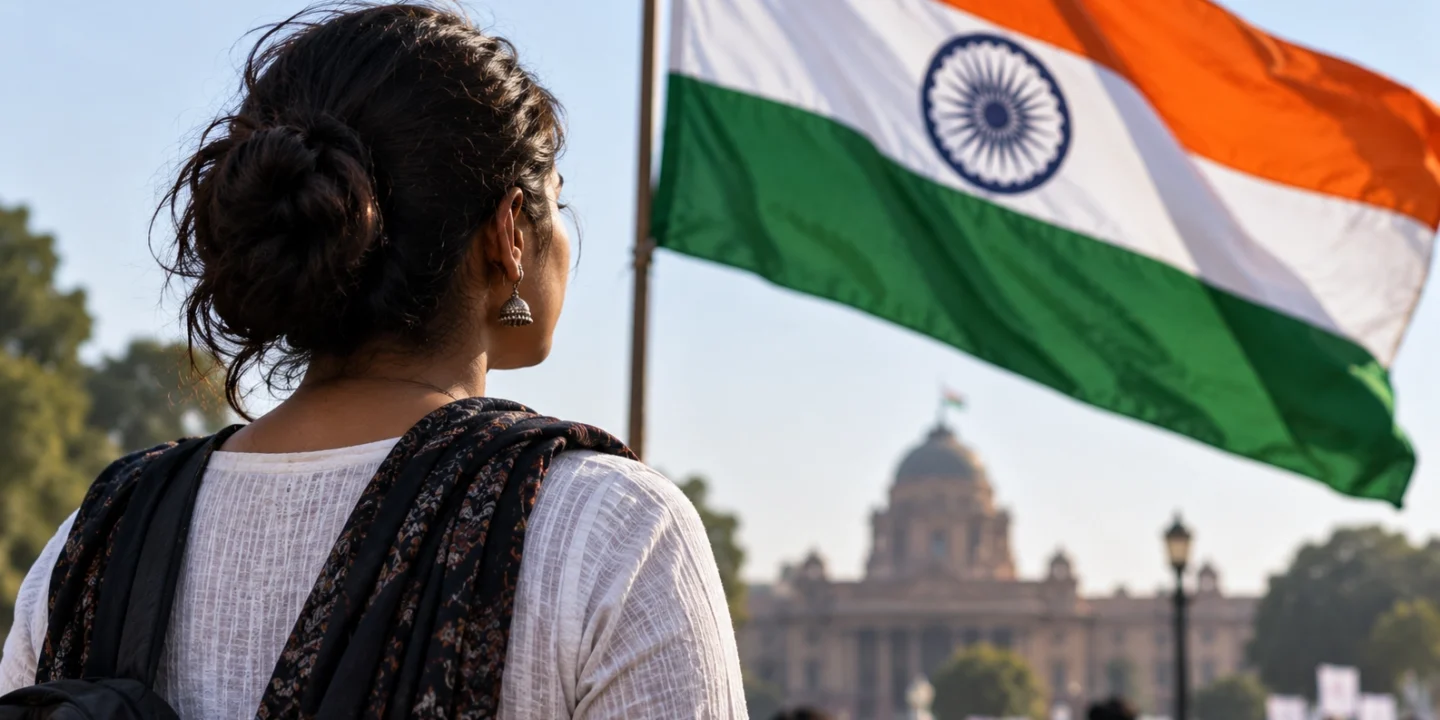




An ex-Muslim atheist Indian on why the song belongs to all of us, and to none of them.
I will sing Vande Mataram. Not because I am a Hindu. I am not. Not because I believe in gods. I do not.
Not because I have discovered some divine calling between one cup of tea and another national controversy. I am an atheist. I am an ex-Muslim. I have spent enough years questioning religion to know that no song, slogan, book, flag, or political drama is above criticism.
I will still sing Vande Mataram.
Because before I am an atheist, before I am an ex-Muslim, before I am a critic of religion, I am an Indian. If that sentence offends someone, the problem is not with the song. The problem is with the confused political software running inside their head.
I sang it as a Muslim. I sang it inside the ideological world I later escaped, in the phase where religion occupied my mind like an illegal tenant refusing to leave after the court order. I sang it then. I will sing it now with far more clarity, because now I understand what it is.
It is not a surrender to Hinduism. It is not a conversion ceremony. It is not a secret Hindu password whispered to citizens before they are handed a flag and added to a political WhatsApp group. It is a national song born from India’s freedom struggle.
Vande Mataram was written by Bankim Chandra Chattopadhyay in 1875 and published in his 1882 Bengali novel Anandamath. The phrase means “I bow to thee, Mother,” addressing the motherland. It entered India’s political life when it was sung at the 1896 Calcutta session of the Indian National Congress. During the freedom struggle it became one of the most powerful chants against British rule, carried by revolutionaries, Congress workers, and ordinary people. After Independence, on 24 January 1950, the Constituent Assembly recognised its historic role and gave it equal status with Jana Gana Mana.
This history matters, because the song did not fall from the sky yesterday wearing a party scarf. It is not a BJP invention. It is not a temple hymn smuggled into the Constitution. The British were not afraid of Hindu theology. They were afraid of Indian unity. They were afraid of a song that made people feel India was not merely soil, map, and tax revenue, but motherland. They were afraid that people divided by caste, region, language, and religion might suddenly look at each other and say, “We are Indians.”
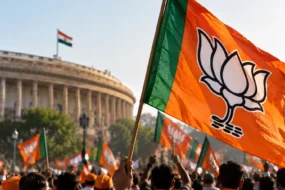
None of this is abstract today. In November 2025 the government launched a year-long commemoration of the song’s 150th anniversary. The Prime Minister recited the full poem, accused Nehru and the Congress of breaking Vande Mataram in 1937 under pressure from the Muslim League, and claimed this division sowed the seeds of Partition. For days in December, Parliament fought over a poem. So let us be exact about the history both sides are now abusing.
The serious political opposition to Vande Mataram came from religious separatist politics, above all the Muslim League, which rejected the song on Islamic theological grounds. When Congress faced that objection in 1937, Nehru consulted Rabindranath Tagore, the Hindu monotheist who had first sung the song in public in 1896. Tagore loved the opening verses about the land and suggested keeping the first two stanzas. The Working Committee then cut the four later stanzas that hail the goddess Durga. The cut was Congress managing the League’s objection, and Tagore’s letter was the instrument. History, sadly, continues to suffer from people who read headlines and then declare themselves historians.
When the Prime Minister recites the full poem, he is reciting the authentic text, and there is nothing wrong with that. The problem is the rest of the performance: putting Nehru on trial as a traitor, claiming the 1937 cut sowed Partition, and folding a freedom-struggle song into one party’s Hindu-nationalist branding. Reciting the poem is restoration. The Nehru-trial and the ownership claim are theatre. Partition had many fathers, and the deepest of them was the idea that religious identity must outrank national identity. A truncated poem did not cause that. Religious separatism did.
And religious separatism is exactly what produced the objection in the first place. That is the disease worth naming. I call it reverse anti-secularism.
Reverse anti-secularism is when a religious group uses the language of secularism to shield its own intolerance from criticism, while demanding that the national space bend around its theology.
Real secularism says the state must not impose one religion over another. Reverse anti-secularism says one religion can veto national symbols because its theology feels uncomfortable. Real secularism protects freedom of conscience for everyone. Reverse anti-secularism converts the insecurity of one community into national policy. It is not secularism. It is theological blackmail wearing a Nehru jacket.
The League’s objection was the first instance. The contemporary version is worse. Today some voices object not to the goddess stanzas, but to the first two, the verses that name no god at all, the ones a Hindu monotheist sang without hesitation. They have travelled further than the Muslim League ever did. The League at least objected to the goddess. These people object to the rivers.
And notice the sleight of hand in the objection. It takes a song and files it under prayer. A song asks you to remember. A prayer asks you to submit. Only by pretending the first is the second can anyone call a freedom-struggle anthem a threat to their faith.
If anyone has a deeper philosophical reason to question the song, it is not Muslims. It is atheists like me. For a Muslim, the objection is framed as one god against another god. For an atheist, it goes further. It is god against no god. I do not believe in Durga. I do not believe in Allah. I do not believe in Yahweh, in divine mothers, divine fathers, divine messengers, divine books, divine swords, or divine customer-service departments operating from heaven.
And I will still recite the whole thing.
Let me be clear about what the later stanzas are. They name Hindu goddesses. I will not pretend otherwise. But a poem is not a prayer. Reciting is not worship. I can recite a verse that invokes Durga exactly the way I can read the Gita or quote the Quran, without believing a single syllable of it. So “if you sing it, sing it whole” is not a command to worship anything. It is a refusal to keep censoring a freedom-era poem to soothe religious literalism. That is restoration, not compulsion.
And let us kill the word compulsion right here. No one is forced to sing Vande Mataram. There is no gun, no fine, no loyalty oath. The only question on the table is whether the original poem or a censored version is the real one. Restoring the original is not coercion. Refusing to be forced would be a question of liberty, but nobody is forcing. Refusing to even recite a poem about your own motherland, because it carries a metaphor your theology dislikes, is not liberty. It is supremacy wearing the costume of conscience.
This is why the present opposition to the song is not just wrong on principle. It is politically suicidal.
When opponents attack Vande Mataram simply because the BJP has seized it, they do the BJP’s work for it. They hand over India’s national symbols on a silver plate and then complain that the BJP owns nationalism. Brilliant strategy. Set your own house on fire and accuse the neighbour of enjoying the heat.
If the BJP tries to claim the song as Hindu property, the answer is not to reject it. The answer is to reclaim it as Indian. When they say “this belongs to Hindu nationalism,” the reply is “no, this belongs to the freedom struggle.” When they say “this is our symbol,” the reply is “it was sung against the British before your present machinery existed, by Congress, by revolutionaries, by Gandhi, by Tagore.”
Instead, some opposition voices and Islamist groups walk straight into the trap. They oppose the song as an Islamic problem and then act shocked when nationalists say, “See, they put Islam above India.” That is not resistance. That is political self-harm with a press conference. And the first victims are not the clerics who manufacture the crisis and escape with the profit. The first victims are ordinary, nation-loving Muslims, who are then forced to prove their loyalty again and again because someone decided to fight a poem about rivers.
If meaning is the test, then apply it to everyone or drop it. That is the only honest position.
If a song must be dissected word by word for religious content, then so must every religious phrase used in public politics. Examine the theological slogans recited at political rallies in front of voters of every faith. Examine the verses that declare one creed supreme. Examine the prayers that curse kafirs. Ask whether those, too, violate the secularism we are suddenly so anxious to protect.
Watch what happens. The secular warriors who can spot saffron from ten kilometres away will suddenly discover they cannot see green even when it is painted on their foreheads. Their secularism has one remarkable talent: perfect vision in one direction, total blindness in the other.
I am not interested in performing a forensic autopsy on one freedom song while handing out theological discount coupons to everyone else. Either the meaning test is universal, or it is just selective cowardice wearing constitutional perfume.
India needs shared symbols the way it needs oxygen. We are a country wounded by caste, language, region, and religious insecurity. We can divide a street into caste zones and a dinner table into ideological factions before the sambar cools. In such a country, national integration is not decoration. We need shared songs, shared memory, shared pride, shared grief, and a shared vocabulary that reminds us that before caste, before sect, before party, before mosque, temple, church, and Twitter bio, we are Indians. That was the original spirit of Vande Mataram. That is why it inspired a freedom movement and frightened an empire.
For anyone whose political imagination still runs on the logic of Partition, history has already built the laboratory next door. Pakistan was founded on the idea that religious identity must outrank national identity. The results are on display: minority persecution, sectarian violence, military dominance, blasphemy hysteria, and a permanent crisis of nationhood. That is not a model. It is a museum of bad ideas. India must not reproduce that disease in reverse.
And there is a better example, ironically, from inside the Muslim world. Iran today is a Shia theocracy, with all the absurdity that follows when clerics run a country as though God outsourced the paperwork to them. Yet Iranians still take pride in their pre-Islamic Persian heritage. They honour Cyrus. They remember Persepolis. They keep their Zoroastrian roots alive. Even under a religious regime, civilizational memory survives. So why should Indian Muslims be taught to fear Indian civilizational memory? Why should honouring the motherland in a poem be treated as a betrayal of faith? Why should an atheist be more at home in his country’s history than the people who claim to be its secular conscience?
The answer is simple. The problem was never the song. The problem is religious insecurity and the politics that feeds on it.
A secular country does not amputate its own memory to comfort religious literalists. It treats all citizens equally, and it lets no religion become the censor board of nationalism. I will not join that cowardice.
I will sing Vande Mataram, not because I believe in any god, but because India has the right to remember its own freedom struggle.
I will sing it, not because I have become religious, but because I refuse to let religion dictate my patriotism.
I will sing it, not because the BJP owns it, but precisely because no party should be allowed to own it, and no cleric should be allowed to veto it.
I will sing it because Bankim wrote it, because Tagore sang it, because the British feared it, and because it belongs to Indian history, not to one temple, one party, one sect, or one vote bank.
I will sing Vande Mataram because this land is my motherland.
Not my goddess.
Not my religion.
My motherland.
And if even that is too much for some people, then the argument was never about a song. It is about whether India is still allowed to have a national soul.




No Comments