




The Middle East Must Not Swap Washington for Beijing or Moscow
Arif Hussain Theruvath
Ask anyone from Cairo to Karachi what they think of the United States, and the charges come readily: America is the oil-hungry imperialist, the arms dealer who profits from perpetual conflict, the self-appointed global policeman who bombs countries into democracy and then abandons them to chaos. The Middle East has a catalogue of grievances against Washington, and most of them are legitimate. From the overthrow of Mosaddegh to the arming of the Mujahideen, from the catastrophe of Iraq to the double standards of its human rights rhetoric, America’s hands are far from clean.
Alongside this disillusionment, a growing fascination with alternative patrons has taken hold across the region and the broader Global South. China is courted as the pragmatic builder who offers infrastructure without lectures. Russia is admired in some quarters as the strongman who backs his allies, as it did Assad in Syria. Saudi Arabia, America’s most important Arab partner, turned to Beijing to broker its 2023 diplomatic rapprochement with Iran, a move that would have been unthinkable a decade ago. As recently as March 2026, China dispatched its special envoy to mediate between Iran and the US-Israeli coalition during the Middle East conflict, presenting itself as the neutral peacemaker in a war America is fighting. The message is unmistakable: the region is shopping for new patrons, and Washington is no longer the only store in town.
It is easy to see why this narrative sells. But it is built on a dangerous half-truth: that because America has done terrible things, its rivals must offer something better. They do not. The proposition being offered to the Middle East is not liberation. It is a trade: swap the flawed, loud, and constitutionally transparent American security architecture for the opaque, extractive, and entirely self-serving grip of Beijing or Moscow. This essay is not a defence of American innocence. America is not innocent. It is, rather, a case for understanding what each power actually does when it operates abroad, what model of the future each offers, and which system contains the capacity to correct its own crimes. On that question, the evidence is overwhelming, and it does not favour Moscow or Beijing.
I. Owning the American Blunders
To understand the present, we must be ruthlessly honest about the past. America’s record in the Middle East is not merely imperfect; it is, in several episodes, indefensible. But before cataloguing the failures, it is worth establishing a distinction that most commentary on this subject either ignores or deliberately obscures.
The Middle East’s foundational distortions were not American creations. They were European ones. The Sykes-Picot Agreement of 1916, in which Britain and France secretly carved up the Ottoman Empire’s Arab provinces into artificial zones of influence, drew the borders of Iraq, Syria, Lebanon, Jordan, and Palestine with little regard for tribal, ethnic, or sectarian realities. The Balfour Declaration of 1917 planted the seeds of the Israeli-Palestinian conflict. Britain’s near-colonial extraction of Iranian oil through the Anglo-Iranian Oil Company (later BP) impoverished the very nation whose resources it was siphoning. These were the acts of classical imperial powers doing what imperial powers do: drawing lines on maps, administering subject populations, and extracting wealth from territories they controlled.
America, crucially, operates on a fundamentally different model. This is not to say the United States has never engaged in colonial behaviour. It has. The annexation of Hawaii in 1898 overthrew a sovereign monarchy against the will of the majority of native Hawaiians. The Philippines was seized from Spain and governed as a colonial possession for nearly half a century, with a brutal war fought against Filipino independence fighters. Puerto Rico and Guam remain unincorporated territories to this day. These facts are part of the record and cannot be wished away.
But even these acquisitions were structurally different from European colonialism in their origins. Every major European colonial empire began with exploratory expeditions explicitly seeking wealth extraction. Vasco da Gama sailed to India seeking spices and trade monopolies. Columbus sailed west seeking gold. The Dutch East India Company and the British East India Company were commercial extraction corporations granted sovereign powers over foreign populations. These were deliberate voyages to distant lands for the purpose of plunder and permanent economic control. America never did this. It never sent ships to “discover” and claim inhabited territories for extraction. Its overseas territories were acquired through wars it was already fighting (the Philippines, Puerto Rico, and Guam came from the Spanish-American War fought over Cuban independence), strategic purchases (Alaska from Russia in 1867, the US Virgin Islands from Denmark in 1917 to prevent German submarine bases), or post-conflict administration (the Northern Mariana Islands after World War II). The motive was security and strategic positioning, not resource extraction. America never established anything resembling the East India Company model of commercial corporations with sovereign powers over foreign peoples. This does not excuse the injustices committed in these territories. But it does mean that equating American territorial history with the centuries-long, extraction-driven, expedition-based colonialism of Britain, France, the Netherlands, Spain, and Portugal is historically illiterate.
But here is the distinction that matters: the American system contains self-correcting mechanisms that no other great power, past or present, has demonstrated. When America acquired colonies in 1898, the Anti-Imperialist League formed immediately to oppose it, led by a former president, the country’s richest industrialist, and its most celebrated writer. The Philippines was granted full independence in 1946. Hawaii and Alaska were incorporated as states with full citizenship. The U.S. Congress passed an official Apology Resolution in 1993 acknowledging that the overthrow of the Hawaiian monarchy was illegal. Puerto Rico has held four statehood referendums since 2012, all won by statehood, because the majority of Puerto Ricans want to become a full and equal state, not gain independence. America’s colonial trajectory has consistently been toward equal status and incorporation, not permanent subjugation.
Now compare this with the actual colonial powers. Britain administered India for nearly two centuries, extracted an estimated $45 trillion in wealth according to the economist Utsa Patnaik, and has never issued a formal apology. As recently as October 2024, Prime Minister Keir Starmer explicitly ruled out both reparations and a formal apology for colonialism. David Cameron, while visiting the Jallianwala Bagh massacre memorial where British troops shot hundreds of unarmed civilians, said there was “an enormous amount to be proud of” in the British Empire. France held Algeria for 132 years and fought a savage war to keep it, killing an estimated 1.5 million Algerians. The Netherlands colonized Indonesia for 350 years, and when Indonesia finally gained independence in 1949, the Dutch forced Jakarta to pay 4.5 billion guilders in “colonial debt” to the Netherlands as a condition of sovereignty. The colonized were made to pay the colonizer for the privilege of their own freedom. Portugal held Goa for 451 years and has never offered a formal apology. Belgium’s King Leopold II ran the Congo as a personal fiefdom where an estimated 10 million Congolese died. To call America a “colonial power” in the same sentence as these empires is to confuse a nation that corrected its aberrations with nations that celebrated theirs.
The Civil Rights Act, the exposure of Abu Ghraib, the Senate’s 6,700-page report on CIA torture, the Congressional investigations into Iraq War intelligence failures: these are not signs of a flawless system. They are signs of a system capable of confronting its own failures. Russia has produced no official inquiry into its atrocities in Chechnya. China has published no report on Tiananmen Square. The CCP does not permit domestic newspapers to investigate the Uyghur camps. That difference is not incidental. It is the entire argument.
The contrast deepens when you examine not just the absence of accountability in rival systems, but the active machinery of denial. The Soviet Union did not merely fail to investigate its crimes. It institutionalized their justification. After each major act of aggression, Moscow published official “White Books” presenting fabricated evidence of “counter-revolutionary threats” or “fraternal requests for assistance” to legitimize what it had done. Hungary in 1956, Czechoslovakia in 1968, Afghanistan in 1979: each invasion was followed by a state-produced volume whose explicit purpose was to make the historical record less truthful, not more. Where America produces Senate reports that embarrass its own intelligence agencies, the Soviet system produced official volumes that glorified them. Russia has faithfully inherited this tradition. After the downing of Malaysia Airlines Flight MH17 in 2014, after the poisoning of Sergei Skripal in 2018, after the massacre at Bucha in 2022, Moscow produced not inquiries but counter-narratives: elaborate, state-funded disinformation designed to obscure rather than reveal. This is not a government that fails to investigate its crimes. It is a government that investigates how best to deny them.
America’s dominant model, when operating as itself rather than mimicking European imperialism, has been commercial integration rather than colonial administration. Post-war Germany, Japan, and South Korea are not American subjects. They are sovereign, prosperous nations rebuilt, integrated into global markets, and transformed into commercial allies. Taiwan, which America never rebuilt but shielded militarily and granted market access, used that security umbrella to engineer its own economic miracle and become a global semiconductor powerhouse. Even Vietnam, where America fought and lost one of its most devastating wars, has become one of its fastest-growing trade partners: bilateral trade exceeded $130 billion in 2024, and Hanoi upgraded the relationship to a Comprehensive Strategic Partnership in 2023, its highest diplomatic tier. The American operating system, at its core, turns adversaries into trading partners and protects partners into prosperity. Understanding this is essential to evaluating what went wrong in the Middle East.
Which is what makes Operation Ajax in 1953 not merely a strategic blunder but a betrayal of America’s own character. When the CIA partnered with Britain’s MI6 to overthrow Iran’s democratically elected Prime Minister, Mohammad Mosaddegh, it was not acting according to the American model. It was acting according to the British one: executing a colonial-style regime change to secure resource extraction for a declining European empire. Mosaddegh’s so-called crime was nationalizing Iranian oil, but even that act must be understood in context. The Anglo-Iranian Oil Company, later rebranded as British Petroleum, had for decades extracted the vast majority of profits from Iranian oil while paying Iran a fraction in royalties. The company refused to even allow an independent audit of its books so that Iran could verify whether it was receiving the payments it was owed. Mosaddegh’s nationalization was not radical leftism or anti-Western ideology. It was a democratic, sovereign response to imperial greed, passed with overwhelming popular support by Iran’s parliament. The nation that was eyeing the oil was Britain, not America. London, unable to accept the loss of its most profitable overseas asset, recruited Washington into doing its dirty work by reframing a colonial resource dispute as a Cold War emergency. Washington allowed itself to be recruited into a British imperial project, dressed up in Cold War clothing. By restoring the Shah as an absolute monarch, America traded a functioning, secular, parliamentary democracy for a pro-Western, modernizing, but politically repressive autocracy whose secret police, SAVAK, would become synonymous with torture and the suppression of dissent. The blowback was historic: within a generation, the 1979 Islamic Revolution replaced the Shah with a theocratic regime that has defined the region’s geopolitics for nearly half a century. Every proxy war between Tehran and Riyadh, every militia clash in Lebanon, Yemen, Iraq, and Syria, every cycle of sectarian bloodletting traces a direct genealogical line back to that moment when America abandoned its own DNA and behaved like the very empires it had once defined itself against.
Intellectual honesty, however, demands that we resist the seduction of hindsight. It is easy, seven decades later, to label American Cold War actions as “paranoia.” But the Soviet Union was not an imagined threat. It was a totalitarian superpower armed with nuclear weapons, one that had already swallowed Eastern Europe, imposed communist dictatorships on hundreds of millions of people from Prague to Pyongyang, and was actively working to extend its reach into Asia, Africa, and the Middle East. Without American resistance, the most likely outcome was not a peaceful multipolar world. It was Soviet domination of Eurasia’s resources and populations, which would have made a third world war far more probable, not less.
The record of what American containment actually prevented is worth recalling. The Marshall Plan rebuilt Western Europe and inoculated it against communist takeover at a moment when France and Italy had the largest communist parties in the democratic world. The Berlin Airlift of 1948–49 kept two million West Berliners free when Stalin blockaded all land access to the city, flying in over 2.3 million tons of supplies across nearly 300,000 flights rather than ceding the city to Soviet control. Consider what this means: a nation that had bombed Berlin to rubble just three years earlier now spent enormous resources feeding its former enemies, at the risk of triggering World War III, without firing a single shot. Russia was the one trying to starve two million civilians into submission. America was the one flying in bread and coal. A nation that averted a world war with bread, not bullets: that is America at its best, and no other great power in history has done anything comparable. For those who insist that America exists only to sell weapons, bread is the antithesis of that narrative, and the Airlift is its refutation. The creation of NATO in 1949 established the collective security architecture that deterred a Soviet invasion of Western Europe for four decades. The Korean War intervention in 1950 prevented the entire Korean peninsula from falling under the same regime that today starves its citizens in the North. The Cuban Missile Crisis of 1962 was resolved without nuclear war precisely because American diplomatic and military pressure forced a Soviet withdrawal. None of these were acts of imperial overreach for their own sake. They were the actions of the only credible counterweight to a totalitarian empire, and the nations that benefited most were not America itself but the hundreds of millions of people in Western Europe, East Asia, and beyond who would have lived under Soviet-style authoritarianism without them.
Ajax must be understood within this larger context. The men in the room in 1953 did not have the benefit of seventy years of retrospective clarity. Stalin had died only months earlier. The Korean War had barely ended. Soviet influence was expanding aggressively, and Iran’s Tudeh Party, Moscow’s local communist proxy, was gaining genuine political ground. For Eisenhower and Churchill, losing Iran to the Soviet orbit was not a theoretical scenario. It was a live threat that could have triggered a domino effect across the oil-rich Persian Gulf, potentially handing Moscow control over the energy resources upon which the entire Western alliance depended. In a pre-digital, pre-satellite era with limited intelligence and enormous ideological stakes, the calculus was brutally simple: risk a future Middle Eastern backlash decades later, or risk the loss of the Gulf and a possible acceleration toward World War III. Ajax, in that context, was not the act of cartoonish villainy it is often portrayed as. It was a Cold War triage decision, taken under genuine existential pressure, by a nation that had already demonstrated through the Marshall Plan and the Berlin Airlift that its instinct was to build, not to destroy.
And this is precisely what makes the lesson so important. The containment strategy did, in the broadest sense, work. The Soviet Union collapsed without a nuclear exchange. Half of Europe and much of East Asia remained free. But the price of that success was externalized onto the people of Iran and, by extension, the entire Middle East, people who had no seat at the table and no say in the decision. The consequences were real regardless of the intent. A generation of Iranians lost their democracy. A theocratic regime was born. And the sectarian proxy wars that followed have killed hundreds of thousands. The point is not that American policymakers were uniquely evil. It is that when great powers make strategic calculations, it is invariably the smaller nations that pay the bill. This is the structural injustice at the heart of the story, and it applies not only to America, but equally to Russia and China when they treat the Middle East as a chessboard for their own strategic games.
The Cold War’s Frankenstein
The second catastrophic miscalculation was the strategy chosen to bleed the Soviet Union in Afghanistan during the 1980s. The United States, alongside Saudi Arabia and Pakistan’s ISI, funnelled billions of dollars and advanced weaponry to the Afghan Mujahideen. The immediate objective was achieved: the Red Army was bogged down in its own Vietnam, and the Soviet Union’s collapse accelerated. But Washington fundamentally misunderstood the force it was arming. American strategists treated Islamic radicalism as a localized resistance tool, a convenient weapon to be pointed at a superpower rival. They failed to grasp that jihadism is not merely a guerrilla tactic. It is an inherently imperialistic ideology with its own sweeping civilizational ambitions, its own vision of global conquest, and its own mechanisms for self-replication. The Mujahideen did not disband after the Soviets withdrew. They metastasized. Al-Qaeda, the Taliban, and the global jihadist networks of the 1990s and 2000s were not aberrations. They were the logical, predictable children of a monster the West itself had nurtured.
Then came the catastrophe of 2003. The American invasion of Iraq, launched on deeply flawed intelligence about weapons of mass destruction that was further exaggerated by senior officials to build a case for war, shattered the region’s already fragile equilibrium. The CIA’s own assessments were riddled with errors and thin sourcing, but the Bush administration compounded the failure by cherry-picking intelligence and making public claims that went beyond what even the flawed estimates supported. The destruction of Saddam Hussein’s Baathist state, for all its brutality, created a security vacuum of staggering proportions. The de-Baathification policy dissolved Iraq’s military and civil service overnight, leaving hundreds of thousands of trained, armed men with no income and a burning grievance. Many of them went on to form the command structure of ISIS. The Islamic State was not conjured by enemies of the West. It was, in substantial part, an American creation, born in the prisons of Camp Bucca and the ruins of Fallujah.
The tragedy of the Middle East is not that foreign adversaries engineered Islamic terrorism to bleed the West. The tragedy is that the West, blinded by Cold War calculus, oil dependency, and a chronic inability to understand the societies it was reshaping, repeatedly disrupted local equilibriums and armed the very forces that would later turn on it. This is not a contested narrative. It is documented history.
II. The Diverging Blueprints: Prosperity vs. Extraction
Having acknowledged these failures, the critical question is not whether America has made terrible mistakes. It has. The question is what structural model each global power offers, and what happens to societies that come under their influence over time.
The American blueprint, when applied to societies with adequate institutional foundations and genuine buy-in, has generated the most sustained human prosperity in modern history. Following World War II and the Korean War, the United States did not merely conquer. It rebuilt. The Marshall Plan alone channelled over $13 billion (equivalent to roughly $130 to $160 billion in today’s dollars, depending on the measure used) into the reconstruction of Western Europe. Japan, Germany, South Korea, and Taiwan were not simply occupied or defended by American military force. They were rebuilt, integrated into global trade systems, equipped with democratic institutions, and transformed into some of the wealthiest, most technologically advanced nations on Earth. This is not American mythmaking. It is measurable economic fact. Japan’s GDP grew from roughly $20 billion in 1950 to over $4.2 trillion at its peak. South Korea went from one of the poorest nations in Asia to the world’s twelfth-largest economy. Germany became the engine of the European Union.
The crucial insight is this: the United States ultimately benefits most from a world of stable, transparent, wealthy democratic trading partners. An economically thriving Japan buys Boeing aircraft. A prosperous Germany invests in American capital markets. A technologically advanced South Korea collaborates on semiconductor supply chains. The American model, for all its flaws, has an inherent structural incentive to build up its partners rather than bleed them dry, because American prosperity is multiplied by the prosperity of its allies.
America failed in the Middle East not because it wanted to destroy the region, but because it attempted to force this blueprint onto a landscape fractured by colonial-era borders, ancient sectarian fault lines, tribal power structures, and economies built around single commodity exports. The blueprint was sound. The application was catastrophically wrong.
The Russian Arsonist
The Russian playbook is structurally the inverse. Russia under Putin does not build prosperous partners. It builds dependencies, leverages crises, and profits from instability. This is not rhetoric. It is the observable pattern of Moscow’s engagements across the Middle East, Africa, and Central Asia.
Russia’s economy remains critically dependent on hydrocarbon exports. Oil and gas revenues have historically accounted for over 50% of Russia’s federal budget revenues in high-price years, and even after Western sanctions following the 2022 invasion of Ukraine, energy exports remain the lifeblood of the Russian state. This creates a structural incentive that is the mirror image of America’s: Moscow does not benefit from a stable, low-energy-price Middle East. It benefits from chaos. Every disruption to Gulf oil supply, every closure of the Strait of Hormuz, every escalation that sends Brent crude upward is a revenue bonanza for the Kremlin. This is not speculation. As recently as March 2026, with the Middle East conflict disrupting Gulf shipping, analysts at Standard Chartered identified Russia as the single biggest beneficiary of the crisis, with oil export revenues surging while Gulf producers lost output.
Russia’s intervention in Syria was the purest expression of this model. When Putin ordered military operations in 2015, Syria was not a nation he intended to rebuild. It was a strategic asset to be preserved at any cost. The objective was threefold: secure the Tartus naval base (Russia’s only Mediterranean warm-water port), maintain a platform for power projection into Africa and the Eastern Mediterranean, and demonstrate to the world that Moscow could protect its allies where Washington would not. Russia achieved all three objectives, but at the cost of hundreds of thousands of Syrian civilian lives and the complete destruction of cities like Aleppo and Idlib. Russia’s air campaign was not a precision counter-terrorism operation. It was systematic carpet-bombing designed to break the population’s will to resist.
And even this “success” proved hollow. When Assad’s regime finally collapsed in December 2024, Russia was forced into an embarrassing withdrawal from the very bases it had spent a decade defending. By early 2025, Russian warships had left Tartus, equipment was being loaded onto cargo ships, and the new Syrian government terminated the 49-year lease Moscow had secured in 2017. Russia had spent billions, killed thousands, and propped up a dictator for a decade, only to lose its foothold the moment the dictator fell. The lesson is instructive: Russia does not build lasting partnerships. It builds temporary alliances of convenience with autocrats, and when those autocrats fall, Russia’s investment evaporates with them.
The Chinese Debt Trap
China offers a more sophisticated model than Russia, but one that is no less self-serving. Beijing’s approach can be summarized as authoritarian capitalism as a service. Through the Belt and Road Initiative, launched in 2013, China has extended massive infrastructure loans to developing nations across Asia, Africa, and the Middle East. By 2025, some 53 African countries alone had signed BRI memoranda of understanding with China. The pitch is compelling: modern infrastructure, no lectures about human rights, no demands for democratic reforms, no conditionality about governance or press freedom. For monarchs, military juntas, and authoritarian regimes, it is an irresistible offer.
But the fine print tells a different story. In 2025 alone, the world’s 75 poorest nations owe a record $22 billion in debt repayments linked to Chinese loans, according to the Lowy Institute. China now holds approximately 26% of the external bilateral debt of the most vulnerable developing countries. The terms of these loans are frequently opaque, with confidentiality clauses that prevent collective debt restructuring. Countries like Zambia, Chad, Ethiopia, and Ghana have all undergone painful debt restructuring under the G20’s Common Framework, with Chinese loans playing a central role in their fiscal crises.
The academic debate around “debt-trap diplomacy” is more nuanced than popular media suggests. Researchers like Deborah Bräutigam at Johns Hopkins have argued that deliberate asset seizures are rare, and that China has in fact cancelled or restructured billions in African debt. This is fair. But the more sophisticated critique is not about deliberate seizure. It is about the structural relationship that these loans create. China’s lending model produces dependent economies locked into opaque bilateral relationships with a single creditor, with limited negotiating leverage and no transparency mechanisms. Whether Beijing intends to “trap” nations or not, the result is a form of financial subordination that constrains sovereignty as effectively as any military occupation.
More troubling still is what China exports along with its capital: the tools of authoritarian control. Chinese surveillance technology, facial recognition systems, AI-powered monitoring platforms, and digital censorship infrastructure have been sold to governments across Africa, the Middle East, and Southeast Asia. The same technology that powers the mass internment of over a million Uyghur Muslims in Xinjiang, identified as potential crimes against humanity by the United Nations, is being packaged and exported as “smart city” solutions for authoritarian regimes worldwide. China does not merely finance infrastructure. It teaches regimes how to modernize their economies while maintaining total surveillance-state control over their citizens. That is not a partnership. It is the franchise model for 21st-century authoritarianism.
III. What Both Powers Actually Fear
There is a deep irony in the Global South’s romance with Russia and China as supposed defenders of Muslim-majority nations against Western imperialism. Both powers are, in fact, deeply hostile to political Islam and have committed atrocities against their own Muslim populations that dwarf anything the United States has done domestically.
Russia fought two devastating wars in Chechnya (1994–1996 and 1999–2009) to suppress Muslim separatism in the North Caucasus. The second Chechen war, launched by Putin to consolidate his rise to power, involved the near-total destruction of Grozny and the killing of tens of thousands of Chechen civilians. Russia’s “solution” to Chechen resistance was not engagement or reform. It was the installation of Ramzan Kadyrov, a warlord who runs Chechnya as a personal fiefdom under a veneer of Islamic piety, in exchange for absolute loyalty to Moscow. Russia’s model for managing Muslim populations is brutal pacification followed by the installation of a compliant strongman. It is colonialism with a local face.
China’s treatment of its Uyghur Muslim minority is arguably the worst ongoing atrocity against Muslims anywhere in the world today. Since 2017, the Chinese government has detained more than one million Uyghur and other Turkic Muslims in what it calls “vocational education and training centres” but what investigators have documented as mass internment camps involving forced political indoctrination, forced labour, forced sterilization, family separation, and the systematic erasure of Uyghur cultural and religious identity. The United States Holocaust Memorial Museum reported in 2025 that over half a million people remain in formal prisons or extrajudicial detention in Xinjiang. The parliaments of multiple nations and the US State Department have declared these actions genocide.
Yet the silence from the Muslim world has been deafening. Saudi Arabia, the UAE, Pakistan, and nearly every Muslim-majority nation have refused to criticize China over the Uyghur crisis. At the United Nations, many actively defended Beijing. Why? Because China offers unconditional financial support with zero accountability on human rights. The price of Chinese investment is silence. The powers the Middle East is courting as alternatives to Washington are not merely indifferent to Muslim suffering. They are actively engaged in it when it suits their domestic interests. The only difference is that their crimes receive a fraction of the scrutiny that American actions attract.
IV. The Price of Transparency
Everything documented in this essay about American failures was documented by Americans. That single fact is the argument.
Operation Ajax was declassified by the CIA’s own historians. The Iraq War’s flawed intelligence was dissected across two phases of Senate investigations. Abu Ghraib was reported by an American soldier. The CIA’s torture programme was documented in a 6,700-page Senate report that the government itself commissioned. Watergate brought down a sitting president through two newspaper reporters and a functioning judiciary. The system that committed each crime is the same system that investigated, debated, and recorded it for history. The world vilifies America because the world can see America’s failures. This is not a weakness. It is the most important structural feature any great power can possess.
Russia and China offer the opposite. Russia has produced no inquiry into Grozny, Aleppo, or Bucha. China has published no investigation into Tiananmen, the Uyghur camps, or the famine deaths under Mao. The absence of bad news from Moscow and Beijing is not evidence of good governance. It is evidence of effective censorship. When you align with a democracy, however flawed, your grievances can be heard and public pressure can shift policy. When you align with an autocracy, your grievances disappear into silence.
V. The Counterbalance: What Happens When America Leads, and When It Doesn’t
History has run the experiment both ways. After World War I ended in 1918, America retreated into isolationism. The Senate rejected the Treaty of Versailles, refused to join the League of Nations, and turned inward. The result was catastrophic. The League, without American military or economic backing, was toothless. Japan invaded Manchuria in 1931; the League condemned it; Japan left the League; nothing happened. Italy invaded Ethiopia in 1935; the League imposed weak sanctions; Italy ignored them; nothing happened. Germany remilitarized, annexed Austria, swallowed Czechoslovakia, and invaded Poland, all while America sat behind its Neutrality Acts. By the time Pearl Harbor forced America back into the world in December 1941, Hitler controlled most of Europe, Japan controlled much of Asia, and a war that would kill 70 to 85 million people was already well underway. The League of Nations without America was a debating society. Its failure is the most expensive proof in modern history that American disengagement does not produce peace. It produces a vacuum, and that vacuum gets filled by aggressors.
After 1945, America made the opposite choice, and the results speak for themselves. Instead of retreating, it stayed. It built NATO, launched the Marshall Plan, executed the Berlin Airlift, maintained troops in Europe and Asia, and committed to the containment of Soviet expansion. The United Nations, unlike the League, survived, precisely because America was its principal architect, funder, and enforcer. The UN was, in essence, the League of Nations with America in the room. For decades, this framework held. The Soviet Union was contained and eventually collapsed without a nuclear exchange. Western Europe remained free and became prosperous. East Asia was stabilized. A third world war, which in the late 1940s seemed not just possible but probable, never materialized. That is not an accident. It is the direct result of American engagement.
The historical data supports a conclusion that most commentary on American power elides entirely: the probability of a general war between great powers has declined dramatically since 1945, and that decline correlates almost precisely with the degree of American engagement in the world. Historians now refer to the post-war period as the “Long Peace,” the longest uninterrupted absence of direct conflict between major powers in the modern era. This is not a historical coincidence. It is the product of the deterrence architecture that American leadership constructed and still maintains: the nuclear umbrella extended over allies, the forward-deployed military presence in Europe and the Pacific, the economic interdependencies created by American-led trade frameworks, and the alliance structures that made aggression against any member prohibitively costly. For all the crises and proxy conflicts of the past eight decades: Korea, Vietnam, the Balkans, Afghanistan, Ukraine, the Middle East. None has metastasized into the kind of general, civilisation-consuming war that the world suffered twice in the first half of the twentieth century. That is not luck. It is architecture. And it is architecture that only one power has both the will and the capacity to maintain. Even now, with the Middle East in conflict and Ukraine under assault, the absence of direct great-power collision is itself a testament to how well that architecture has held. The problems we face today are serious. But the baseline from which we measure them: no world war in eighty years. That is the most extraordinary achievement in the history of international order, and it belongs, in large part, to American engagement.
The pattern is unmistakable. The League of Nations: America absent, failed. The United Nations: America present, survived. NATO: American-led, kept the peace for seven decades. The Marshall Plan: American-funded, rebuilt a continent with food, not fighter jets. The Berlin Airlift: American-executed, averted a world war with bread, not bombs. The Abraham Accords: American-brokered, delivered trade agreements, not arms contracts. The conspiracy that America exists to perpetuate war and sell weapons does not survive contact with this record. America’s DNA, when it operates as itself, is that of a deal-maker, not an arms dealer.
That conspiracy deserves a more direct burial than pattern-listing alone provides, because the argument is not merely unsupported. It is internally incoherent. Consider what an America genuinely motivated by weapons sales would have done after 1945. It would not have rebuilt Germany and Japan into industrial competitors. It would have kept them broken, dependent, and permanently militarized — ideal markets for American arms, incapable of manufacturing their own. It would not have launched the Marshall Plan, which gave European economies the capital to compete with American manufacturers. It would not have created NATO, an alliance whose fundamental purpose is to deter the very wars that would generate the most lucrative arms contracts. It would not have brokered the Abraham Accords, a framework explicitly designed to make regional conflict less likely and more costly for its biggest Gulf customers. If the United States were the arms dealer of legend, every major foreign policy achievement of the past eighty years would be a strategic own-goal. The conspiracy does not merely lack evidence. It collapses under the weight of its own logic. When you trace what America actually did in each of these episodes, the pattern that emerges is not a war machine. It is a deal-maker: imperfect, self-interested, sometimes catastrophically wrong, but structurally oriented toward a world in which commerce, not conflict, defines the relationship between nations.
This is not to say the current international order is functioning well. The United Nations is, in the bluntest formulation, the League of Nations with America in the room, and that has been sufficient to prevent another world war, which is no small thing. But it has not been sufficient to prevent the wars that are happening, and the reasons why illuminate something important about what multilateralism without decisive leadership actually produces.
The first layer of dysfunction is structural. Russia and China, as permanent veto-wielding members of the Security Council, routinely block resolutions that threaten their interests or those of their client states. The result is an institution that can condemn but cannot act, that can debate but cannot enforce.
What is less examined is the second layer: Europe. The European members of the Security Council — Britain and France — and the broader constellation of European nations whose diplomatic weight shapes the UN’s operational posture have, over the past two decades, developed a pronounced tendency to treat foreign policy as a vehicle for moral positioning rather than strategic outcome. The instinct is not wrong: naming atrocities, holding violators to normative standards, insisting on the primacy of international law — these are legitimate and important functions. But they have increasingly been pursued as substitutes for rather than complements to decisive action. When the current Middle East conflict escalated, European capitals issued communiqués, convened emergency sessions, called for ceasefires, debated arms embargo motions, and condemned atrocities on multiple sides — and accomplished, in strategic terms, essentially nothing. The gap between the clarity of European moral pronouncements and the absence of any European capacity to enforce them has never been wider, or more damaging. Europe is, in the cruellest sense, the loudest voice in the room with the least ability to change what happens outside it. Its internal political divisions — between governments that prioritize humanitarian framing and those that emphasize security realism, between electorates sensitized to refugee flows and those focused on energy dependence — have made coherent collective action nearly impossible. The result is a Security Council where the authoritarian members obstruct and the democratic members deliberate, and nothing moves.
The lesson is not that the UN is worthless. An institution that has helped contain great-power conflict for eight decades is not worthless. But its survival has always been a function of American power operating either through it or alongside it — through frameworks like NATO, the Abraham Accords, and the bilateral security arrangements that fill the gaps the Charter cannot. When America leads through its own frameworks, things get built. When it defers to a multilateral body where authoritarian powers hold vetoes and European partners lack the strategic resolve to compensate, paralysis follows. The United Nations works best as a stage for American-led solutions, not as a substitute for them.
VI. A Possible Future
To be clear: nothing in this essay is a passport for American meddling. The argument is not that the Middle East should accept American hegemony uncritically, or that Washington’s catastrophic track record in the region does not demand profound accountability and structural reform. It does. The region has every right to demand that the United States stop treating it as a chessboard for great-power competition, stop arming autocrats for short-term strategic gain, and stop subordinating the aspirations of 400 million people to the imperatives of oil markets and arms contracts.
But there is something America offers that no other power on Earth can: a globally unifying proposition that transcends sectarian, ethnic, and territorial divisions. That proposition is simple: business and shared prosperity. It is the one goal that Sunni and Shia, Arab and Israeli, monarchist and republican can all pursue without existential threat to each other. Prosperity does not require you to abandon your identity. It requires you to see your neighbour as a customer rather than an enemy. This is not idealism. It is the logic that rebuilt post-war Europe, that turned Japan from a devastated adversary into the world’s second-largest economy, that transformed South Korea from a war-ravaged peninsula into a global technology leader. It is the logic that has settled conflicts, delayed wars, and arguably prevented World War III.
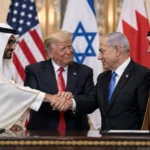
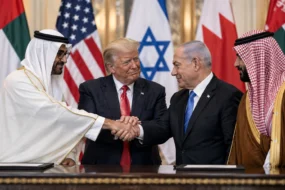
The Abraham Accords are the most powerful contemporary testimony to this logic. Whatever one thinks of Donald Trump’s character, temperament, or conduct in office, the diagnosis behind the Accords was correct and the prescription was transformative. For decades, the conventional wisdom held that Arab-Israeli normalization could only follow a resolution of the Palestinian question. Every previous peace framework began there, and every one stalled there. The Accords flipped the sequence entirely. Normalize first, on the basis of shared commercial interest, and let economic integration create constituencies for peace that outlast any single administration or political crisis. The UAE, Bahrain, Morocco, and Sudan signed on not because they suddenly embraced Zionism, but because the economic logic was overwhelming: technology partnerships, investment flows, tourism, energy cooperation, and access to innovation ecosystems that sectarian isolation had denied them for generations.
The durability of the Accords is the evidence. They have survived a change of administration, the October 7th attack, regional wars, and enormous turbulence. Not without strain: Bahrain recalled its ambassador and froze certain agreements after October 7th. But no signatory has severed ties. Trade between Israel and the UAE grew from $200 million in 2020 to over $3 billion by 2024. That is what prosperity-based frameworks do: they create material stakes in peace that make reversal costly. No other power could have brokered this. Russia has no economic model to offer. China offers loans and surveillance technology, not reconciliation. Only America had both the leverage and the commercial vision to tell the Middle East: your future is richer together than apart.
The Accords also demolish the narrative that America exists to perpetuate war and sell weapons. If that were true, the Accords would be the most self-defeating act in American foreign policy history. Why would the world’s largest arms supplier to the Gulf broker a peace architecture that makes war costlier for its biggest weapons customers? The Accords are the logical impossibility at the heart of every conspiracy theory about American warmongering.
The answer to American failure is not Chinese or Russian patronage. It is a more honest, more accountable, and more mutually beneficial relationship with the one power that has a structural interest in building prosperous partners rather than dependent clients. A prosperous, democratic, transparent Middle East is America’s ideal trading partner. It is Russia’s and China’s worst nightmare. That distinction is not incidental. It is the entire argument.
Conclusion
The Middle East stands at a crossroads. After decades of justified anger at American interventionism, the temptation to embrace its rivals is understandable. But the region must ask itself a hard question: which power’s success depends on your prosperity, and which power’s success depends on your subjugation?
The silence of an autocratic regime is not peace. It is the absence of the right to complain. The Middle East deserves better than a choice between a flawed democracy and a polished tyranny. But if that is the choice on offer, it would be wise to remember that only one of these systems contains the seeds of its own correction.
• • •
Arif Hussain Theruvath is a Clinical Research Associate and co-founder of Ex-Muslims of Kerala. He writes on secularism, geopolitics, and civil liberties.









No Comments