



An audit of maps, headlines, and surnames, with no scripture, no charters, and no wars required
By Arif Hussain Theruvath
On Sunday, May 16, 1948, the front page of The New York Times carried this headline: “Arab Armies Invade Palestine.” The Boston Evening Globe ran “Arabs Invade Palestine.” The Raleigh Times: “Palestine Invaded by Arabs.”
Read those headlines with today’s vocabulary and they are gibberish. If Arabs are the Palestinians, how do Arabs invade Palestine? Does France invade the French? The headlines only make sense if, in 1948, the word “Palestine” and the word “Arab” pointed at two different things. They did. And tracing exactly what each word pointed at, and when, and who changed it, and why, dismantles the anti-Zionist narrative more cleanly than any argument about religion, terrorism, or war ever could.
This essay deliberately uses none of the usual ammunition. No Torah. No archaeology. No Hamas charter. No October 7, no Nakba debates, no casualty arithmetic. Only names, dates, and documents, most of them written by the British Empire, the League of Nations, Arab leaders themselves, and newspapers nobody accuses of Zionism. Call it a narrative audit. The anti-Zionist story has a load-bearing premise: that an ancient nation called Palestine, inhabited by a people called Palestinians, was colonized and displaced by foreign Jews. Every name in the historical record testifies against that premise. The names are the receipts.
The premise of this essay, stated once and carried through every section, is this: the anti-Zionist narrative requires an ancient Palestinian nation displaced by foreign Jewish colonizers, and the documentary record of names shows that premise is false in both directions. The Jews were called Palestinians; the Arabs refused the label until it became strategically useful. This is an audit of a narrative, not an erasure of a people. Several million human beings exist today, identify as Palestinians, and have every human right that anyone has. None of that is in question. What is in question is a story, and the story claims antiquity, indigeneity, and displacement by foreigners. Every exhibit that follows tests that story against the one kind of evidence nobody can retroactively edit: what things were actually called, by whom, and when.
—
Part One: Where the name “Palestine” comes from
The land had a name, and the name was Judea. That is not a Zionist talking point; it is Roman administrative record. The province the Romans governed, taxed, and eventually
destroyed in two wars was Provincia Iudaea, the Latinization of Judah. Its people were Iudaei. Every European language still carries the fossil: Jude, Juif, Jood, Jew. The word “Jew” literally means “person from Judea.” A Jew in Jerusalem is, etymologically, the only person on earth who is named after the place he is standing on.
In 135 CE, after crushing the Bar Kokhba revolt, the emperor Hadrian did something emperors rarely bothered to do: he renamed the province as a punishment. Iudaea became Syria Palaestina, a name lifted from the Philistines, an Aegean sea people who had settled the southern coast over a millennium earlier and who had ceased to exist as a people around the sixth century BCE. The Philistines were not Arabs, not Semites, and not ancestors of anyone alive today. Hadrian chose the name precisely because it was the name of Judea’s extinct ancient enemy. The renaming was an act of erasure, and the Romans were explicit about it. Jerusalem became Aelia Capitolina, and Jews were barred from it.
So the first thing the audit establishes: “Palestine” enters history not as the name of a nation but as a colonial insult directed at the Jews. The name itself is a monument to the fact that the Jews were there first, and were there so stubbornly that an empire had to rename the map to spite them.
For the next eighteen centuries, “Palestine” survived as a loose geographic term in European and church usage, the way “Levant” or “Mesopotamia” did. It was never the name of a state, a province with those borders, or a people. Under four hundred years of Ottoman rule, the empire that actually governed the land, there was no administrative unit called Palestine at all. The land west of the Jordan was split between the Vilayet of Beirut and the independent Sanjak of Jerusalem; the land east of it belonged to the Vilayet of Syria, governed from Damascus. An Ottoman tax collector in 1890 could not have located “Palestine” in his own empire’s org chart. The people living there called themselves Arabs, Syrians, Muslims, Christians, or by their clan and town. Nobody filled in “Palestinian” on any Ottoman form, because the category did not exist.
—
Part Two: The British resurrect the name, and give most of it away
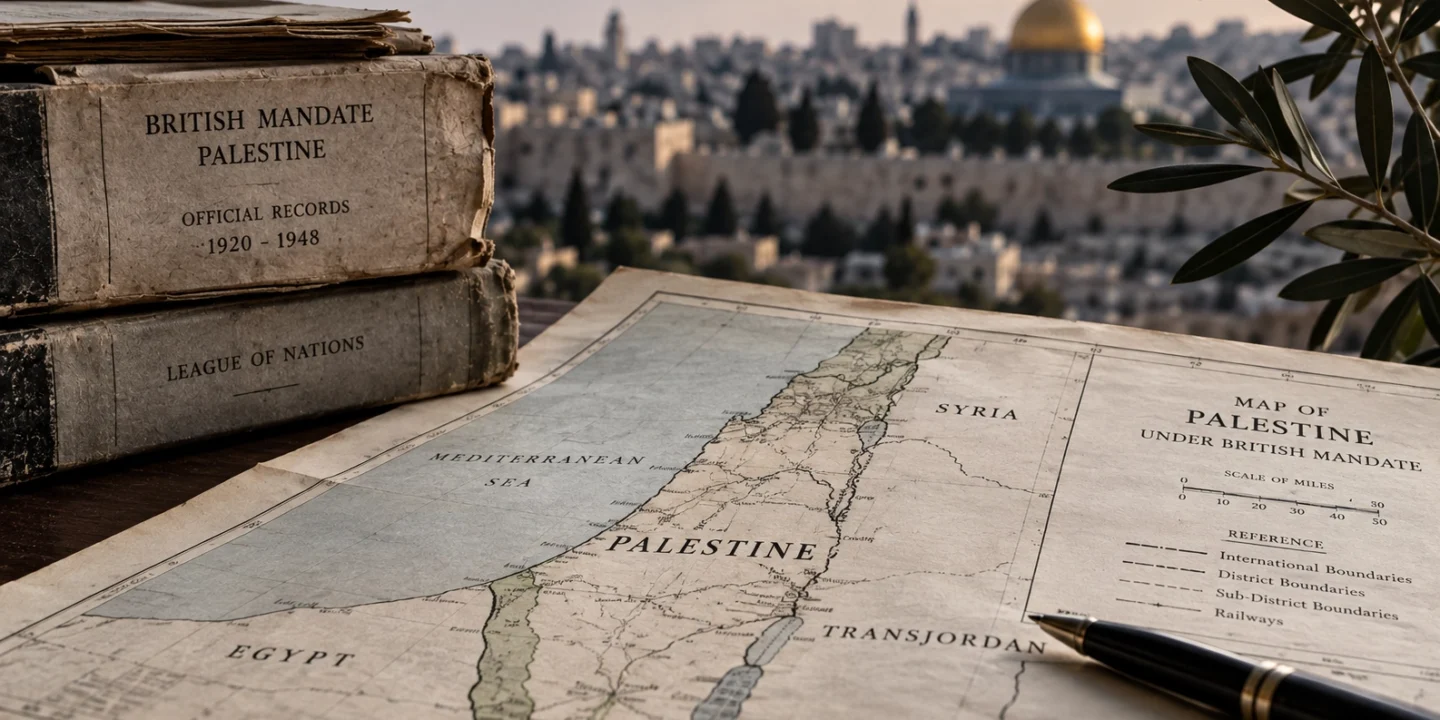
“Palestine” returns to the map in 1920, at the San Remo conference, when the League of Nations assigns Britain a mandate over the territory and revives the old Roman name for it. The Mandate for Palestine had one defining legal purpose, written into its preamble and articles: the establishment of a Jewish national home. That was not an incidental feature. It was the mandate’s job description, endorsed unanimously by the fifty-two member states of the League of Nations. The modern political entity called “Palestine” was created, on paper, as the vessel for Jewish national restoration. This is the single most inconvenient fact in the entire debate, and it is simply a matter of reading the founding document.
The original mandate territory spanned both banks of the Jordan River. The eastern bank, roughly 77 percent of the total area, was commonly described in the period’s discourse as eastern Palestine, with the coastal strip and hill country as western Palestine. Then came the carve-up, and here the timeline of names becomes forensic:
March 1921, the Cairo Conference. Winston Churchill, as Colonial Secretary, hands the territory east of the Jordan to the Hashemite emir Abdullah, a prince from the Hejaz, in today’s Saudi Arabia, as consolation for his family’s loss of Syria to the French. Abdullah was not from the land he received. He rode into it.
September 1922, the Transjordan Memorandum. Britain invokes Article 25 of the Mandate, and the League of Nations approves a formal instrument exempting all territory east of the Jordan from every clause concerning the Jewish national home. With one document, 77 percent of Mandate Palestine is closed to Jewish settlement and reserved for Arab rule.
May 1923. Britain recognizes the Emirate of Transjordan as an autonomous entity under Abdullah. The name means, literally, “across the Jordan,” defined entirely by its relation to the river, because the territory had no prior independent name to revert to.
May 25, 1946. Independence, as the Hashemite Kingdom of Transjordan.
1949. Having occupied and then annexed the hill country west of the river during the 1948 war, the kingdom renames itself the Hashemite Kingdom of Jordan, since “Transjordan” no longer described a state now sitting on both banks. The annexed territory needed a name too, and the Jordanians coined one: the West Bank. Until that moment, the world, including the United Nations in its own 1947 partition documents, had referred to the area by its historical names, Judea and Samaria. “West Bank” is younger than the State of Israel. It is a 1950 Jordanian administrative label, invented to dissolve the Jewish names of the Jewish heartland into riverbank geography.
Pause on what this timeline means. An Arab state was carved out of Mandate Palestine in 1922, comprising three quarters of it, handed to a monarch imported from Arabia, and it exists today with a seat at the UN. Jordan is, by birth certificate, the Arab state of Palestine. The “two-state solution” was implemented a century ago, and the Arab side received the larger share. Anyone who says the Jews took everything and the Arabs got nothing is arguing against a map the League of Nations published. The audit premise holds: the names on the map record an Arab state created from Palestine, not an Arab nation erased by it.
—
Part Three: When Arab nationalism called Zionism its sibling
Here lies the most suppressed document set in the entire debate, and it must be entered into evidence before we examine who carried the name “Palestinian,” because
it answers a prior question: how did the founders of Arab nationalism themselves classify Zionism? Not as colonialism. As a sibling.
On January 3, 1919, at the Paris Peace Conference, Emir Faisal bin Hussein signed a formal agreement with Chaim Weizmann, president of the Zionist Organization. Understand who Faisal was: son of the Sharif of Mecca, military commander of the Arab Revolt against the Ottomans, the man T. E. Lawrence rode beside, and the closest thing modern Arab nationalism has to a founding father. The agreement he signed welcomed the Balfour Declaration, endorsed large-scale Jewish immigration into Palestine, and envisioned the Arab state and the Jewish national home developing side by side in cordial cooperation, with Muslim holy places under Muslim control.
Two months later, on March 3, 1919, Faisal wrote to the American Zionist leader Felix Frankfurter. The letter expressed deep sympathy for the Zionist movement, called its proposals moderate and proper, and wished the Jews “a most hearty welcome home.” And then it delivered the sentence that detonates a century of later propaganda: Faisal described the Jewish movement as national and not imperialist, described his own Arab movement as national and not imperialist, and declared there was room in Syria for both, writing that neither could be a real success without the other.
Read that again. The founding generation of Arab nationalism, at the very table where the post-Ottoman world was being designed, classified Zionism as a national liberation movement parallel to its own, and explicitly ruled out the word that anti-Zionism would later build its entire edifice upon: imperialism. The “Zionism is settler colonialism” framework is not the original Arab position. It is a revision of the original Arab position. The founders saw two peoples emerging from Ottoman rule, each reclaiming nationhood. The revisionists needed one of those peoples recast as European invaders, and to do it they had to bury Faisal’s letters. That is why almost nobody has heard of them.
Two objections will arrive immediately, so let them be answered immediately. First: Faisal attached a handwritten caveat making the agreement conditional on the Arabs obtaining their independence, and when France seized Syria and expelled him in 1920, he treated the deal as lapsed. True, and irrelevant to the point. The caveat was a grievance against European powers for breaking promises about Syria. It was conditionality about implementation, not a retraction of the classification. Faisal never wrote that he had been wrong to call Zionism national rather than imperialist; he wrote that Britain and France had cheated the Arabs. The diagnosis of Zionism stands in his own hand.
Second: Faisal was a Hejazi prince, not a representative of Palestine’s Arabs. This objection self-destructs on contact with the record, because in 1919 Palestine’s Arab leadership insisted they were not a separate people needing separate representation.
The First Congress of Muslim-Christian Associations in Jerusalem, meeting that very year, declared the land an inseparable part of Arab Syria, the domain Faisal claimed and briefly ruled from Damascus. By their own proclamation, Faisal was their leader. One cannot argue that the local Arabs were southern Syrians under Faisal in 1919 and simultaneously that Faisal had no standing to speak on Palestine in 1919. Pick one; either choice damages the later narrative.
So who performed the reframing, and when? The sequence is documented. The first phase was local and clannish: Amin al-Husseini, appointed Grand Mufti of Jerusalem by the British in 1921, built his power by turning Zionism into a religious menace, fueling the riots of 1920 and 1929 with fabrications about al-Aqsa, while his clan fought the rival Nashashibis for primacy. The second phase industrialized it: the Muslim Brotherhood, founded by Hassan al-Banna in Egypt in 1928, adopted Palestine as the emotional engine of its pan-Islamic project, ran mass campaigns from the mid-1930s, and grafted imported European antisemitism, Protocols translations and all, onto jihad doctrine. The third phase fused it with the worst ideology in human history: the Mufti spent 1941 to 1945 in Berlin as Hitler’s guest, broadcasting Nazi propaganda in Arabic and recruiting for the SS, and Brotherhood volunteers marched into the 1948 war as the armed expression of the new theology, later codified in Sayyid Qutb’s tract “Our Struggle with the Jews.”
This is the genealogy of the “colonialism” charge. It was not the primary Arab understanding of Zionism; the primary understanding is in Faisal’s letters, and it said the opposite. The charge was cooked later, in the kitchens of clan ambition and Brotherhood politics, because divisive movements need a foreign devil, and a sibling national movement cannot serve as one. Anti-Zionism’s central accusation is therefore not merely wrong; it is a documented act of historical revision against the Arab record itself. The audit premise holds again: even the classification of Zionism testifies, in Arab handwriting, for the other side.
—
Part Four: Who the “Palestinians” were between 1920 and 1948
Now the second blade of the audit. During the Mandate, the territory was Palestine, so its residents were Palestinians, Jews and Arabs alike, as a citizenship category. But examine who actually embraced the name, and who recoiled from it.
The Jews wore it. The Jerusalem Post was founded in 1932 as The Palestine Post. The Israel Philharmonic was founded in 1936 as the Palestine Symphony Orchestra. Bank Leumi was the Anglo-Palestine Bank. The Jewish-owned airline was Palestine Airways. The Jewish volunteers who fought Hitler in British uniform were the Palestine Regiment and later the Jewish Brigade, and British soldiers called them, simply, Palestinians. The Mandate’s own currency and postage stamps carried the territory’s name in three
languages, and the Hebrew read “Palestina (E.Y.)”, the initials standing for Eretz Yisrael, the Land of Israel. The British colonial government itself printed, on every coin and stamp, the equation that Palestine is the Land of Israel.
The Arabs refused it. In 1937, the Arab nationalist leader Auni Bey Abdul Hadi told the Peel Commission: “There is no such country as Palestine. Palestine is a term the Zionists invented. There is no Palestine in the Bible. Our country was for centuries part of Syria.” In 1956, Ahmad Shukeiri, then a Saudi delegate and later the founding chairman of the PLO, told the UN Security Council that “Palestine is nothing but southern Syria.” The local Arab leadership of the Mandate period overwhelmingly identified as Arabs of southern Syria, and their political movements said so in their founding documents. The First Congress of Muslim-Christian Associations in 1919 declared the land an integral part of Arab Syria.
So when the wire services wrote their headlines on May 15, 1948, the vocabulary was precise. “Arab armies invade Palestine” meant exactly what it said: the armies of Egypt, Transjordan, Syria, Lebanon, and Iraq, foreign Arab states, crossed international lines into the territory called Palestine, where the people most associated with that name, the ones with Palestine on their banks, orchestras, newspapers, and regiments, were the Jews, who had declared their state the previous afternoon. The headline is not a paradox. It is a photograph of the moment’s reality. The paradox only appears when later generations retrofit a new meaning onto the word and then read it backwards into 1948. The audit premise holds a third time: the Jews wore the name, and the Arabs refused it, in the Arabs’ own sworn testimony.
—
Part Five: The great renaming, 1964 to 1977
When did the meaning flip? We can date it almost to the year, because the people who flipped it left a paper trail.
The Palestine Liberation Organization was founded in 1964, in Cairo, under the sponsorship of the Arab League. Note the date: sixteen years after Israel’s founding, and three years before Israel held an inch of the West Bank or Gaza. What, then, was the “Palestine” to be liberated in 1964? Only Israel itself. And in case anyone doubts it, the PLO’s original 1964 National Charter, Article 24, declared that the organization exercised no sovereignty over the West Bank or Gaza, which were then in Jordanian and Egyptian hands. The founding document of Palestinian nationalism explicitly renounced the only territories that today’s discourse calls “occupied Palestine,” because in 1964 Arab states held them, and nobody demanded a Palestinian state there. Article 24 was quietly deleted in the 1968 revision, after Israel had taken those territories in a defensive war. The claim followed the conflict; the conflict did not follow the claim.
The mask slipped fully in 1977, when Zuheir Mohsen, head of the PLO’s military department and leader of its as-Sa’iqa faction, told the Dutch newspaper Trouw that there are no real differences between Jordanians, Palestinians, Syrians, and Lebanese, that the Palestinian people is a political construct maintained “only for political and tactical reasons” as a weapon in the struggle against Israel, and that once that struggle succeeded, the distinction would be dissolved back into Arab unity. One can hardly accuse Mohsen of Zionist bias. He was describing his own project from the inside. The premise holds a fourth time: the label was adopted when it became strategically useful, on the adopters’ own admission, and not a day before.
—
Part Six: The surnames are migration receipts
A final layer of the audit sits in the phone book. Walk through the family names of prominent Palestinian society: al-Masri, “the Egyptian,” one of Nablus’s most powerful clans. Al-Hourani, from the Hauran plateau of southern Syria. Halabi, from Aleppo. Al-Hijazi and al-Yamani, from the Hejaz and Yemen in Arabia. Al-Mughrabi, from the Maghreb of North Africa. Al-Kurdi, the Kurd. Al-Turki, the Turk. Bushnak, the Bosniak. These names are not slurs; they are the standard Arab convention of naming families by their place of origin, and they honestly record waves of migration into the land during the Ottoman and Mandate periods, much of it drawn by the economic boom that Jewish development itself generated.
Let the point be precise, because it is often made crudely. Jews also migrated; Israeli phone books are full of Warsaw, Sana’a, Baghdad, and Casablanca. Migration is not an accusation. The difference is what each narrative claims. Zionism never pretended Jews did not migrate; return after exile is its entire premise, and the exile is documented by the Romans who caused it and named the land “Palaestina” to celebrate it. The anti-Zionist narrative, by contrast, claims a population rooted in the land from time immemorial, displaced by foreign arrivals. For that narrative, and only for that narrative, the surnames are a problem. A nation of immemorial natives does not carry the map of its own arrival in its names.
—
The verdict of the audit
Assemble the exhibits. The land’s original name, Judea, names the Jews. The name “Palestine” was coined by Rome as an instrument of anti-Jewish erasure. For eighteen centuries no state, province, or people bore the name. When it was revived in 1920, it was revived as the legal container for the Jewish national home, with “Land of Israel” printed on its money. Three quarters of it was immediately severed to create an Arab kingdom that still exists. The founding father of Arab nationalism himself classified
Zionism, in writing, as a national movement and not an imperialist one, and welcomed the Jews home; the “colonialism” charge was a later fabrication of clan ambition and Brotherhood theology, fused in Berlin with the century’s worst ideology. Through the entire Mandate, the Jews embraced the name Palestinian while Arab leaders rejected it as a Zionist invention and called themselves southern Syrians. The newspapers of 1948 reported Arabs invading Palestine because that is what happened. The word changed hands only in the 1960s, sixteen years after Israel’s birth, through an organization whose own charter disclaimed the West Bank and whose own commanders described the new identity as a tactical weapon. And the family names of the population record arrival from Egypt, Syria, Arabia, and beyond.
None of this required a verse of scripture or a single image from any war. The anti-Zionist narrative does not fall to Israeli archives or Jewish memory. It falls to its own vocabulary. Every word it uses, Palestine, Palestinian, West Bank, testifies for the other side the moment you check the word’s date of birth.
The honest conclusions are two, and they are compatible. First: a Palestinian Arab identity exists today, holds real meaning for those who carry it, and political questions about their future deserve serious answers, as all questions about living human beings do. Second: that identity is younger than the State of Israel, was forged against Israel rather than before it, and cannot sustain the narrative of an ancient nation displaced by foreign colonizers. Israel does not need to win the argument about names. It only needs the names to be read aloud, with their dates attached.
The defense rests. The exhibits were never ours. They were the map, the league, the emir’s letter, the charter, the headline, and the phone book.
—
Arif Hussain Theruvath is an ex-jihadi Muslim, CTO and Co-Host of Make Sense Media, a Clinical Research Associate, and a two-time Freethinker of the Year. He focuses on political analysis and counter-terrorism projects. Founder of Ex-Muslims of Kerala and President of Non-Religious Citizens (NRC), India.












No Comments