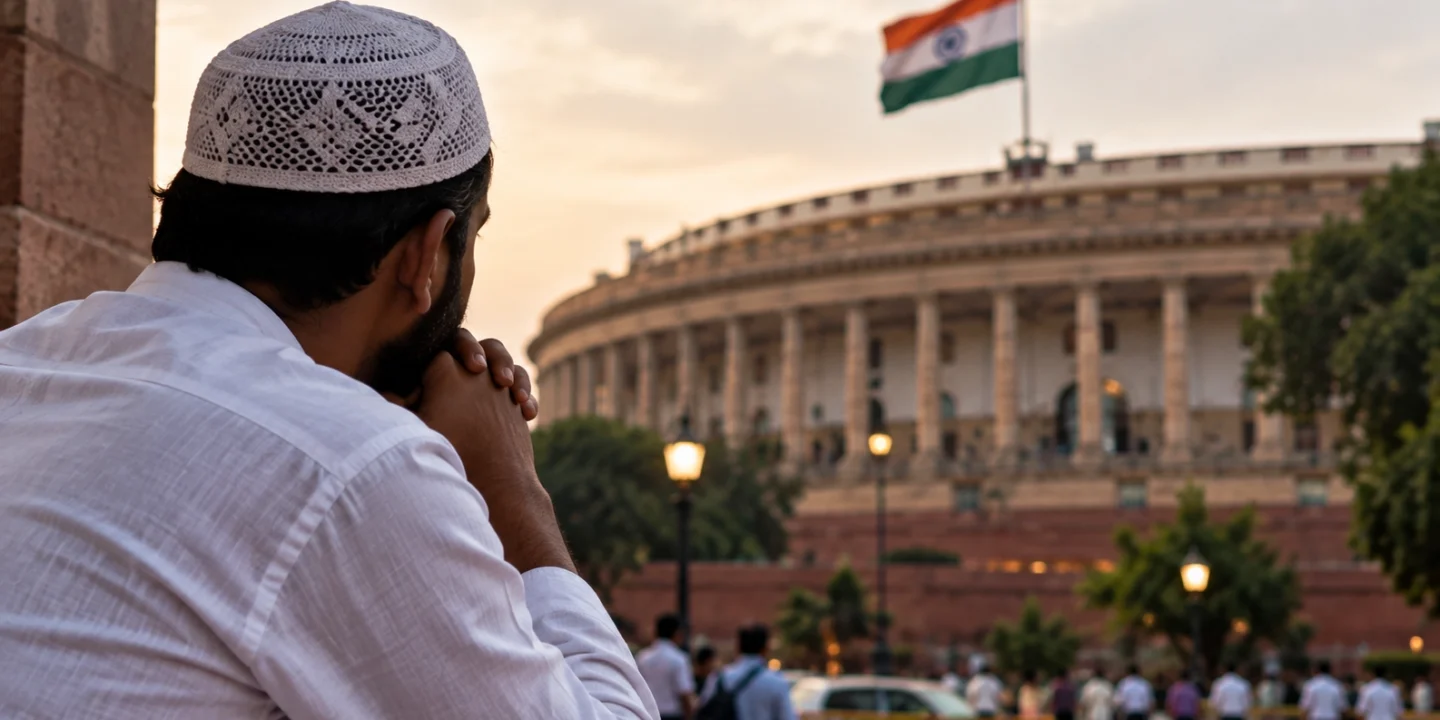




by an Indian Muslim by birth, ex-Muslim by belief
I. The Unsaid Word
In May 2026, on the day he was named Chief Minister of Kerala, V.D. Satheesan said something truer than Kerala politics usually permits. Defending the Indian Union Muslim League against a campaign to isolate it, he warned that if the League weakened, “communal forces will occupy that political space,” and that the League is the political party that prevents this from happening.
Credit him first, because almost nobody in his chair says it. The leader of a secular front, on his first day at the top, admitted in public that the Muslim League is a dam. Not a partner of convenience. Not a vote bank. A dam. Something is being held back, and the League is the wall holding it. That is the most honest thing anyone in Kerala’s secular establishment has said about the Muslim question in years.
Now finish his sentence, because he could not.
“Communal forces,” വർഗീയ ശക്തികൾ, is the great two-faced phrase of Kerala politics. It is built to point both ways at once, Hindutva on one flank and the other lot on the other, so the speaker can sound firm while naming no one. But watch what the sentence actually does. The space in question is Muslim political space, the space the League would vacate if it weakened. Hindutva does not move into vacated Muslim space. The BJP does not inherit Malappuram. Only politics that claims the Muslim can occupy the ground a Muslim party leaves behind. So in this one sentence, stripped of the euphemism, “communal forces” carries exactly one possible value. The SDPI. The successors of the banned Popular Front of India. The Jamaat-e-Islami Hind and its electoral fronts. Any new entrant of the same kind. Islamised politics. There is no second referent the sentence will bear.
I say Islamised politics, not political Islam, on purpose. Political Islam implies there is some other Islam sitting quietly beside it, a private spiritual core that the politics is merely an outgrowth of. Islamised politics names the direction of travel correctly. Politics is the open, shared, neutral ground, the way communist politics deformed a neutral economics, and this is what happens when the doctrine is poured into it. The reader who wants to know why I think the distinction is not cosmetic can follow it down. Here the term will do its own work.
So the Chief Minister of Kerala told the truth and could not say the word. That is not a personal failing. No one in Kerala can say it. The CPI(M) cannot say it. The Congress cannot say it. The League least of all. The whole establishment shares one reflex: name the dam, never name the flood. That gap, between what everyone knows and what anyone will say aloud, is not a footnote to the problem. It is the problem.
Read what his sentence assumes once it is said plainly. First, that Kerala Muslims cannot do what every other community does, spread themselves across ordinary parties and lead normal political lives inside them, the way Christians and Ezhavas and Nairs do. They need a confessional vehicle or they have nothing. Second, that without that vehicle the pull of Muslim politics runs toward Islamised politics and not toward the secular mainstream. If Kerala Muslims were simply democrats who happened to be Muslim, the League’s collapse would scatter them into the Congress and the CPI(M), not into the SDPI. Satheesan’s fear only makes sense if the default direction, left unchecked, is the flood.
Here I have to split a word the whole debate keeps welded shut. “Muslim” is two things. Muslim by birth is an inheritance, a name on a form, a community you are read into whether you assent to anything or not. Muslim by belief is assent to the doctrine. The line is not drawn by me, and not by any cleric. It is drawn by the individual’s own assent, and the freedom to not assent is exactly what the bloc is built to deny. The people the dam acts on are the believers, the ones for whom assent creates the pendulum between Islamised politics and constitutional democracy. The by-birth millions who do not assent are not in the reservoir at all. They are downstream. They are among the people the flood would drown. The dam protects them too, and it protects them badly, because the dam is built and staffed by believers.
And the dam does not only hold the flood out. It fences the reservoir in. The by-birth Muslim who wants an Ambedkarite political life, who wants to walk out of the confessional vehicle into a general party, who wants reform, is held inside by his own community, and the League is one of the wardens, not only the SDPI. The man who tries to leave the bloc is called a traitor, a sellout, a Sanghi, by the same structure that claims to protect him. So the League is at once the wall against the flood outside and the fence around the reservoir within. Those are one structure seen from two sides.
I write this as a Muslim by birth and an ex-Muslim by belief, which is to say from the one vantage the welded word denies exists. The League may indeed be a dam. The question the rest of Kerala will not ask is what that says about the water, and whether a dam built out of the same material as the flood can hold.
That is the awkward bargain. The League is a religious party. The alternative to the League is worse.
II. Two Branches
The Indian Union Muslim League was founded on 10 March 1948 in Madras, the post-partition residue of the 1906 All India Muslim League. The original AIML was a colonial-era pressure group that hardened, between 1937 and 1947, into the vehicle for Pakistan. That is the bad lineage. There is a less remembered second one. In 1928, in Ismailia, Egypt, Hassan al-Banna founded the Muslim Brotherhood. The Brotherhood and the late-stage Muslim League were ideological cousins. Both answered colonial humiliation by proposing Islamised politics as the cure. Both treated Muslim identity as a single bloc with theological backing. The League pursued territorial separation. The Brotherhood pursued capture from within. Two branches of the same twentieth-century anxiety.
What happened after 1948 split the branches further. The Brotherhood went underground in Egypt, exported its cadres across the Arab world, generated Sayyid Qutb and his theology of takfir, and seeded movements from Hamas in Gaza to Ennahda in Tunisia. Its sister tradition, Maulana Maududi’s Jamaat-e-Islami founded in Lahore in 1941, split at Partition into Jamaat-e-Islami Pakistan and Jamaat-e-Islami Hind. The two trees are parallel, not parent and child, but share the same political theology and the same instinct to weld Muslim identity into one bloc. The League, in its Indian remnant, did something stranger than either. It chose parliamentary democracy. Not because its leaders were converts to Nehruvian secularism, but because they were Malabar businessmen, traders, landowners, professionals, and they could see what the Islamist model meant for commerce, for stability, for sons who needed to get into engineering college. The IUML became the only post-1947 Muslim party of significance that opted to work inside a constitutional democratic frame and held the line for seven decades. Whether it is still holding is what this essay is about.
III. Two Muslims
The split I drew in Section I is the hinge of everything that follows, so let me set it against the wider record before going further.
Three claims get conflated in this debate and have to be pried apart.
The first claim is that individual Muslims, in plural societies, function as democratic citizens. True. Tens of millions of examples across India, the UK, France, the US, Canada, Singapore. Not in dispute. This is the by-birth Muslim, and often the by-belief Muslim who keeps his faith private. He is not the problem. He is, more often, the target.
The second claim is that Muslim-majority polities can consolidate into liberal democracies. Empirically unsupported. Of fifty-seven OIC member states, in recent Freedom House assessments, not one is classified as Free. None. The best performers sit in Partly Free with heavy caveats: active blasphemy laws, legal and social hostility to apostasy, weak minority protection, personal-status codes that treat women as half-citizens. Indonesia, the case Western liberals reach for first, holds elections and runs shariah courts in Aceh, jails minorities under blasphemy law, and drifts year on year toward greater Islamist accommodation. Senegal’s electoral system survived a constitutional crisis in 2024 only barely, inside the political veto of the Sufi brotherhoods. Tunisia’s brief liberal opening closed under Saied. Turkey’s AKP began as the great hope of compatible-Islam-and-democracy and became the textbook case of backsliding through Islamist consolidation. Bangladesh collapsed in August 2024. The pattern across fifty-seven states is too consistent to be bad luck.
The third claim is that Islamised politics is compatible with democracy. False by design. It places revealed shariah above legislated law, and any system that does that is theocracy whether or not it holds elections.
Where Muslim-majority states have contained Islamised politics, they have done it by coercion, not by democratic culture. The Arab model, monarchies and generals crushing the Brotherhood from above. The Central Asian model, post-Soviet states inheriting hard secularism from the Soviet apparatus and keeping the boot on. The Chinese model, which I will not dignify. These are not democracies. They are quarantines.
The IUML sits in a fourth category none of the three claims describe. A Muslim party inside a non-Muslim-majority constitutional democracy, a coalition partner, distracted by panchayat contracts and Waqf board appointments. Globally there is no other case of significance. It is the only place the experiment of moderate Muslim mass-party politics under a secular constitution has run for seven decades without collapsing into Islamism or being shut down by an authoritarian. The thing we are debating whether to tolerate is the only successful instance of its kind on earth. That is why the stakes are not local.
IV. The Kashmir Mirage
The obvious counter-example is the Jammu and Kashmir National Conference. NC won 42 of 90 seats in the October 2024 J&K assembly elections, formed government with Congress, and Omar Abdullah returned as Chief Minister. Since then he has been visibly pragmatic with the centre, praising Modi at the Sonamarg tunnel inauguration in January 2025, building working relationships, dropping daily 370-restoration rhetoric for focused statehood demands. The BJP itself under-fielded in the Valley, contesting only 19 of 47 seats and none during the 2024 parliamentary elections. Some read this as accommodation, a tacit recognition of Kashmiri agency that let NC occupy the space.
Three things keep Kashmir from being a Kerala model.
First, NC is not structurally analogous to IUML. Its constitution does not restrict membership by religion. Its founding ideology under Sheikh Abdullah was Naya Kashmir, a secular-socialist programme. It has historically held Kashmiri Pandits. Its identity is regional and ethnic, anchored in Kashmiriyat, not Islam. IUML’s identity is religious by constitution and by membership rule. Comparing them is comparing a regional party to a confessional one.
Second, the Islamist space in Kashmir was not contained by NC’s electoral politics. It was contained by central coercion from August 2019. Jamaat-e-Islami Kashmir banned in 2019. Hurriyat leaders jailed, dead, or irrelevant. PSA, UAPA, NIA, ED used hard. Asset freezes. Mosque networks watched. Hizbul Mujahideen’s recruitment pipeline collapsed. The centre cleared the field by force, then held elections, and NC won the depopulated landscape. JIH could only contest through three independents in South Kashmir, and that was to bargain for the lifting of its ban, not from strength. That is the Central Asian model. Hard secular coercion from above clears the ground, a regional party then occupies it. The logic that runs Tashkent and Astana runs Srinagar today.
Third, the BJP’s Valley under-fielding was not magnanimity, it was arithmetic. The same election saw the party redraw constituencies to hand Jammu six new seats and Kashmir one, empower the LG to nominate five MLAs, back proxy outfits widely read as fronts, and time Engineer Rashid’s interim bail to split the anti-BJP vote. The BJP tried hard and lost. It contested few Valley seats because the post-370 legitimacy story was worth more than seats it would never win anyway. NC’s victory lets the BJP point and say: normalcy, elections, transition, 2019 vindicated. NC is the unintended beneficiary of a story the BJP needs to tell.
The party that actually tried the alignment-with-BJP route in Kashmir was the PDP, and Mehbooba Mufti’s arc is the whole warning in one career. Inside the 2014 coalition she praised Modi without restraint, calling him the only man who could pull Kashmir out of the quagmire. The alliance collapsed in 2018. She was jailed for fourteen months after the 370 abrogation, discarded the moment she had served her purpose, and now calls the same party what it is, accusing it of dividing the country on religious lines. Alignment bought her a praise phase and then destroyed her party. The Kashmir voter has already run the experiment of a Muslim party openly allying with the BJP and rejected it without mercy. NC’s 2024 win is partly a verdict on what happens to those who try.
Kerala has none of the Kashmir conditions. No central coercion clearing the Islamist field. PFI was banned as an organisation, not dissolved as a community of activists, and JIH operates legally through the Welfare Party. The Kerala state has to compete with these forces inside democratic norms, not on a cleared field. If IUML attempted overt BJP alignment tomorrow, its voters would be in the SDPI and the JIH fronts within one cycle. The PDP is the cautionary tale, not the model.
So why not run the Srinagar model everywhere? If coercion pacified the Valley, why leave Kerala to the awkward dam at all, why not clear the Islamist field across the country by force and be done with it?
Because Srinagar did not solve anything. It sat on it. This is the Mihna logic in modern dress, the same move the next section traces twelve centuries deep, a settlement imposed from above that buys silence and calls it peace. The caliph who ran the inquisition did not win the argument, he produced the backlash that buried his own school. The security state that locked down the Valley has not reconciled Kashmir, it has policed a resentment that waits for the lid to slip. Coercion never wins. It only delays, and it makes the eventual reckoning worse.
The national-scale version is suicide for the republic. To run the Srinagar model across two hundred million people you would need routine detention, mosque surveillance, and party bans as ordinary policy. That is not a democracy with a Kashmir exception. That is the end of the democracy the exception was carved out to protect. The Central Asian model is available only to states that have already stopped being democracies. The price of the lid is the country.
So the lid is not an alternative to the dam. It is a faster road to the flood. Every method with an actual track record either delays the problem or deepens it. Coercion delays. The dam holds and cracks. Partition deepened it into Pakistan. The one path that aims at draining the reservoir instead of sitting on it, separating the inherited name from the assented doctrine and building citizenship over identity, has never been tried at scale, and the reason is worth naming. It serves no one in power. The dam suits the League, the lid suits the security state, the border suited the Partitionists. The exit suits nobody with a stake in the bloc, which is exactly why it has never been built, and why the man who embodies it is treated as a threat by all of them at once. It is not the best proven solution. There are no proven solutions, only proven deferrals. It is the only one that aims at an end instead of a delay.
The Kashmir comparison gives us no model. It confirms the Kerala bind, and it tells us the way out is not more force.

V. The Dam
That is the buffer. Not the cosy fiction that Kerala Muslims are uniquely moderate by some special cultural grace. The buffer is institutional. A party with offices, a paper, a youth wing, a women’s wing, a panchayat-level cadre, and an incentive structure that makes its leaders care about road tenders and panchayat presidencies more than about the Caliphate. Boring politics is the feature, not the bug. Boring politics is what keeps the civilization-jihad model from finding purchase in the Muslim political imagination of South India.
Kerala without the buffer is the Marad beach, 2 May 2003. Eight Hindu fishermen killed by a Muslim mob in a coordinated assault, weapons cached in advance. The Justice Thomas P. Joseph commission found activists of both the NDF, the precursor to PFI, and the IUML actively involved in planning and execution, and named IUML local leaders P.P. Moideen Koya and Mayin Haji as party to the conspiracy or holding prior knowledge of it. The case is usually thrown at the League. It actually proves the buffer thesis inverted. Where the League was complicit, it was being eaten locally by the cadre that would later go full PFI. Where the League acts as the League, a party of contractors and businessmen, Marad does not happen. Where it lets itself be captured by JIH-trained or NDF-aligned hands, it does.
That is the danger, stated plainly. The League is too small, too coalition-dependent, too commercially distracted to impose anything on anyone. The risk is not that the League conquers Kerala. The risk is that it is eaten from inside, and that what walks out wearing its electoral skin is not what held the line for seventy years.

VI. The Crack
Internal capture is not a hypothetical. The playbook is Brotherhood doctrine straight from al-Banna: enter the moderate institution, do not break it, become indispensable to it, move the Overton window one committee meeting at a time. The mosque federations of France and Belgium were colonised this way over decades. Inside the IUML the warning signs are there for anyone willing to read them. Leaders who would not condemn the PFI by name when the ban came in 2022, retreating instead into balanced formulations. Public statements rehabilitating the political role of the JIH rather than calling it out. Acceptance of JIH electoral support in the 2026 Kerala campaign, with vote transfers from JIH-aligned pockets to IUML candidates. Positions on the Karnataka hijab case that ventriloquised JIH talking points almost word for word. The cordoning of moderate voices, women and reformists, called Sanghi the moment they question Personal Law Board orthodoxy. The slow trade of the League’s real ideology, Malabar mercantile pragmatism, for an imported clerical idiom that owes more to Qutb than to Mohammad Ismail Sahib.
The right watches this and concludes that all Muslim political organisation is jihad-adjacent and should be crushed. Wrong conclusion from a correct observation. The moderate party has to be defended from capture, and defending it is a national-interest project, not a Muslim one. India needs the IUML to stay the IUML, and to become considerably more than it currently is.

VII. The Immovable Whip
To understand why the capture keeps recurring no matter who runs the League, you have to stop treating it as a present-day scandal and see it as the tradition’s oldest reflex. The boundary of the faith has always been policed by force, and the only thing that changes across twelve centuries is whose hand holds the whip.
Start with the rationalists, because everyone expects them to be the heroes. In ninth-century Baghdad the Mu’tazila were the reason-first theologians, the men who argued the Quran was created rather than eternal and that human intellect could weigh revelation. When the Abbasid caliph al-Ma’mun made their doctrine state creed, they did not win the argument by argument. They built an inquisition, the Mihna, and forced scholars to recant under threat. Ahmad ibn Hanbal was imprisoned and flogged for refusing. The rationalists, holding state power and fearing the alternative, reached for the whip exactly as their enemies later would. Hold that thought against any moderate faction that tells you it only wants to lead the community for the community’s good.
Then the wheel turned. The Mu’tazila lost their state backing. Abu al-Hasan al-Ash’ari, himself a defector from their ranks, built a theology that turned their own rational tools to the defence of orthodoxy, and the synthesis he founded buried them. Within a few generations the Mu’tazila were not merely defeated in debate. They were written out, declared heretics, read clean out of the faith. The men who ran the inquisition became the cautionary tale told to justify the next one. Reason itself was demoted, made the servant of revelation and never again its judge. The door the Mu’tazila had pried open was not argued shut. It was policed shut.
Run the wheel forward and the pattern repeats with a new warden each time. The Sufis, who carried the inward and mystical reading of Islam, were tolerated, even celebrated, for centuries, until the puritan reaction came for them. Ibn Taymiyya in the fourteenth century supplied the doctrine, and the Wahhabi movement from the eighteenth industrialised it, declaring shrine-visiting and saint-veneration shirk and putting the sword behind the verdict. The Salafi current that descends from them now calls the Sufi a grave-worshipper the way the Ash’arite called the Mu’tazilite a heretic, and means the same thing by it: you are no longer one of us, and being outside is not safe.
Notice what is constant. Not the doctrine. The doctrines fought each other to the death. The constant is takfir, the act of declaring a fellow Muslim an unbeliever, and the constant is that disagreement gets settled by reclassifying the dissenter as outside the faith rather than by letting him argue and live. Rationalists did it to traditionalists, traditionalists did it to rationalists, puritans did it to mystics. The warden changes. The whip does not.
This is the machine, not a malfunction of it. And lest the diagnosis read as a claim that only Islam runs such a machine, it does not. Every totalising ideology manufactures the enemy it needs to hold the formation together. The difference is in the housekeeping. Communism kept it simple and ran a single permanent enemy, the capitalist, for the better part of a century. Islamised politics has never been so economical. It has always required an aggressor to close ranks against, and it has never once been short of candidates: the pagans of Mecca, then the Jews of Medina, then the Christians and the Byzantines, the Zoroastrian Persians, the Crusaders, the Hindu, the colonial West, the Zionist, the apostate, and now, in Kerala, the Sanghi. The named enemy rotates with the century. The need for an enemy is the fixed point. Inward, the warden changes and the whip stays. Outward, the enemy changes and the siege stays. They are the same machine facing two directions, and both exist to stop the individual from ever stepping out of the formation.
B.R. Ambedkar saw the mechanism in 1940, from outside the tradition and with no ex-Muslim’s axe to grind. In Pakistan or the Partition of India he noted that Indian Muslims carried the same social evils as Hindus, the subjugation of women, caste, child marriage, but that uniquely among them no reform movement could survive, because every reform impulse was, in his words, suppressed by the need to “close the ranks” and present a united front against the Hindu menace at any cost. He had the diagnosis exactly. The siege kills the reformer. Where Ambedkar and I part is the cure. He cut the line through the map, two nations, two states, so each could reform in peace. I cut it through the word. The fault line worth drawing is not between Hindu and Muslim territory. It runs between the born and the believing, between the inherited name and the assented doctrine. Free the first from the custody of the second, and you do not need a second partition to let reform breathe.
That is why the ex-Muslim is not a marginal figure in Indian politics but the central secularising one. The ex-Muslim is the living proof that the category can be exited, and the exit is precisely what the bloc is built to seal. He is the Mu’tazilite who walked out before the inquisition could convene, the man the whip is meant for. Protect him, and you are not indulging a fringe. You are demonstrating, in public, that there was a person underneath the politics all along.

VIII. The Overdue Reform
The buffer thesis earns the League tolerance. It does not earn the League a defence as it currently stands. Four reforms would carry the IUML from least-bad-option to actively-defensible-institution. The leadership has dodged all four for thirty years.
Rewrite the constitution. The clause restricting primary membership to Muslims and barring a non-Muslim from leading the party is the original sin. It is what makes every defence of the League collapse, in the end, into special pleading. A serious reform opens membership to any Indian who shares the platform, strikes the religious bar on leadership, and remakes the party from a confessional outfit into a secular force that takes Muslim community concerns seriously the way the Kerala Congress takes Christian concerns seriously, without limiting the membership card to one faith. Structural, not cosmetic. It loses some of the old guard. It wins the right to be taken seriously by every constitutional democrat in the country.
Name the enemy. The League has to say in public, by name, what it has spent decades refusing to say. That the Brotherhood and Maududi models are incompatible with Indian democracy. That the JIH’s hukumat-e-ilahi doctrine is not a private devotional matter but a political programme the League rejects. That the PFI ban was correct and the SDPI is not a coalition partner at any level, anywhere. That dual membership with JIH cadre structures disqualifies a man from IUML office.
This is not symmetric whataboutism against the League’s old habit of naming Hindutva. The asymmetry of precedent is empirical, and it is the whole point. Islamised politics has a living catalogue of what it builds wherever it organises unchecked. Pakistan since 1947. Iran since 1979. Afghanistan twice. Bangladesh in 2024. Mosque-federation capture in France and Belgium. Sharia councils and the grooming-gang cover-ups in England, where the very “do not hand the right any ammunition” reflex this essay attacks is what kept the police looking away. Hindutva, after more than a decade of central power, has produced lynchings, hijab bans, anti-conversion laws, bulldozer politics, and mosque-survey adventurism, all bad enough to oppose without flinching, and it has not produced a saffron theocratic state. The Islamist alternative has produced theocracy or social fracture nearly everywhere it has been left alone to do so. Naming that asymmetry is not a concession to the right. It is the test of which kind of Muslim party the IUML intends to be. The ambiguity is the capture vector. Naming the enemy is the entry fee for the role of moderate Muslim party in a constitutional democracy.
Stop policing the reservoir. This is where Section VII stops being history and becomes a demand. When the League calls its own reformers and women and ex-believers Sanghi for asking about Personal Law, about inheritance, about apostasy, about the political role of clerics, it is running the Ash’arite play on the Mu’tazila one more time, with a new warden and the same whip. The reformist Muslim, the ex-Muslim, the Muslim feminist, the scholar who reads the sources critically, these are not threats to the community’s political life. They are its immune system. A body that kills its own immune cells dies of the infection it was trying to suppress. The League has to let the reservoir drain toward citizenship instead of fencing it in.
Drop the reflexive defence of every Personal Law Board orthodoxy. The Muslim Personal Law Board is not the religious authority of Indian Muslims. It is a self-appointed clerical lobby with a consistent record against women, against reform, and against the constitutional integration of the people it claims to speak for. The League can hold space for genuine community concerns without taking dictation from Deobandi or Salafi-aligned scholars on every question of personal status. Selective engagement with reform is the move. Blanket defence of the status quo is surrender dressed as loyalty.
These four are the only real defence of the League as a defensible institution. Anything short of them is buffer maintenance, and buffer maintenance is a slowly degrading equilibrium with one terminal state.

IX. From the Gallery
The rest of Indian politics has to stop hedging too.
The Congress and the Left spent decades treating the PFI and the JIH as awkward relatives who are basically fine, and treating any criticism of them as Islamophobia. That has to end. The 2022 PFI ban was the right call and both fronts should say so without the throat-clearing. Recall that when the ban was coming, Kerala’s own secular leadership flinched: the Opposition leader of the day asked whether banning SIMI had achieved anything, and the CPI(M) state secretary argued that proscription only strengthens the proscribed. That is the exact “balanced formulation” reflex this essay has been tracking, performed at the top of the secular establishment. The JIH is the next conversation, not necessarily a ban, but a disclosure regime, a clear electoral firewall, and a hard rule that no UDF or LDF candidate takes JIH cadre support without consequence.
The BJP, for its part, has to stop using legitimate concern as cover for blanket Muslim demonisation, because every time it does it makes the buffer harder to hold and the capture easier to excuse. The story the BJP top tier tells about itself, Hindutva maturing into civic developmental nationalism, is real at the level of rhetoric. The Viksit Bharat framing, the infrastructure, the developmental pitch, all of that is happening. It is also running in parallel with the old majoritarian register, not in place of it. The IUML voter in Malappuram does not experience the Viksit Bharat reframe. He experiences the Karnataka hijab ban, the UP bulldozers, the lynching cases that never quite produce a conviction, the Sambhal mosque survey, the CAA-NRC architecture. His party’s opposition to the BJP is not blind. It is reading the same signals he reads. If the BJP wants moderate Muslim politics to meet its civic-national project halfway, it has to make that project real for Muslims on the ground. Until then the League cannot pivot even if it wanted to.
And the secularising engine has to be let run. Ex-Muslim voices, reformist voices, women’s voices, the dissenters inside the community, need the protection of the state, not merely its permission. The protection is not a personal favour to them. It is the public signal that the persecution comes from Islamised politics and not from the community. When the state shields an ex-Muslim from a fatwa, it is saying out loud that the ordinary Muslim is not the threat. When it shrugs and lets the dissenter die, as it did with Farooq, with Chekannur Maulavi, with too many others, it confirms the Hindutva story that every Muslim is the threat. Protecting the apostate is, against every lazy intuition, the most pro-Muslim policy the Indian state has available to it.
X. Verdict
The IUML can be the platform this country needs it to be. It is closer to being that platform than anything else India has, anything else any country has ever had. It is also one bad internal election away from becoming the precise opposite.
So: do not dissolve the League. Demand it grow up. Demand it strike the religious-membership clause from its constitution. Demand it name the JIH, the SDPI, and the Brotherhood-Maududi lineage as the enemies they are, not as rhetorical balance against Hindutva but as the existential threat their own global record has earned. Demand it stop running the inquisition on its own reformers. Demand it choose, in public and for the record, between the mercantile pragmatism that built it and the imported clerical theology that is eating it. Indian democracy will live or die on whether that choice gets made while there is still time to make it.
XI. The Second Test
No Muslim-majority polity has consolidated as a liberal democracy. No country has integrated Islamised politics into a constitutional democracy at scale and kept both. The first attempt to run that experiment inside undivided India ended in Pakistan. Millions displaced. Up to a million dead. A theocracy on the western flank that has since failed even at the lesser task of being a coherent state. That was the world’s first test of the question.
India is running the second test now. Around two hundred million Muslims inside a constitutional democracy that has held, more or less, for seven decades. The third-largest Muslim population on earth, woven in as voters, MPs, judges, soldiers, taxpayers, citizens. The IUML is the model institution of that test. If it holds, the second attempt holds. If it is captured, the second attempt joins the first in the failure column, and there is no third India to try again with.
If the second test fails, where does the next line get drawn? Kashmir was already redrawn by force in 2019. The southern Malabar coast where the League lives. The eastern frontier from Bengal to Assam. The western concentrations. Or the demographic interior of the north, where Uttar Pradesh alone holds more Muslims than Saudi Arabia holds people. A fracture does not have to look like 1947 to be a fracture. Political fracture, social fracture, cultural fracture, partial demographic fracture, each is its own kind of failure, and none of them needs a new border to be real.
This is the luxury India has that France and Belgium and Bangladesh and Tunisia and Egypt and Turkey never had. The only working version of this experiment anywhere on earth runs out of Panakkad and Calicut. Most of the world has never run it at scale, and the part of the world that tried mostly failed. They are watching India run it for the second time. We should not waste it. We should also stop pretending it will keep working without being fundamentally rebuilt, because the dam is real, and the dam is made of the same material as the flood.



No Comments