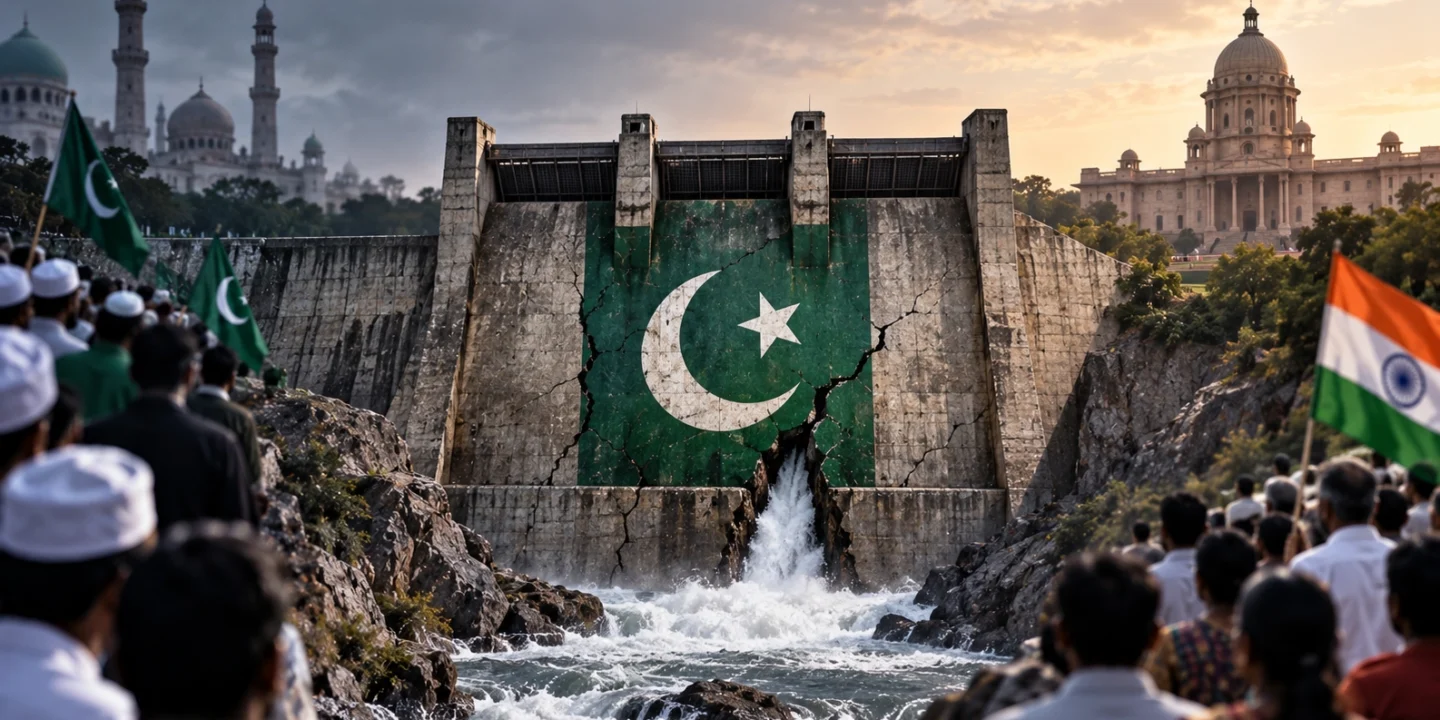




“The Muslim League is a Dam and That Is Exactly Why Indian Democracy Should Worry.”
Arif Hussain Theruvath, Ex-Muslim, Kerala
30 May 2026
This essay is an inquiry into the place of the Muslim League in Indian and Kerala politics. It is written by a man who is Muslim by birth and ex-Muslim by belief, speaking his mind plainly.
I. The Word That Was Never Spoken
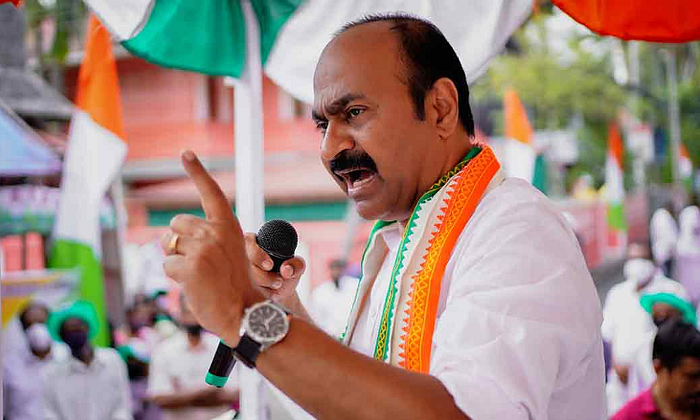
When V.D. Satheesan took charge as Chief Minister of Kerala in May 2026, he said something far more honest than what Kerala politics usually permits itself. Defending the Indian Union Muslim League against moves to isolate it, he offered a warning: if the League grows weak, that political space will be taken over by “communal forces.” It is because the League holds, he said, that this has not happened.
Give the man his due first. Almost no one in his position has had the nerve to say it that openly. The leader of a secular front has publicly admitted that the Muslim League is not merely a coalition partner or a vote bank. It is a dam. Something is being held back there, and the League is the wall holding it.
This may be the most truthful thing anyone in Kerala’s secular establishment has said about the Muslim question in a long time.
But the sentence he could not finish, let us finish for him.
“Communal forces” is a double-edged phrase in Kerala politics. It is built to point both ways at once: Hindutva on one side, Islamist forces on the other. That way a speaker can sound rough and tough without naming anyone. But look at what Satheesan’s sentence actually signals. The political space he is describing is Muslim political space. He is talking about the vacuum that opens up if the League weakens. Hindutva will never move into the Muslim political space the League vacates. The BJP is never going to become the inheritor of Malappuram.
The space a Muslim party abandons can only be filled by another political force that speaks in the name of Muslim politics. Strip away the careful vocabulary and “communal forces” here means one thing only: the successors of the banned Popular Front of India (PFI), the SDPI, Jamaat-e-Islami Hind, its political fronts, or some similar formation yet to take shape.
In other words, Islamized politics.
Yes, I use that term deliberately. The oft-used term “Political Islam” can leave the impression that beyond it there exists a separate, peaceful Islam, while politics is treated as only an unfortunate outgrowth. “Islamized politics” names the actual process precisely: the conversion of shared spaces of citizenship into the boundary markers of religious doctrine.
So, the Chief Minister of Kerala told the truth and still could not say the word. That is not his personal failure. It is the shared disease of Indian, Kerala, and global politics. The CPI(M) cannot say it, the Congress cannot say it, and above all the League cannot say it. Every political leadership here shares one response: name the dam but never name the flood.
This silence is not a footnote to the problem. It is the problem.
Satheesan’s sentence underlines a reality no one likes to admit. It assumes that if the League weakens, a large share of Muslim political energy will not flow naturally into ordinary secular parties. It will move instead toward a harder, more religiously centered politics. If Kerala’s Muslims were simply democrats who happened to be Muslim, then the collapse of the League would scatter them naturally into the Congress, the CPI(M), and other common platforms. The fear inside Satheesan’s words is that this natural flow cannot be guaranteed, and that what cannot be absorbed will drain into Islamized politics.
This is where Kerala has to confront a distinction it has so far refused to make.
“Muslim” is not a single layer. It holds at least two:
· Muslim by birth: individuals who carry the name, the family history, the social position, and the religion column on a form, simply because they were born into a particular community.
· Muslim by belief: individuals who accept the religious laws and doctrines fully or in part, conform to them, and argue for them.
It is not I who draw these lines, nor any cleric. The line is drawn by individuals themselves, by their own choice. The political aim of confessional bloc politics is precisely to deny individuals the freedom to make that choice.
The millions who are Muslim by birth but do not subscribe to religious rigidity are not at the bottom of this reservoir. They are downstream. If a flood comes tomorrow, they are the people most likely to drown first. When trouble arrives, they are victims of it, even though they had no hand in causing it.
This dam may protect them too, but not very effectively. Because the dam is built and controlled by the second group, the believers who take religion seriously, the people for whom Waqf and triple talaq are the live issues.
And this dam does more than hold back the flood from outside. It also fences in the reservoir so the water inside cannot escape. A Muslim by birth who wants an Ambedkarite political life, who wants to leave the confessional bloc and work in a common party, or who reaches for reform, is held captive by his own community. The League is not innocent here. The same system meets anyone trying to climb out of this vote bank by calling him a traitor, a sellout, a “Sanghi.”
In short, the League is both the wall that holds back the flood from outside and the fence that locks in the reservoir within.
This is the awkward bargain we are caught in.
The League may be a dam. But the question Indian democracy must ask is this: what does it tell us about the water being held back? How long can a dam built from the very same material as the flood hold against it?
The Muslim League is a religious party. The alternatives that could replace it may well be worse. That is exactly why this question matters so much.
II. The Exception
After the Partition of India, as the Indian remnant of the political tradition that produced Pakistan, the Indian Union Muslim League was founded in Madras on 10 March 1948. We cannot wave away that uncomfortable lineage so easily.
But history did not stop there.
The League did something its critics are reluctant to admit, and it matters greatly: it chose the path of parliamentary democracy. It worked from within the framework of the Indian Constitution. It became a coalition partner, a negotiator, a development partner in local bodies and panchayats. It focused not only on protecting religious identity but on roads, contracts, education boards, scholarships, community institutions. Put another way, its politics became calm and ordinary. It stays so under the Satheesan government.
That calm is not a weakness. It is the League’s single greatest feature.
It is exactly this kind of mundane political work that keeps the popular imagination from drifting into the revolutionary politics that poisons all civil exchange. A party that worries about road tenders, school managements, professional colleges, constituency development, and survival inside a coalition can never be a revolutionary Islamist movement. Its leaders may speak the language of community and religion, but their interests are worldly and tied to commerce. That is decisive.
The IUML is proof of how religious politics can be tamed through constitutional democracy, commerce, coalition discipline, and local accountability.
That is no small achievement.
Look at it globally. There are not many Muslim political models that have worked successfully for decades inside a secular constitutional framework without collapsing into Islamism or being crushed by authoritarian power. Most Muslim-majority countries still struggle to build stable liberal democracies. In many places Islamized politics has either captured the state, provoked military repression, or pushed democracy into permanent crisis.
The League belongs to a rare other category: a Muslim party operating inside a constitutional democracy with a non-Muslim majority, dependent on coalition politics, disciplined by elections, forced to negotiate with people outside its own community.
That is why the League cannot be dismissed as a mere communal outfit. And it is also why it cannot be defended blindly.
So, the claim that “the League is a religious party, therefore it is no different from Islamist organizations” is wrong.
Likewise, the claim that “the League is moderate, therefore there is no problem at all” is equally wrong.
The real argument is more complicated than both: the League has genuinely worked as a democratic buffer against several bad political currents, and yet the same religious structure that lets it hold the Muslim political space also raises the odds that it will be captured from within.
The League is a defense. The League is also a serious danger.
III. Kashmir Is Not the Kerala Model
The example usually held up in contrast is Jammu and Kashmir. In the 2024 assembly elections the National Conference won, and Omar Abdullah returned as Chief Minister. Some read this as proof that the Muslim political space can be folded into local democratic politics without a religious party like the IUML.
But Kashmir is never Kerala.
· First, the National Conference is not structurally equivalent to the League. The NC is a regional party rooted in Kashmiri identity, in Kashmiriyat, not a religious party confined to Muslim membership. Its ideology since Sheikh Abdullah’s time rested on regional nationalism and secular socialist politics. Historically it had non-Muslim members and leaders. It speaks for Kashmir, not for Islam. The IUML speaks for Muslim political representation. That difference is fundamental.
· Second, what held Kashmir’s Islamist groups in check was not the NC’s democratic moderation alone. It was also the heavy repression the central government applied there after August 2019. Jamaat-e-Islami Kashmir was banned, separatist networks were broken, Hurriyat leaders were jailed or rendered irrelevant. Through security laws, investigative agencies, surveillance, asset seizures, and harsh administrative measures, the political field was completely cleared. Only after that did electoral politics resume.
This is not the Kerala model. This is the hard-security model. It bears a marginal resemblance to the Central Asian methods of Tashkent or Astana more than anything from Malabar: a secular order imposed forcibly from the top before electoral politics is permitted.
None of these conditions exist in Kerala. The PFI may be banned, but its social networks and sympathy did not wash into the Arabian Sea out of fear of a government notification. Jamaat-e-Islami Hind still operates legally through its cultural, media, student, and political fronts. The SDPI keeps trying to find its political footing. Kerala’s governing institutions have to compete with these currents from within democratic norms, not by clearing the ground through force.
That is why trying to “solve” Kerala’s problems on the Kashmir template is dangerous.
Adopting such an approach at the national level would amount to the suicide of our republic. To impose the Srinagar model on some two hundred million people, you would have to make detentions, mosque surveillance, party bans, and ideological policing the ordinary policies of the state. That is not democracy defending itself. It is democracy surrendering itself through an administrative memo.
Force may hold Islamized politics back temporarily, but it cannot defeat it. A lid is never a cure for the disease. It only presses the pressure inward and then mistakes that silence for stability.
At the national level, this lid is no substitute for the dam. It only speeds the way to the flood.
So, Kashmir offers Kerala no model at all. It only complicates the crisis further. Suppress the Muslim political space and you wreck democracy. Surrender it to hard Islamist forces and that too wrecks democracy. Leave it to the League as it is, without reform, and you only postpone the crisis.
The only serious path left is this: drain the reservoir.
Separate inherited Muslim identity from a politics built on religious doctrine. Protect the individual who is Muslim by birth from the custody of believers. Build citizenship above the religious identities of the vote bank.
This path serves no one who profits from the vote bank. That is exactly why it has never been seriously tried at scale.
IV. The Dam and the Crack
The League’s value lies in its institutional weight. It has offices, newspapers, youth wings, women’s wings, local committees, financial networks, educational institutions, ties with the clergy. Listed out, this sounds tedious. But it is exactly such tedious institutions that stop dangerous ideologies from swelling into mass movements.
The League’s ordinary political appetites matter here. It wants ministries, seats, influence in education, welfare schemes, Waqf boards, and local government. It wants enough respectability to sit beside the Congress and negotiate with the state. All of this keeps it inside constitutional politics.
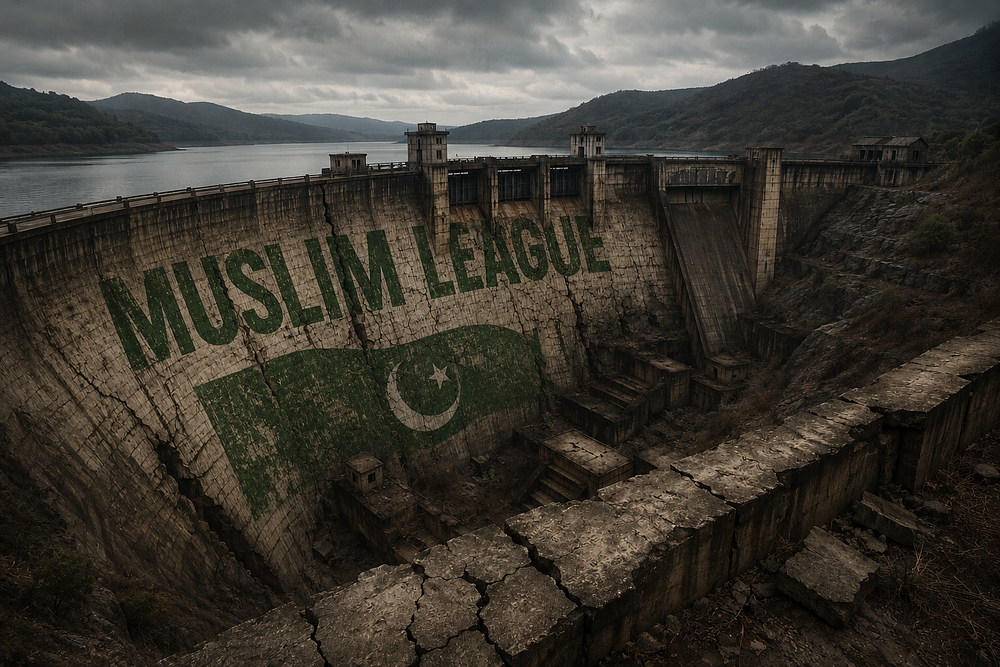
This is the dam.
But the crack in it is internal capture.
Get Arif Hussain Theruvath Mohammed’s stories in your inbox
Join Medium for free to get updates from this writer.Subscribe
Remember me for faster sign in
The danger here is not that the Muslim League will conquer Kerala. The League is too small to grow on its own and too dependent on coalitions for that. It is a pragmatic, commerce-minded political party. The real danger is that this party could be eaten from within by harder ideologues. The new form that emerges wearing the skin of the old League, the League that guarded this border for some seventy years, may not be the old League at all.
The symptoms are already visible:
· The crack widens when League leaders hesitate to condemn the PFI by name.
· The crack widens when Jamaat-e-Islami Hind is treated as an ordinary democratic pressure group rather than a movement with theocratic political aims unfit for a secular democratic republic.
· The crack widens when electoral support from Jamaat-leaning quarters is accepted without any open political price tag.
· The crack widens when positions on the hijab, personal law, blasphemy, apostasy, or clerical supremacy align more with Jamaat-style arguments than with constitutional principles.
· The crack widens when Muslim women, reformers, rationalists, or ex-Muslims who question orthodoxy are branded “Sanghi” or as “Outcasts.”
This is not an argument for suppressing Muslim political organizations. That is the right-wing position, which approaches the real problem the wrong way.
The right conclusion is different: a moderate party must be protected from capture by extreme ideologies. That is not a concern for Muslims alone. It is the country’s common interest. India needs the Muslim League to remain the League, and it needs the League to become far better than it is today.
V. The Old Whip
Clerics policing the boundaries of Muslim identity did not begin yesterday. It is one of the oldest reflexes in Islamic political history.
In ninth-century Baghdad, the Mu’tazilites, known as the rationalist theologians, won the backing of the Abbasid Caliph al-Ma’mun. They argued that the Quran was created and not eternal, and that reason held primacy in matters of theology. But once they held power, they did not try to win by argument alone. They built an inquisition called the Mihna and forced scholars to accept their positions. For refusing, Ahmad ibn Hanbal was imprisoned and flogged.
Then time turned. The Mu’tazilites lost power. Orthodox factions rose. The rationalists of Islam were declared heretics. Over time they were pushed even out of the memory of Islamic history.
The doctrines may have changed here, but the machinery of repression did not.
Later hardline orthodox movements turned on the Sufis, declaring shrine visits and urs festivals “shirk.” Reformers, Sufis, philosophers, modernists, women, apostates, dissenters, all of them have faced the same boundary-enforcing repression. The wardens may have changed, but the whip has not.
This is relevant because modern Islamized politics follows the very same method. It does not merely disagree with dissenters. It expels them from the community. The reformer becomes a traitor, the feminist a Western agent, the ex-Muslim an enemy, the Muslim who questions clerical supremacy a Sanghi. Chekannur is still being born today.
The words may change with the centuries, but the purpose is the same.
In his 1940 book Pakistan or the Partition of India, B.R. Ambedkar pointed to this phenomenon precisely. He described how internal reform within Muslim society is continually crushed because the community is forced to stand united against an alien Hindu majority. He saw how this siege identity kills internal reform. And it is not accidental either. The pagans of Mecca, the Jews and Christians of Medina, the Zoroastrians of Persia, and later the West, the Zionists, the Sanghis, all take their place as the enemy. And so, the stagnation of reform persists.
But Ambedkar and I part ways on the remedy.
He drew his line on the ground: two nations, two states. But the better line is not on the map. It runs inside the word “Muslim” itself.
To be Muslim by birth and to be Muslim by belief are not the same thing. An inherited name must never become an imposed doctrine. Community does not mean the clergy. The individual is not a vote bank.
This is where ex-Muslims become relevant. Ex-Muslims are not a marginal group in Indian politics. They stand at the center of any honest debate about secularism. They are the living proof that individuals can walk out of a religious identity. And blocking that exit is the central aim of religiously centered politics. That is exactly why they must be protected.
Protecting ex-Muslims is not a favor granted to a small group. It is proof that beneath those identities there was always a free citizen. That is why the League’s treatment of reformers, women, and ex-Muslims is not a minor issue. It is the single greatest test of what the League actually is.
Because a dam that imprisons the people below it can never claim to be protecting them.
VI. The Reforms the League Cannot Avoid
The League is often accepted as a defensive wall. But no one can give it unconditional support on that basis. If the League wants to survive as a democratic institution, four reforms are non-negotiable:
1. Rewrite the constitution
The League’s greatest flaw is the constitutional provision that restricts primary membership to Muslims and bars non-Muslims from its leadership. This undermines every defense ever offered for the League.
A genuine reform would open membership to any Indian citizen who accepts the party’s principles. The religious restrictions on leadership must go. While taking the Muslim community’s concerns seriously, the League must remake itself as a secular democratic party.
This is not impossible. The Kerala Congress represents Christian social interests to a significant extent without restricting its membership to Christians alone. Caste-based and regional parties have over time grown into broader democratic platforms. The League should follow the same path. Keep the community’s concerns, remove the religious fences. This one move would completely transform the moral standing of the Muslim League in Indian democracy.
2. Name the enemy
What the League has shied away from saying for several decades now needs to be said plainly: the Brotherhood-Maududi model is not compatible with Indian constitutional democracy. Jamaat-e-Islami Hind’s old doctrine of divine sovereignty (iqamat-e-deen) is not mere personal spirituality. It is a political vision. The League must reject it without the slightest hesitation.
· The League must say openly that the PFI ban was justified.
· It must make clear that the SDPI is not its coalition partner at any level.
· It must declare that it will not tolerate simultaneous dual membership in Jamaat-leaning organizations and in League leadership.
This is not merely a defensive argument. It does not mean the League should stop opposing Hindutva. Wherever constitutional principles are violated, Hindutva must be opposed with full force: lynchings, bulldozer politics, anti-conversion laws, mosque survey controversies, discriminatory policing, the humiliation of minorities, all of it must be resisted strongly. But naming Hindutva must never become an escape from naming Islamized politics. It is this ambiguity that opens the door for extremist forces to enter the League.
A Muslim party that cannot name Islamist politics can never be called moderate. It is only standing by, waiting to be taken over. That is hypocrisy and pretense.
3. End the guard over the reservoir
The League must stop seeing Muslim reformers as enemies. The Muslim feminist who questions personal law is no traitor. The ex-Muslim who asks for safety is no Sanghi. The scholar who reads Islamic histories critically is not destroying the community. The young Muslim who wants to join ordinary politics without clerical permission is no deceiver.
None of these people are threats to the community’s democratic future. They are its immune system. A body that kills its own immune cells will collapse faster than any infection could manage. If the League wants to protect Muslims, it must first accept the reality that not everyone born Muslim wants to live in its political custody. It must let this reservoir flow toward free citizenship.
4. Stop taking orders from clerical lobbies
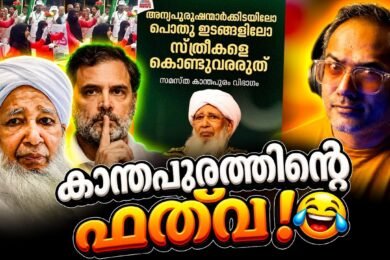
The All India Muslim Personal Law Board, and Samastha, are not the sovereign bodies of Indian and Kerala Muslims. They are self-appointed clerical pressure groups that have consistently opposed reform, especially women’s rights. The League can represent the community’s real needs without pawning its judgement to Deobandi, Salafi, or other hardline orthodox clerical interests. The League leadership must first recognize that it is not the clergy. It must first judge itself to be what it is: politicians.
Reforms should be supported where they are just. Religious freedom should be defended where it is endangered. The state should be opposed where it crosses its limits. But the reflex that treats Islam as doomed unless every orthodox claim is protected must end. Internal renewal must be supported. The League claims to stand for constitutional and secular politics. It must live up to that claim.
These four reforms are what would turn the League from a temporary defensive wall into a durable, genuinely democratic institution. Without them, it will remain a dam slowly developing cracks. And it will break. That is what the world’s examples remind us.
VII. What the Rest of India Must Do
None of this means the entire responsibility rests on the League alone.
The Congress and the Left must stop treating organizations like Jamaat-e-Islami and the SDPI as somewhat stubborn relatives who are perfectly harmless until the BJP complains. They are not harmless. Their long-term political goals are not compatible with liberal democracy.
That does not mean the answer to everything is a ban. Democracies should not reach for bans as easily as politicians reach for their hypocrisy. But clear disclosure, electoral firewalls, public criticism, and ideological clarity are essential. No candidate of the UDF or LDF should quietly buy the support of Islamist networks and then justify it by calling it “community outreach.” Call things by their real names. Politics becomes more transparent when voters are not treated as children.
The BJP has a large responsibility in this too, but it is often the most reluctant to even think along these lines. Concern about Islamized politics must never become a shield for general Muslim hatred. Every time the BJP or its ecosystem humiliates ordinary Muslims, it makes the League’s reforms harder and lends more force to the Islamists’ arguments. An ordinary League voter in Malappuram does not hear development speeches as mere advice. He sees the hijab bans, the bulldozers, the lynchings, the mosque surveys, and the CAA-NRC anxieties directly. His fear is not fake at all.
If the BJP wants the moderates and the Muslims by birth to enter a national citizenship rather than be captured by the identity siege, it has to convince them that this national citizenship is real: not through speeches, but by treating them differently from the hardliners and granting them their due dignity in police stations, courts, schools, housing, employment, and daily life.
The Indian state must encourage and nurture secular change within the Muslim community: it must protect ex-Muslims, reformers, women, feminists, rationalists, and critics of clerical supremacy. That protection is not a gift handed to them. It is a precise message that the real threat here comes not from all Muslims but from Islamized politics. When the state protects an ex-Muslim from fatwas or mob threats, it says this to ordinary Muslims: you are not prisoners of mere beliefs, you are free citizens. The problem is not you. The problem is the religion.
But when the state lets dissenters be threatened and attacked, it confirms the worst stories told by both sides. The Islamists say apostates deserve fear. The Hindutva camp says every Muslim is a threat. Protecting apostates, to put it without any hesitation, is one of the best pro-Muslim policies the Indian state can adopt. Give Muslims by birth the chance to choose their own belief and politics: Islamized politics or secular, democratic, constitutional politics.
VIII. The Verdict
The IUML can become the better platform India needs. Of all comparable organizations in India, the League is probably the closest to that standing already. For the past seven decades it has kept Muslim political representation inside electoral democracy, coalition discipline, and constitutional negotiation. That achievement deserves recognition.
But that recognition must never become blind worship.
One small wrong turn inside, and it will not take long for the League to become the exact opposite of what it has so far been praised for. So, the answer is not to break the League. It is to demand that it grow more democratic.
· Demand that it remove its religious membership restrictions.
· Demand that it open its leadership to all citizens.
· Demand that it say openly that Jamaat-e-Islami, the SDPI, and Maududist currents are threats to constitutional democracy.
· Demand that it stop portraying reformers and ex-Muslims as traitors.
· Demand that it choose between the pragmatic development politics that built it and the imported clerical language that is eating it.
The Muslim League is a dam. V. D. Satheesan was a hundred percent right. But no democracy can lock its citizens inside inherited religious fences forever. Our aim is not to break the dam overnight. It is to make the dam unnecessary.
That means opening up the League, opposing Islamized politics by name, protecting reformers and ex-Muslims, and letting Indian citizens who are Muslim by birth live as ordinary citizens without being dragged back into the custody of belief.
India’s second test is not how to control some two hundred million Muslims. That is entirely the wrong question. The real test is how to protect two hundred million citizens from being reduced to nothing more than Muslims.
The League can help India pass that test. It only has to show the wisdom to recognize the reservoir and the human beings beneath it. Best wishes. To the League, and to India.
Thank you.



No Comments