


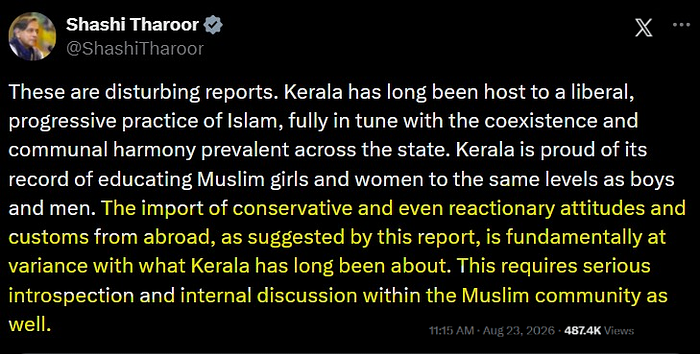
I welcome Shashi Tharoor’s willingness to speak openly about the findings now being discussed in Kerala, particularly the growing influence of religious conservatism within sections of Kerala’s Muslim community.
As an ex-Muslim who has been raising concerns about radicalization, Islamic Politics, and the steady normalization of hardline religious attitudes for years, I want to make one point clear: this is not a new warning.
Ex-Muslim circles, reformists, rationalists, and others who closely observe developments within Muslim communities have been sounding the alarm about these changes for years. No, decades. What Tharoor has done is not discover a new phenomenon. His intervention has brought an issue that was too often dismissed, ignored, or politically stigmatized into mainstream public discussion and given it a new sense of urgency.
That is why his intervention matters.
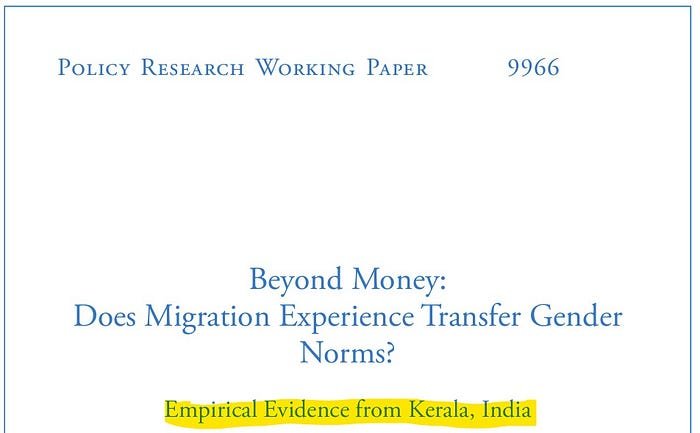
The immediate context is a 2022 World Bank Policy Research Working Paper titled Beyond Money: Does Migration Experience Transfer Gender Norms? Empirical Evidence from Kerala, India. The study examined whether migration to Saudi Arabia and other Gulf countries could transmit social attitudes back to Kerala and found significantly more conservative gender attitudes among migrants returning from Saudi Arabia.
This deserves discussion not because every Gulf returnee is conservative, and certainly not because Kerala Muslims should collectively be placed under suspicion. It deserves discussion because the phenomenon researchers describe as “social remittances” is real. People do not return from migration carrying only money. They can also return with cultural practices, political ideas, religious interpretations, attitudes toward women, and new notions of what constitutes proper social behavior.
For decades, Kerala celebrated the Gulf connection largely through remittances and economic mobility. But along with the perfume, Kopiko, Bounty chocolates, and consumer goods that came home in expatriates’ boxes, ideas traveled too. Some of those ideas were modern and liberating. Others represented considerably more puritanical forms of religion than the religious culture Kerala had historically known.
However, I think it would be a serious mistake to reduce this discussion simply to “Salafism.”
Kerala’s Muslim religious landscape is far more complicated. Salafi or Mujahid organizations have certainly been influential in promoting more scripturalist and puritanical interpretations of Islam, and exposure to the Gulf has strengthened some of these tendencies. But blaming Salafis alone gives every other conservative faction a convenient escape route.
The larger issue is the increasing legitimacy being given to puritanical interpretations of Islam itself.
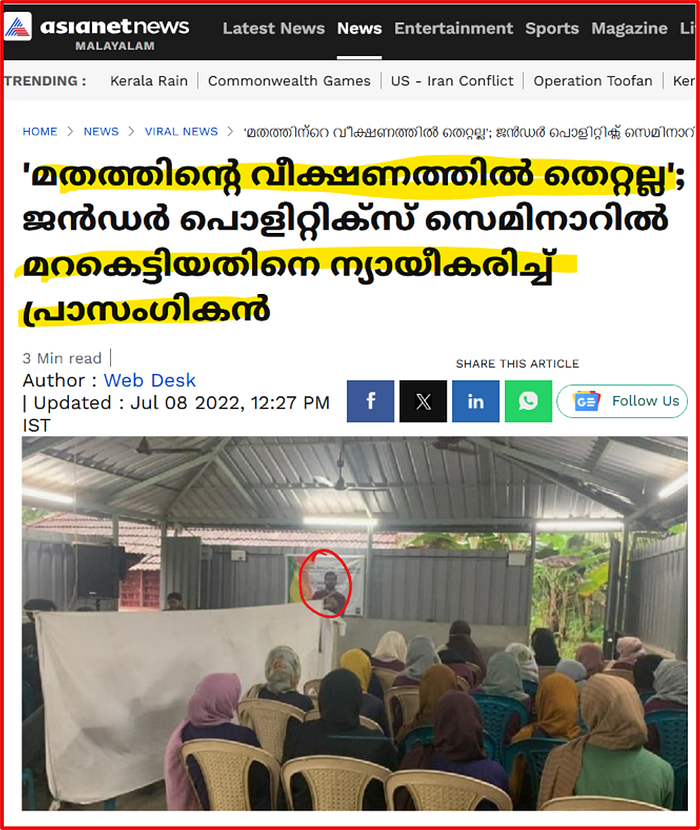
We can see conservative positions on gender, social interaction, dress, religious identity, and cultural participation even among organizations that present themselves as representatives of Kerala’s indigenous or traditional Sunni Islam. Samastha, for example, is certainly not a Salafi organization. Yet controversies involving gender segregation and restrictions on women have emerged from within that ecosystem as well.
That distinction matters enormously.
If a girl is excluded from a stage, women are segregated at public functions, or rigid separation between men and women is defended on religious grounds, the practice does not suddenly become progressive merely because the organization responsible is not Salafi.
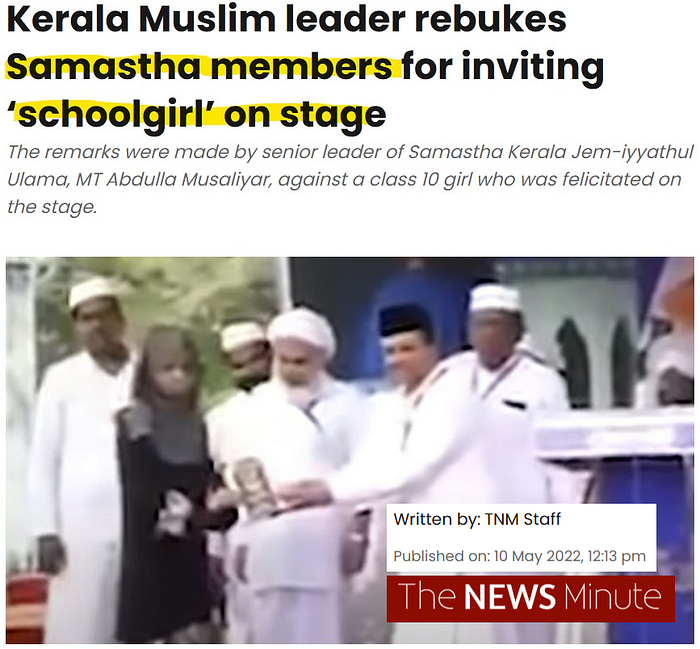
The underlying religious doctrine and the social consequences it produces deserve examination.
When the Taliban segregates girls and women, the ideological element is immediately visible because we are witnessing its most extreme manifestation. But the underlying principle of religiously mandated gender segregation does not begin with the Taliban.
Much milder versions can become normalized in ordinary community life, including weddings, religious gatherings, educational institutions, and public events.
That is precisely how social conservatism expands. It rarely arrives through one dramatic announcement. It becomes normalized through a hundred smaller restrictions until practices that once appeared alien begin to look ordinary.
The recent controversies surrounding Muslim participation in Onam celebrations should therefore concern us as well. Kerala has transformed Onam into something much larger than a narrowly religious ritual. It has become a shared cultural celebration across communities.
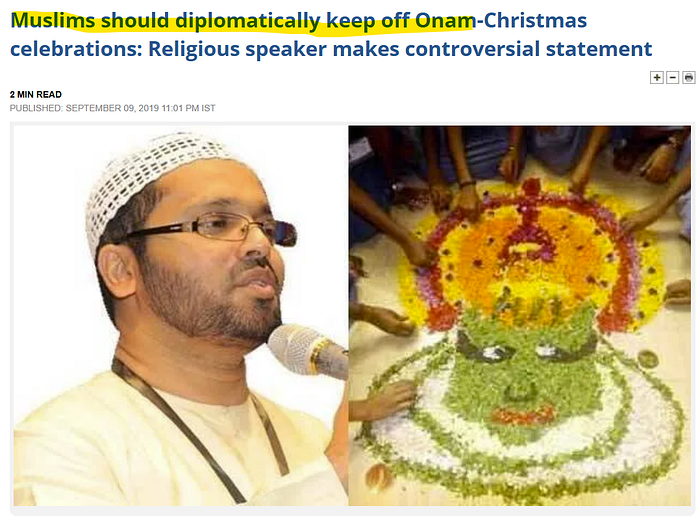
When Muslim children are told that participating in such celebrations violates Islam or constitutes shirk, we should not casually dismiss it as an isolated theological disagreement. It is part of a wider argument over whether religious identity should separate young Muslims from Kerala’s shared cultural life.
The encouraging part is that many younger Muslims themselves are rejecting this thinking. Kerala’s Gen Z Muslims are often far less willing to allow clerics to dictate whom they can celebrate with, which cultural spaces they can enter, or how they should interact with their friends.
That resistance should be welcomed.
But the fact that young people are pushing back does not mean the ideological pressure is imaginary. On the contrary, it demonstrates that a contest over social values is already taking place within the community.
Every time concerns like these are raised, there is also a predictable political response: dismiss the person speaking as influenced by the Sangh, accuse them of Islamophobia, or claim that the entire discussion is part of an anti-Muslim campaign.
That reflex is dangerous.
An issue does not become false because the BJP or RSS has spoken about it. Nor does criticism of religious conservatism automatically become communal politics. Genuine social problems must be examined on the strength of evidence, irrespective of which political camp first chooses to speak about them.
Now, strangely, part of the debate has shifted away from the substance of the issue and toward whether Shashi Tharoor should have spoken about it publicly, whether he should have been more cautious, and whether his language required greater nuance.
My question is very simple.
If a comparable report had documented increasingly reactionary practices within Hindu communities, would India’s political and intellectual establishment, particularly in Kerala, spend this much time debating whether the findings should even be discussed openly?
Or would the conversation move immediately toward reform?
Religious reform cannot operate under two different standards.
There is another political contradiction that Congress itself must confront. Tharoor belongs to a party that speaks proudly about progressivism, gender equality, and constitutional values while simultaneously opposing the Uniform Civil Code politically even before the country has had an opportunity to examine and debate a concrete final draft.
One can disagree with any eventual UCC proposal. That is democracy.
But rejecting the very discussion of uniform civil rights while simultaneously acknowledging serious problems arising from religious conservatism exposes an uncomfortable contradiction in Indian secular politics.
This is precisely why Tharoor’s intervention is important.
He has not invented this discussion. He has helped move a discussion that ex-Muslims and reformist voices have been pursuing for years from the margins into mainstream politics.
The issue is not Hindu versus Muslim. It is liberal democracy versus religious authoritarianism, irrespective of which religion supplies it.
Kerala’s extraordinary achievements in education, public health, social reform, women’s advancement, pluralism, and communal coexistence were not gifts from religious orthodoxy. They were achieved because generations of reformers were prepared to confront religious and social conservatism.
We should not suddenly lose that courage when the orthodoxy in question happens to come from a minority religion.
What Kerala needs now is serious academic research, responsible journalism, open public discussion, and appropriate scrutiny by state and national authorities into radicalization, extremist preaching, ideological networks, foreign influence, funding, and organizations promoting separatist or deeply reactionary social attitudes.
Such scrutiny must be evidence-based. It must target ideologies, organizations, financing, and identifiable activities, never ordinary Muslims merely because of their religious identity.
That distinction is essential both for national security and for communal harmony.
Radicalization is considerably easier to confront while it remains an ideological and social problem than after it develops into a policing or national-security problem. Ignoring early warning signs in the name of political sensitivity is not secularism. It is negligence.
So the question should no longer be whether Shashi Tharoor should have spoken about this.
The real question is why concerns that have been raised for years required a politician of Tharoor’s stature before much of Kerala’s political, media, and intellectual establishment was willing to treat them as worthy of serious discussion.
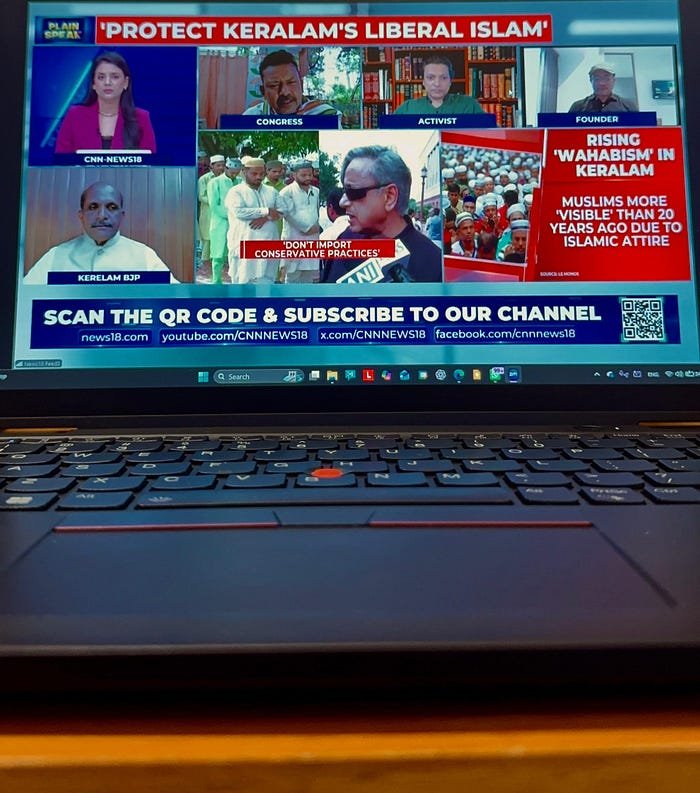
My thanks to CNN-News18 for inviting me to participate in the discussion and for creating space for a serious conversation on an issue that India, and Kerala in particular, can no longer afford to treat as politically untouchable.