


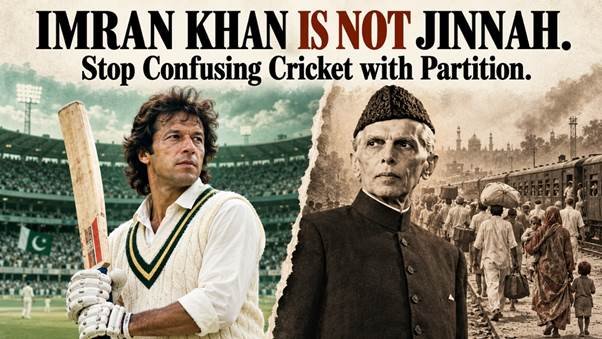
Imran Khan Is Not Jinnah. Stop Confusing Cricket with Partition.
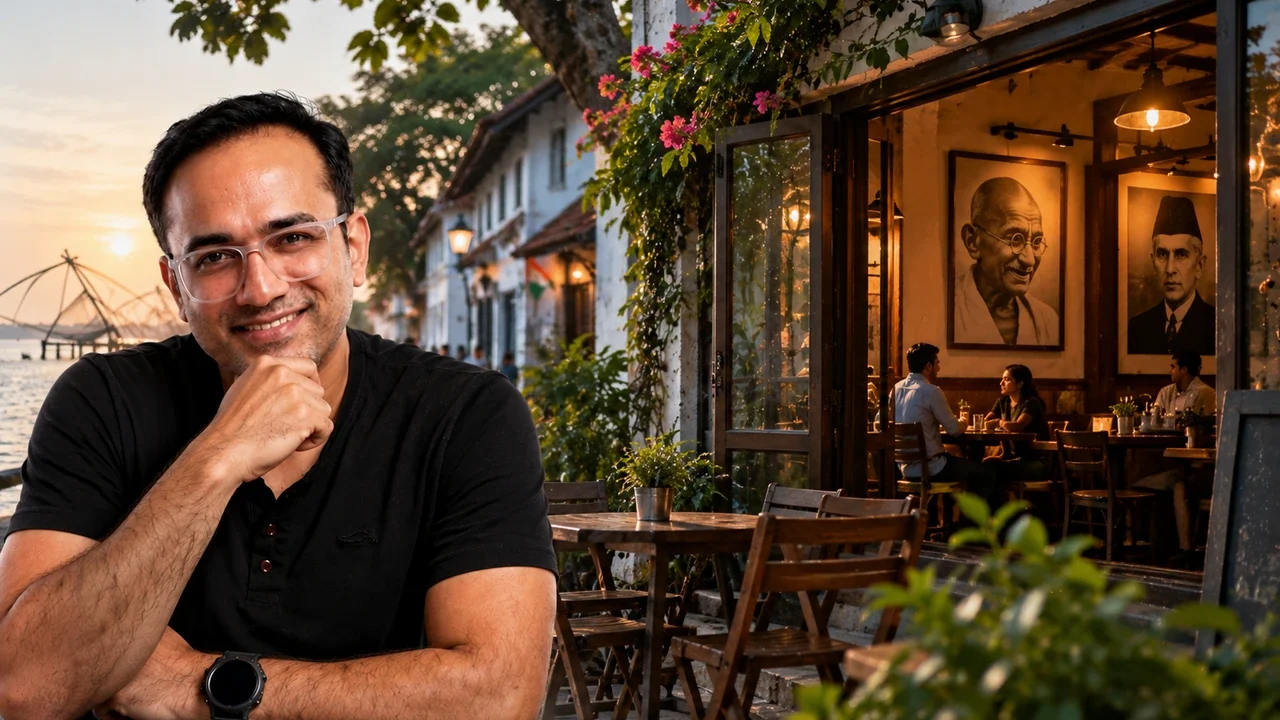
The Kashi Art Cafe controversy exposes two political failures: the radical Right’s habit of turning ordinary life into a communal conspiracy, and the willingness of some liberals to whitewash troubling politics merely because the Right opposes it.
I reject both. Neither deserves protection from scrutiny.
Police registered a case against vlogger Amrit Singh Darren over allegedly communal remarks involving Kashi Art Cafe, its food, its artwork and Fort Kochi’s Muslim population. His criminal liability is a matter for investigation. The intellectual poverty of his argument is already visible.
He bundled a name, a menu, an artwork and a community into one ominous story. It was poor investigation and worse storytelling. This is the far Right’s familiar talent: even when a subject deserves scrutiny, approach it so clumsily that the legitimate question disappears beneath the rubbish piled around it.
A café serving beef in Kerala does not establish an Islamist agenda. Hindus eat beef here too. A name does not transform a café into a religious institution. And displaying a historical figure does not automatically endorse his politics.
The artwork in question is Riyas Komu’s Blood Brothers: Two Fathers from Gujarat. Its alternating reliefs of Gandhi and Jinnah invite reflection on their intertwined histories and Partition. Criticize the artistic framing if you wish. But understand it first. A historical juxtaposition is not automatically a declaration of allegiance.
Outrage without homework is still ignorance, however patriotic the background music.
Reporting also identifies the owner of the café as Edgar Pinto. His religion is beside the point. The café would deserve the same factual scrutiny and protection against communal insinuation even if its owner were Muslim.
Fort Kochi’s longstanding Muslim presence belongs within a wider history of trading communities, migration and coexistence. That history cannot be reduced to a visitor’s demographic suspicions.
Nor does a Muslim majority, wherever it exists, constitute evidence of danger. Would a Hindu-majority neighborhood in Palakkad automatically suggest a conspiracy? No. Apply the same standard elsewhere.
Where there is evidence of illegal funding, intimidation or discrimination, investigate it. Where the complaint consists merely of Muslims owning shops, helping one another and prospering, the problem is resentment, not national security.
Hindu organizations concerned about economic advancement should invest their energy in enterprise, mentoring, access to capital and cooperation across caste boundaries. Dismantling caste exclusion and untouchability will accomplish more than resenting somebody else’s solidarity.
There is a warning in the history of antisemitism. Jewish participation in commerce and public life was repeatedly distorted into fantasies of hidden control. The Holocaust arose from a much larger machinery of racial hatred, conspiracy thinking and state persecution, not simply commercial envy. But the recurring mechanism matters: a minority’s visible presence becomes an accusation against its collective intentions.
We should recognize that mechanism before reproducing it.
Yet none of this gives Jinnah a certificate of innocence.
Defending an artwork and defending Jinnah’s politics are separate acts. Anyone moving from the first to the second must answer for that move.
Jinnah led the Muslim League’s campaign for Pakistan and its call for Direct Action in August 1946. The resulting Calcutta bloodshed included organized attacks on Hindu civilians. Hindu families were attacked, homes and businesses were destroyed, and people were killed because of their religious identity. These were human beings subjected to communal terror, not an inconvenient footnote in a debate about artistic freedom. Historical accounts also identify the incendiary role of Bengal’s Muslim League leadership.
The Hindu Right we criticize today did not emerge from an empty historical landscape. Its organizations predated Partition, but massacres, displacement and the experience of religious separatism supplied powerful material for its politics of fear and protection. My argument is that dismissing those experiences, or sanitising the leaders associated with them, strengthens that politics. It allows the Right to claim that it alone remembers Hindu suffering.
Those who want to challenge the Right should stop supplying it with that advantage.
Invoking Indian admiration for Pakistani cricketers like Shahid Afridi or Imran Khan as an excuse to defend Jinnah is another farce I saw here. Its a false equivalence. Admiring sporting talent does not amount to endorsing religious separatism. The objection to Jinnah is not that he was Pakistani. It is his central role in the divisive politics that drove Partition and its catastrophic human consequences.
Yet “the Right dislikes him, therefore he must be defensible” has become an intellectual shortcut for some self-described liberals. It eliminates the inconvenience of independent judgment. One merely checks the opponent’s position and announces its opposite.
That is outsourced thinking: the Right chooses the subject, and you supply the opposite slogan.
If liberals refuse to identify minority communalism, they hand the Right a monopoly over naming it. They then complain when the Right exploits that monopoly irresponsibly.
The answer is to expose communalism consistently, including when doing so embarrasses one’s preferred political camp.
The same honesty is necessary when confronting Islamist extremism. Extremists and their apologists can operate through respectable language, professional standing and public performances of moderation. This is the conduct I mean by “white-collar jihad”: making coercive Islamist politics appear harmless while excusing, concealing or legitimizing its consequences.
Such conduct harms peaceful Muslims too. When extremists exploit a community’s reputation for peacefulness as cover, they betray the very people whose goodwill protects them. Documented instances of this deception become ammunition for communal propagandists, who then extend suspicion to innocent Muslims.
That collective suspicion is wrong. The deception that feeds it must also be confronted.
Where someone presents a moderate public face while demonstrably enabling extremism, expose the contradiction.
My demand is for a louder public challenge to those who claim to speak and act in Islam’s name:
“A peaceful majority that stays silent is politically irrelevant to the fight against extremism. Peaceful Muslims should make more noise against jihadist violence, so extremists cannot hide behind their silence or claim to represent them.”
That is a call for visible civic resistance. Its purpose is to isolate extremists and strengthen the people they exploit.
What brings me to the mirror test, however, is the selective outrage: the speed with which some people condemn the Right, the reluctance to confront minority communalism, and the slide from defending artistic freedom into excusing Jinnah.
Silence alone does not prove endorsement. But someone who actively sanitises Jinnah cannot escape criticism by pointing to the stupidity of his critics.
So let us test the principle.
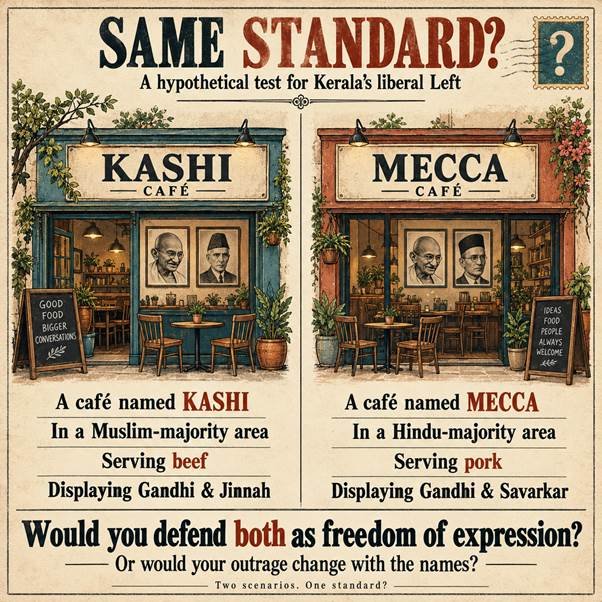
Imagine a café called Kashi, in a Muslim-majority neighbourhood, serving beef and displaying Gandhi and Jinnah in an artwork about political history.
Now imagine a café called Mecca, in a Hindu-majority neighborhood, serving pork and displaying Gandhi and Savarkar in an artwork about political history.
These are hypothetical scenarios. The demographic description given is not an established fact.
Now, would Kerala’s liberal Left defend the second café with the same conviction?
Would it examine the artwork’s context before assigning malicious intent? Would it defend the proprietor against threats? Would it distinguish displaying Savarkar from endorsing his politics?
Or would “food freedom” become “religious insensitivity,” and “artistic expression” become “deliberate provocation”?
Keep the circumstances comparable. An established historical artwork and a targeted campaign of harassment are different things. But context must be investigated in both cases. It cannot be a courtesy reserved for political favorites.
The test does not demand identical opinions about Jinnah and Savarkar. It demands identical standards of evidence, freedom and protection.
And the mirror faces the Right too. Anyone defending the hypothetical Mecca café must defend Kashi under the same conditions. Otherwise, the accusation of hypocrisy becomes a confession.
My position is clear. Defend Kashi against communal insinuation. Challenge attempts to sanitize Jinnah. Defend the hypothetical Mecca café under the same standards. Preserve the freedom to criticize both artworks and both political figures.
When Kashi becomes Mecca, beef becomes pork, and Jinnah becomes Savarkar, does your principle survive?
If it does, demonstrate it.
If it does not, stop calling your preference a principle.
Arif Hussain Theruvath

I am Arif Hussain Theruvath—The Doubt Engineer. Ex-Homeopath. Ex-Muslim. Ex-Communist. Ex-Woke. Every label I shed taught me that certainty is a cage and the key is a question. I don't sell answers; I engineer doubt—about narratives, authority, and comfortable lies. Because the right question can crack dogma, challenge blind faith, and set the mind free.

No Comments